Saturday, March 26, 2011

album of the day: Pictures at an Exhibition


People used to make records
As in a record of an event
The event of people playing music in a room
- Ani Difranco, "Fuel"


When I was in high school, I spent a lot of time riding my bike out to a shopping center in Greensboro that had a really good book store and a decent record store where I spent a lot of the money I made on my paper route. Among the great finds was a cassette tape of Modest Mussorgsky's Pictures at an Exhibition. I didn't know anything about classical music then, and still know next to nothing, but I could tell from the start that this 1958 concert recording by Sviatoslav Richter was a monumental piece of work.

I played that tape to death, always only playing the side containing Richter's performance and ignoring the orchestrated version by Maurice Ravel on the other. I bought a CD of somebody else playing the solo piano original by Mussorgsky, but it had none of the appeal of Richter's. When my old tape-deck crapped out several years ago, I tried to find a CD of the Sofia concert, and for years, it just wasn't available. Thanks be to iTunes. And thanks be to whoever decided not to tamper with the original engineering, despite its many faults.

In comparison with present-day recording technique and production values, this is a disaster. Seemingly every cough of every audience member is faithfully preserved on the scratchy, flattish monaural recording. My guess would be that, aware of Richter's attacking style, the recording engineer placed the microphone (I expect just one) several feet away from the piano, to avoid red-lining too much.

But Richter is impossible to describe adequately. In his hands, Mussorgsky's sorta tone-poem, sorta programmatic suite is a weird tragicomic passion play. No other performance I've heard has 1/10 the humor, gravity, energy, or meaning. Maybe Richter was just making it all up, and those staid, smoothed-over renderings (I'm looking at you, Ravel) are more genuine. I don't care.

Richter came into the concert hall, sat at the piano, twinkled around with the introduction of the recurrent theme, thence through the Gnomus, the Tuileries, the Ballet of the Chickens in their Shells - all the silly stuff, played with terrific dynamic variation (the Chickens seem to dance in stop-motion animation, very cartoon-like), and then beat the living hell out of the rest of the piece, stomping out a terrifying Catacombs in particular.

I don't know anything about Sviatoslav Richter, really, but in my opinion he was a pretty scary dude. The Wikipedia article about him quotes him as saying he believed performers should simply express the composer's intentions, but if that's so, I can't understand why his performance of Mussorgsky is so different from others I've heard.

I also can't seem to find any information on the circumstances of the 1958 Sofia recital, other than that it was recorded and well-regarded - which is incredibly feint praise for it.

Thursday, March 24, 2011

a delicate matter about a crappy book

I'm working on a book review for an academic journal. I won't say what journal or what the book is, because, to be blunt, the book is really bad (so far - I'm about halfway through it). In fact, it's so bad, it's making me angry.

Back in grad school, I wrote a satire called The 12-Step Program For Academic Success, spoofing the career-building behavior of some of the academics I knew. One of the steps was putting together an academic book or "volume" (because in the 90s, nobody called them books - they were all "volumes" or "works"). Part of the gag was that academic books are, generally, horribly written, and patched together from articles that the author previously published.

I didn't know then to call this behavior "duplicate publication" or "self-plagiarism," but it didn't set well, and still doesn't. Maybe a series of articles is worth binding together, and maybe that series presents a coherent line of thought, but in my opinion, the vast majority of academic books put together thus is neither.

The present instance is not only incoherent chapter-to-chapter, but within each chapter there are gaps or clashing themes that the author has made no real pretense of making coherent. Readers are apparently supposed to assume that it flows and makes sense.

Part of me is angry because this has been published, and I don't have a book published. (That's pretty stupid, since I haven't written a book. But envy isn't always rational.) A larger part of me is angry because I have to read it to write the review - allegedly - and I promised, and have already written nasty notes in the margin, so I can't really back out of it or follow my whim to throw the book as far away as I can. A still larger part of me is righteously angry because it's so crappy, so clear an example of crappy academic behavior, and because I can see a much better way to approach the topic and to form the arguments than this hack did.

Sheesh!

Now, the delicate matter. If I write the review I feel the book richly deserves - a right thrashing - what happens then? What if I meet this guy sometime? What if his friend shows up at a conference where I'm presenting a paper?

I've written a couple very negative reviews of books before, but they were for the journal of the American Hegel Society, The Owl of Minerva, back in the anarchic days of the Hegel Society, when scathing, terribly nasty disputes via email discussion thread typified the prevailing ethos. (Hot damn, it was fun!) Most academic discussion, in print at least, is much more polite, and a lot of academics are thin-skinned, and some are vicious.

The topic, too, is one that attracts a lot of academics who believe themselves to be good-intentioned, but who are easily provoked. Could be some nastiness coming my way in return.

Tuesday, March 22, 2011

random hockey post

I rarely write anything about hockey. There are 28,309,146 hockey blogs out there, and around 98.3% of what anybody writes about hockey is blather - like all other sports.

Anyway, in addition to being a lifelong hockey fan, I'm a Pittsburgh Penguins fan. Lately, that's been great, because of players like Sidney Crosby, Kris Letang, Marc-André Fleury, and so on. Crosby has been the best player in hockey since he started in the NHL in 2005, and this season was looking to be his most productive as a scorer. In January, Crosby was hit in the head in two successive games, and has been unable to play since because of concussion. The first hit was not called a penalty, but was in my opinion a deliberate action in attempt to injure. The second was called a penalty, and did result in Sid's head striking the edge of the wall around the ice, but I don't think it was an attempt to injure, just a dumb play.

Controversy over head shots has heated up ever since. Two games ago, Penguins forward Matt Cooke, who has a long history of doing stupid and deliberately injurious things during games, elbowed a New York Rangers player in the head, and received a game penalty and a suspension through the end of the regular season and the first round of the playoffs.

Hockey fandom and media are basically unanimous in praise of the suspension, because, they repeat, the NHL finally got the discipline right.

Wrong.

Unfortunately for all hockey fans, what the NHL did was on the basis of this player's reputation and history, and the current controversy. I am not saying that Matt Cooke should be allowed to deliberately target opponents' heads with his elbows. I am saying that the punishment befit the criminal, not the crime. It wasn't justice; it wasn't even discipline. They made an example of him. Cooke's suspension is a spectacle, or a PR campaign (especially after Penguins owner Mario Lemieux made such a big deal about head hits), to show the NHL is Really Taking Player Safety Very Seriously Indeed.

I believe all the blather about head shots and attempt-to-injure penalties lately really misses a main factor: the salary cap. (If any hockey fans happen by, I do mean that seriously, but you may have noticed this really isn't a hockey-related blog, so I'm not going to pursue it.)

Anyway, enough about this.

Monday, March 14, 2011

academic freedom, freedom of speech

In two of my classes this semester, we've been spending an inordinate amount of time on an article about academic freedom, its distinction from freedom of speech, and the way economic pressures threaten academic freedom. The article defines academic freedom as the right to teach and to research as an academic sees fit, without undue pressure to conform to some extrinsic production measure.

I woke up this morning wondering about the meaning of academic freedom in my life and in the economic and political environment of contemporary academia. Some basic truths, of a sort, came to mind.

No one actually cares what I say or do in my classes, as long as it doesn't subject the university to liability or otherwise damage the university's public image. Almost nothing I might say about my actual field makes any difference to the university from this standpoint. Nobody much cares if I teach a bunch of crazy radical stuff in my classes, unless and until a student complains about it. In my own experience, what students are likely to complain about is personal conflict, not course content. Students complain about course content tactically, in order to attack faculty.

No one actually cares what I say or argue for in anything I publish, as long as it doesn't similarly endanger the university's currency interests. Administrators aren't going to read what I present at conferences or publish in journals or books. Most of what most faculty publish is in technical jargon that administrators wouldn't grasp, of course, but the main reason they don't read it is that they have absolutely no concern about what's in it - only how much of it there is, and whether it's peer-reviewed.

Which means that the university isn't particularly interested in curtailing the content of my exercise of academic freedom. The content of my speech concerns them much more when I speak as a private citizen, because as a private citizen I might freely criticize the university in a way that could endanger the university's currency interests. That is, the university has a fairly strong interest in curtailing my freedom of speech.

This is how it looks from my perspective, as a non-tenure-eligible faculty member who has a contractually guaranteed position until I either grossly violate university rules or a layoff is declared. It would likely look very different, ironically enough, if I had tenure at risk.

After all, there are tenure-track but not-yet-tenured faculty who are scared shitless to write anything as benign as this blog and post it somewhere. (I guess I mean this particular post.)

Academics argue for tenure on the basis of the claim that it and it alone can protect academic freedom. I wonder if what they mean to protect is freedom of speech, instead.

Thursday, March 03, 2011

need a break

Well, ladies and gentlemen, Doc Nagel is in a bad way. I blame a large part of this on the confluence of recent events - the department tenure-track search, looming budget cuts to the CSU (yet again), daily news of the unconscionable exercise of power. I blame another large part on the unrelenting propaganda demonizing organized labor, in particular in public higher education. It feels lately as if everything I care about is threatened or under attack. No exaggeration: the ideal of education, my own job, my loveliest, the cat, my favorite hockey team...

On the other hand, obviously the largest part of my terrible, doomed mood is sui generis. Everything I care about seems to be under attack because I feel truly terrible about myself these days. A few people who regularly read this have known me long enough to know that that had been a constant until Lauren came into my life. And although it is very hard to feel terrible about myself with her around, somehow I'm managing it.

For me, this often takes the form of a sort of voice constantly telling me the same thing, no matter what happens: "You're a terrible person." I've checked a book out of the university library, but it's been sitting on my shelf unread. "That's because you're a terrible person." A class session went poorly. "That's because you're a terrible person." A class session went well. "That doesn't change the fact that you're a terrible person." I committed a typo in an email I sent. "That's because you're a terrible person."

It gets old after a while.

But hey, do you wanna know why I get depressed, and why I feel this way despite how wonderful Lauren is, and how basically good life is right now? I'll give you a hint: It's because I'm a terrible person. That's what I've heard, anyway.

Taking a break from this is kind of a weird task, because this delightful partner in dialogue is, of course, me. (Hey, wanna know why I'm so cruel to myself? I'll give you a hint...)

Saturday, February 26, 2011

what education is for

I'm in two faculty reading groups this semester. One is reading a history of the CSU, written by a long-time administrator and CSU president, and has precisely the kind of perspective you'd expect. When that group gets together, we're awfully cranky about the book, the author, and CSU administrators.

The other group will be meeting for the first time Wednesday to begin to discuss a book by Louis Menand on colleges and the need for reform of higher education. So far, it lacks the conceit of "evidence" of that wretched screed I was reading earlier, but it also just seems to lack any solid reasoning. So, I'm getting cranky with Louis Menand now. It appears I can't read anything about higher education at all without getting cranky.

Menand's first chapter deals with general education, which he thinks is higher education's bastard. He compares Harvard's various attempts at a core curriculum, with Columbia's early general ed program, with various others at small, elite cross-section of US colleges. (It's nice that he's not pretending to be making a general survey of the whole field, but that's about the nicest thing I can say about it so far.)

He makes one point, in the rather offhand, vaguely insinuating way he has, that I do think is worth pondering further: What, really, is the purpose of general education? And that question, I agree with him, is really about what we think a college-educated person should look like.

In my freshman year, I took a course in the honors program called "The Culture of Education." It had 8 students in it, was team-taught, and one of the faculty had a TA for the course. (In a large bureaucracy, such mistakes in resource-allocation decisions are bound to occur.) We read some Plato, some Rousseau, we read a bunch of illegally photocopied articles, and we read Allen Bloom's The Closing of the American Mind, the 1985 book that is, I believe, the granddaddy of stuff like Menand's book.

This morning, I couldn't help recalling a conversation in that class about the purpose of education. Bloom, thinking that he was following the true cultural heritage of the West that started with Plato, argued that education is for the development of moral, political, and aesthetic values. At 18, I resented him telling me which values, and as a clever 18 year old, I suspected his argument of a whole bunch of special pleading. We started getting into it: Who the hell is Bloom to say this is the purpose of education? But then, what else could it be for?

One of the students in the class was an Education major - that is, a future grade-school teacher. She offered the common-sensical view that, for her, education was preparation for her future career. I saw this as begging the question. Maybe the purpose of education for her, and according to her view of things, was career preparation, but what was the purpose of her career? Well, she said, to educate children. To what end? So that they could go on to college.

I didn't like Bloom's strategy, which prescribed a specific political end of education. I didn't like her reasoning, which seemed obviously circular. Plus, I was already referring to the university experience as "higher indoctrination." This is a basic hazard of being a college student by default, and having no life or career plans. I had a funky kind of disinterest - maybe disaffection is a more accurate term - that made me hyper-critical of anything anybody said was a purpose for education, or even a goal for education. (Now that I'm telling this story, I have to admit that I was way more cranky back then.)

It was also hypo-critical of me, since there I was taking up space and haunting the nastier parts of the library. And now, I think that what a college-educated person should look like is approximately either me (college philosophy instructor and rabble-rouser), or my loveliest (semi-gainfully-employed amateur polymath and bricolageuse), or maybe my friend Imj (aka Bobo the Wandering Pall-bearer; intentionally-unemployed amateur poet and casual roller-derby official).

Friday, February 25, 2011

temporal anomaly

Late last night, as it started to drizzle, I stood looking out and down on the townhouses that form our complex. Newly wet, in the orange-yellow haze of the dim streetlights, they looked very little but enough like the condos my friend Doug lived in in Northern Virginia almost 20 years ago. The feeling of looking down through the rain was not significantly but sufficiently like my Card Lane, Pittsburgh pastime, peeking out the big front windows of our second-story apartment. I felt very strangely as though all this time hadn't passed, and this wasn't Turlock, California, or 2011.

I've gone through a hell of a lot since leaving Pittsburgh in 1998 - several career crises, three major depressive episodes, an ugly divorce, involuntary home-ownership, an unpleasant number of feline deaths, the entire freaking Presidency of G.W. Bush. How can it feel as if nothing has happened, as if I'm still back there, back then?

The feeling was so strong, it was very hard to accept that I actually am here, or that any of that time really has passed, or even that I was around for its passing. My sweetest tried to help me shake it off, looking straight at me, touring me around the apartment to show me the guitars, the kitchen, the rooms we sometimes call the Room of Requirement and the Chamber of Secrets, finally pointing out that Alexander and Arthur, die Ăœberkätschen, the Flying Kittois Brothers, 35 pounds of compressed silliness, have only been here three years.

So I guess the date on the calendar means that it really isn't 1998 anymore, nor 1992. Where the hell have I been?

Friday, February 11, 2011

moral offense and moral response

I have two classes this semester that are focusing on justice, morality, and freedom of speech. We're looking at the First Amendment, exceptions to it, and the difference between the legal right to free expression, and the moral question of what one should or should not say. Later, we're reading the Republic.

But for now, I'm presenting them some material on obscenity. In addition to being a big fan of obscenity, I've also done a little stuff on the legal and moral issues, in particular about pornography. Although I don't plan to present them any porn, I am going to play them George Carlin's "Dirty Words" routine, and a couple snippets of a Lenny Bruce bit that got him arrested for obscenity.

My take on it is that there's a difference between obscenity and offensive speech, both legally and morally, and it's important to sort out what's what to that extent. Obscenity, we restrict. Offensiveness, we can't. By which I mean, in my view, it's not terribly compelling to claim a right not to be offended, and one key reason it's not compelling is that offense is subjective.

I had the classes read an article by a guy named Robin Barrow on what he calls the duty not to take offense. He attempts (and, my class yesterday and I believe, fails miserably) to distinguish what merely feels offensive to someone in particular from what is quintessentially offensive, and hence morally wrong. His example of such a quintessentially offensive display is, very unhelpfully, public beheading of a non-combatant. His initial example of what merely feels offensive is, also unhelpfully, his calling a colleague a "stupid bitch."

In class, I suggested we could write him a letter. "Dear Professor Asshole," I said we could begin.

Anyway, he does make one provocative point that has made me wonder further. He claims that we have a moral duty not to take offense, which he says is based on the "true moral principles" of freedom and toleration. Taking offense, he says, in the sense of making some formal action, based on a moral judgment in response to what has offended you, is intolerant. (So, as the class saw pretty clearly emerging from the paper, he wasn't wrong to call his colleague a "stupid bitch," or at least, not as wrong as she was for filing a formal complaint about it. Because, see, he apparently has the right to call her a "stupid bitch" and she hasn't the right to take offense at it. Um, yeah. Whatever. This, obviously enough, isn't the part that provoked me to think further.)

For instance, when we take offense in the context of someone joking, we are being humorless and overly "self-regarding." The context is the crucial thing here, and is the reason why nothing someone says can be "quintessentially offensive" in the way he points to. The class came up with a number of examples: "nigga," "faggot," "fat cow," etc.

The fact of the matter is, we get offended, and sometimes we are right to be offended, even if our taking offense is also self-regarding (is it always wrong to be self-regarding? Egyptians in the streets have clearly lost their sense of humor about Hosni Mubarak, but I would not want to say they are wrong to take offense...). It's a question that I come back to every so often about moral judgment: What is the right thing to do in response to what we find to be morally objectionable? If we have the right to make moral judgments of other people, what is the moral thing to do about it?

I think that most of the people I make moral judgments against are people I don't have a lot of respect for in the first place, and so, sorry to say, I don't worry very much about how I treat them, or what I say about them: "That guy is an asshole." "That chick is shit-crazy." "He's a deranged sociopathic monster incapable of seriously holding any belief or telling the truth." Because I'm not too concerned to be good or well-intentioned toward the deranged sociopathic monster, I don't worry about whether I'm doing something morally right or wrong when I treat him contemptuously or disdainfully.

In my cooler moments, I admit to myself that this is probably wrong of me. I should be better than that, I guess. But suppose that he really is a deranged sociopathic monster (and oh, he is!). Does my moral judgment against his behavior lead to any appropriate response?

And here, I mean something beyond protecting myself or others against him, I mean something directly responding to his morally condemnable behavior, something that is corresponding or seeks some kind of moral equilibrium. Kant, for instance, seems to believe that certain violations of the moral law can be met with reciprocal responses: hence, capital punishment for murder.

In the case in question, I try to let everyone I care about know what he's up to. Is that enough? Is that even a moral way for me to behave?

Tuesday, February 08, 2011

analytically adrift

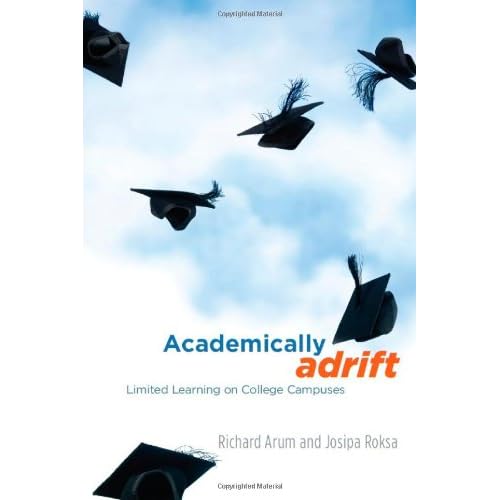
This will likely be my second and last post on Richard Arum and Josipa Roksa's recently heralded critique of higher education in the US, Academically Adrift. I've about had it.

Psychologists used to employ the term idée fixe to name a certain mania for constantly repeating or returning to the same word or concept, regardless of its relevance to the situation. It's a kind of mental illness, a psychopathy, if you will, that people like Freud would have ascribed to childhood psychosexual traumas.

So much the worse for Arum and Roksa, who monomaniacally return to the same themes throughout this badly-argued book. Through the first 60 pages or so, I had thought that I was seeing just another politically-motivated screed against the academic establishment, or tenured faculty, or both, buoyed by cherry-picked empirical evidence. Would that it were so, at least for their sake. Instead, what I'm finding are lengthy red herring tangents of absolutely no probative value, subjected to analysis and critical reasoning that, ironically enough, would earn you a very poor grade in my critical reasoning class.

One example, of many, lest I be considered cruel: After dismissing the value of student-faculty contact outside of classrooms as having limited academic value, they spend several pages documenting that of the 9% of sophomore students in their sample who never talked with a faculty member outside of class, there were great over-representations of certain under-advantaged socioeconomic and cultural groups. Their conclusion: those students (9%) are losing out.

Okay, okay, one more. (I insist this is for demonstrative purposes only.) After beating to freaking death the evidence that many students, especially in non-selective institutions like community colleges, don't write a 20-page paper or read 40+ pages per week in any class as freshmen, they conclude, without a shred of argumentative support, that therefore these students lose out on development of critical reasoning skills. I don't mean to claim that reading and writing are irrelevant to developing those skills, but they haven't shown why 20 pages or 40 pages are relevant measures, at all. Not. One. Whit. Of. Argument.

Lauren's take: these are two people who were forced to write 20-page papers as freshmen, and are pissed off that they were, while their own kids now out-argue them, despite going to a mere CSU for a year.

That's nice to think, but I've read ahead to the exciting conclusion, where they say what their "mandate" for reform includes (and with that, I won't even bother), and repeat, for the bajillionth time in the book, the initial claim that they promise they will justify and never do: that There Is Something Rotten In The State Of Academia, and they know this because so few students report having been required to write a 20-page paper or read 40+ pages per week in a freshman college class.

It's a classic case. I'm thinking lack of breastfeeding, aren't you?

Sunday, February 06, 2011

iphone, apple, evil, etc.

I'm getting flak for buying an iPhone. Some of it is because it's an Apple product, and Apple is considered a purveyor of evil in some circles - of which more anon. Some of it is because the two networks you can use with iPhone are both supporters of neo-conservative political groups. AT&T infamously gives money to the Tea Party, for instance. The rest of it is just because of the in-crowd, poseur, pod-people kind of behavior ascribed to Apple users, especially iPhone users.

As for money going to the Tea Party, from a progressive standpoint, the power of the Tea Party among the GOP isn't entirely bad news, if you think about it. If Michele Bachmann runs for President in 2012, it's going to be very obvious to many more people just how insane she and her political ideas are.

The reason I went for the Apple smart phone is because I'm an Apple user and wanted the greatest possible integration of the various gizmos in my life. There is also a particular kind of user experience that Apple products provide, that I'm comfortable with and used to.

Here's the thing: the iPhone is what we got instead of flying jet cars. Of the futurist notions of technological changes in how we travel, communicate, and so on, the one that's actually come true is right there in that little bitty shiny black device.

And Apple is, indeed, evil. They have a market strategy that can only be the result of dealing with Satan. Their target is, approximately, me. Yesterday I was on customer support several times, trying to work out an upgrade to Leopard for my old iBook G4. Every time I was on hold, I mean every time, the music was exactly pitched to flatter how hip I still manage to be, despite being of a certain age when hips become more a concern than hipness.

The machines are cool. The store is cool. They go out of their damned way, with regard to every aspect of everything they do, to make it just that bit more cool: layout of the sales floor, down to the spacing of the units apart from each other, how staff approach you, that whole Genius Bar silliness. It's strangely exhausting. (We went through a phenomenological and ideological analysis of the store Friday night and unpacked this whole shebang, but I neglected to take notes. Maybe I'll recap it some time.)

So, yep, evil.

Friday, February 04, 2011

academically adrift


I've begun this widely-discussed book which claims that colleges don't educate and college students don't learn. I'm deeply suspicious.

For instance, the second chapter begins by noting that in the last 30 years or so, access to higher education has been extended (the data they cite include the number of people with plans to attend college). They turn to discussion of data about high school students' efforts, aspirations, and their understanding of the link between their future career plans (if any) and their educational needs for reaching them. They say that almost half of high school students believe that they can reach their life goals even if they don't put a lot of effort into high school, and that many incoming college students are not planning for their lives.

It is this unique point in time - when access to college is widespread, concerns about inadequate academic preparation are prevalent, and drifting through college without a clear sense of purpose is readily apparent - that serves as the historic context for our observations of the lives of students as they unfold at twenty-four four-year institutions. (p. 34)

First, anecdotally, I would have told anyone who asked me, at age 17, that I didn't make much effort at all in high school, and that even less was required of me. I also had no life plans, let alone college plans. I didn't plan to go to college at all, and only ended up starting that fall at the University of North Carolina at Charlotte because my dad brought home an application one June day and told me I was going to fill it out and go to college.

I don't think being "adrift" in that way is necessarily a bad thing. Most of my friends in college spent some time adrift - changing majors, changing career goals, taking classes that ended up not being related to either, etc. From a certain perspective on the purpose and value of higher education - one I would think is far more narrowly and crudely utilitarian than my own - I suppose that might support the view that such people and experiences are not fulfilling the purpose of education. Among the purposes I believe drifting does serve are exploration, self-reflection, and the critical capacity to distinguish between different visions of self and future. (I anticipate, based on the first chapter, that the authors will, instead, connect such drifting to a "collegiate culture" of partying and recreation.)

Secondly, what they've demonstrated is not that anyone is and remains adrift "through college," only that they begin without certainty of what they plan to do.

That kind of slipperiness between premises and conclusion is found throughout the first chapter as well. It's crafted very carefully to make the slippage difficult to see and to work out through logical analysis.

But, as someone told me, the main problem is that everyone's talking about it but no one's read it. (I disagree slightly. Every article I've read about the book cites two factual assertions, from pages 4 and 18, so I conclude that the media heads writing about it have read those two pages, at least.)

Friday, January 28, 2011

faculty ethical responsibility, bureaucracy, and curriculum
a local example

Today I reminded myself that I need to get more done on the paper on faculty ethical and social responsibilities in heavily bureaucratized institutions. It occurred to me that a recent academic senate discussion on our campus gave me a pretty interesting example of one of my key claims in the paper: At a certain point, bureaucratic division of labor responsibilities makes it so difficult for faculty to know the full implications of what they do, that it becomes impossible for them to take responsibility for what they do. (I borrow this idea from ethicist Michael Davis.)

The example concerns an ongoing issue on campus. Before I get into this, I want to preface by saying I am interested in this as an example, and I don’t mean to make any judgments of the people involved or the specific proposal they’re making (in fact, I like all the people involved that I've met, and the proposal looks kinda cool to me). I’m not at all trying to make sport of the frustration they might be feeling about the senate discussion. On the contrary, I think it’s totally understandable. All I’m wanting to do is think through the ethical issues, as related to the paper I’m going to be presenting at the AAUP conference this summer.

The faculty and administration in the College of Natural Sciences proposed a pre-medical professions certificate program for post-baccalaureates. The program would provide science education to satisfy prerequisites for qualification to apply to various advanced medical education programs – medical school, dental school, etc. The program would be conducted through university extended education (UEE), taught by faculty identified by academic departments in CNS, and the courses would correspond with regular-session courses taught by those departments. The departments and college would share any surplus revenue with UEE.

This program, on the surface, more or less appears to meet the specifications of the relevant CSU Chancellor’s Office Executive Order governing extended education, as a “special session” that is permitted outside the normal state-supported curriculum. Even though the courses correspond exactly with regular curriculum courses, the “special session” designation seems justified by the circumstances of the students (returning post-baccalaureates).

In academic senate discussion of the proposed program, three areas of concern came up. One was the implication of the Memorandum of Understanding signed between the college and UEE, which, it was said, could set a precedent for similar MOUs on campus that would be disadvantageous for faculty and for departments. Second was that faculty paid on the UEE salary schedule would be substantially underpaid compared to their regular salaries (the lack of qualification of UEE work for retirement or healthcare benefits was not discussed). Finally, it was suggested that although the program appeared to meet the letter of the Executive Order’s requirements for a special session, the students in the program would qualify for post-bacc admission into the regular curriculum – there still is a post-bacc program, after all – and so the justification that these classes could not be offered without a special program was not based on program or curriulum needs, but in fact the lack of funding to the state support regular curriculum. (The lack of funding from the state is not sufficient under the EO to justify a special session.)

These are complicated issues, and moreover, from the standpoint of the faculty and administration of the CNS, abstract, distant, and relatively nebulous. If the faculty in CNS agree to teach under these terms, it was suggested, then it is their choice to do so – and, by implication, other colleges and faculty would be free to strike their own bargains with UEE. As to the salaries question, an additional stipend was arranged to bring the faculty salaries for teaching in the program closer to parity with the regular faculty salary (again, the issue of benefits was not discussed). As for whether the special session was warranted by the post-bacc status of the students, two replies were made. First was that it is very difficult for post-bacc students to get into the regular session classes because they have the lowest priority registration status. Second was that the Executive Order stipulates that a career retraining program would qualify as a special session.

The objections raised must strike the CNS faculty who support this program as a lot of meddling over something not relevant to their attempt to serve more students and be entrepreneurial. It is certainly easy to understand why faculty supporters of the program would tend to regard it as nobody else’s business. Furthermore, I see nothing amiss in their interest in starting the program, and no reason to think they have anything but the best intentions. Yet the issues raised are worth consideration, because what one college does in the university does have an effect on the others, and because faculty have a common situation and standing with respect to the university. But as I said, these are difficult issues even to see.

There are broader and still more abstract and general issues that I believe are driving these concerns. One is the integrity of faculty work and of the collective bargaining agreement, as well as of the union that bargains that agreement as the exclusive agent for the faculty. Another, still more abstract, is concerns about the privatization of public higher education. Shifting programs to UEE under the rationale that the regular program can’t accommodate their needs begs the question: Why doesn’t the regular program meet this need for educating the public? Any serious reply to that question should at least consider the long-term funding trends of public higher education as driving factors in the need for the program in the first place.

That said, doesn’t it seem too great a burden for the CNS and its faculty to bear to have to answer these questions? There is an ethical aspect and a cognitive one here. Cognitively, I mean to suggest the following. It is extremely difficult for those of us who care very much to do so, to work out in any detail how the defunding of public higher education has affected access to and quality of public higher education. Asking CNS and its faculty to understand and take responsibility for how their program fits into that overall picture is asking something nearly impossible. I submit that they couldn’t reasonably do it if they wanted to.

If the abstractness and complexity of the situation, and the bureaucratic division of labor reaches a point that they cannot be expected to see, foresee, or comprehend the broader implications of their program proposal in relation to these issues, how can they possibly take responsibility for them.

A further question is whether the CNS faculty and administration are ethically blameworthy for this failure to comprehend or take responsibility. (I’m assuming here that the concerns are legitimate. I think they are. I'm also assuming that they're not responsible for the defunding of public higher education or for bureaucratizaion. I think I'm on safe ground there.) I have two intuitions about this. One is, to the extent that I’m right, and it really is unrealistic or impossible for them to know the implications or effects of what they’re doing, then no, it’s not an ethical failure. But, second, to the extent that they may choose to ignore or brush aside the issues, then yes. But this could mean nothing more than that they are ethically accountable for admitting that they are very nearly precluded from taking that responsibility.

Thursday, January 27, 2011

first day blues

Typical pre-semester anxieties last night woke me at 4 AM, from a bizarre dream in which the Chancellor of the CSU had imposed a policy on remediation involving providing milk to students. (This is a highly expurgated account of the dream. I don't want to go into more detail. Please don't ask. Imagine the weirdest possible ramifications of this. Now make it weirder, and ultimately cruel. There you go.)

I met my first class this morning. I forgot my "JOKE" sign. Note to self: remember that tomorrow morning. Bioethics requires its use.

Now I'm Pandora-ing through my office hour, and starting The Federalist Papers. Check this out:

Ambition, avarice, personal animosity, party opposition, and many other motives not more laudable than these, are apt to operate as well upon those who support as those who oppose the right side of a question. Were there not even these inducements to moderation, nothing could be more ill-judged than that intolerant spirit which has, at all times, characterized political parties. For in politics, as in religion, it is equally absurd to aim at making proselytes by fire and sword. Heresies in either can rarely be cured by persecution.

And yet, however just these sentiments will be allowed to be, we have already sufficient indications that it will happen in this as in all former cases of great national discussion. A torrent of angry and malignant passions will be let loose. To judge from the conduct of the opposite parties, we shall be led to conclude that they will mutually hope to evince the justness of their opinions, and to increase the number of their converts by the loudness of their declamations and the bitterness of their invectives.

That's Hamilton in 1787.

Tuesday, January 25, 2011

brief report of ongoing madnesses

Classes start in two days, and my schedule for the semester is not finalized. Consequently, I have opted not to put my syllabi together for the classes that might still be canceled. So there could be a little confusion as the semester starts.

Lauren is in surgery even as I write this. It's nothing major, it's outpatient, but still, it's surgery. Thanks, I'll tell her you said so.

I've drafted a paper, have another one to get done in a week, and have the revision of the AAUP paper to get started on.

Now for a political note. You may have heard various neocons pitching a return to the gold standard as a way to ... um ... to do something or other. Partly, they think that if the US returned to the gold standard, the federal government would not be able to run deficits because the federal reserve bank would have to stop printing money. From what I know about economics, I believe the basic flaw in their plan is that it simply isn't conservative enough.

After all, money doesn't grow on trees, not even paper money, which isn't even paper in the first place! (And let's not get started on the tree-hugging envirofascist movement!) For money to have real worth, it has to be based on a real, tangible thing. Fiat money isn't based on anything at all, except a social and political convention and the exchange value of goods, services, and labor. Labor obviously isn't tangible, and services aren't physical objects either, so that leaves goods, and we all know that a currency based on the exchange value of goods wouldn't be viable because we wouldn't ever know how much any goods would be worth. Right? Right?

A gold standard would give us a straightforward way to know the real value of everything, as compared to a certain quantity of pure gold. A laptop computer is probably worth its weight in gold, say, but my year's labor is worth, I dunno, say an ingot. I don't know how much an ingot weighs, but I figure, something like that. I'd carry my ingot to the Safeway and exchange it for groceries, get some return weight of gold back, and thus our economy would continue to flow freely, and we could all rest in the comfort of knowing that we really knew what things were worth.

That's the theory, anyway. But as I said, it's not conservative enough. If you really want a solid standard for money, you have to go back further in history, before the gold socialists took over. What we really need is a return to the beads and carved bones standard. You're welcome.

Wednesday, January 19, 2011

lots of things my family doesn't really know about me

We went back to Ohio for a visit. Chrissie Hynde notwithstanding, at least some parts of my city were not gone, though on balance, a lot of it was.

For the first time in probably about 10 years, my sister, my brother and I were all in the same place. There might be a long story behind that, but I'm not really sure. My family is like that.

I was about to write a quick gloss on the general situation, but that's not what I wanted to write about, so to heck with it. I'll just say that I have a brother 11 years older than me, and a sister 5 years older than me, and that, despite their calendar ages, I still insist on being 28.

What I wanted to write about is how weird it is to suddenly connect with all of them in this mediated way.

I'm connected to a few family members on Facebook, and posts to this antique blog eventually find their way to Facebook, so everything I write here or on Facebook is open to their inspection. My sister-in-law even mentioned, while we were in Ohio, that she has looked at a couple things I've posted, and a few of them she isn't too sure about.

So, all the stuff I post about erotic experience, about the weird food I cook and eat, about politics in higher ed, about union activism, about the whole world I occupy on a daily basis that has very very little to do with anything they knew or understood about me as a kid in Ohio... All of that is what they might read on any given day.

Today, for instance, I worked on the paper I'm hoping to present at the Back To The Things Themselves conference in New Brunswick this summer. The paper is about erotic experience, and today I wrote about being seduced by peaches.

Tomorrow it's as likely as not I'll be writing here about academic politics again, since I was just at the CFA meeting last weekend, and I also received confirmation today that my schedule for Spring is likely to change, with one week before classes start.

It's strange to think of my family reading any of this. I wonder what they might think of it, or of me, or whether they let it pass without wondering.

Tuesday, January 04, 2011

news and sports (that is, conspiracy theory and buying stuff)

What kind of a year will 2011 be? Well, if headlines like Obama exhorts Republicans to put politics aside is any indication, it's going to be a politically annoying year. I don't do partisan politics that much in this space, because the "two-party system" is utterly broken and predictable. But as I mulled over the GOP's early effort to repeal last year's health care reform bill, while the President was still on vacation, in a totally symbolic, legislatively useless, sniveling, pandering paean to their particularly wigged-out extremist wing, I came up with a very strange scenario.

I'm embarrassed to say, it's a cloak-and-dagger scenario, a really goofy, totally unsubstantiated, yet eerily plausible association of the sort that lead people to buy extremely rural real estate and stock their property with large quantities of canned food, canned heat, and weapons. Ready?

Throughout the Obama administration, there has been a conspiracy to destroy him - his historical reputation, his political agenda and power, his public image, everything. We know the Republicans have said they spent the first two years of Obama's administration attempting to obstruct everything on his legislative agenda. We know the Republican sympathizers at Fox News and elsewhere have spread deranged fantasies about him. I don't mean that. When people tell you they hate you, that they believe you're evil, and that they plan to try to destroy you, and then they do, that's not a conspiracy.

A conspiracy isn't a conspiracy unless it's covert, sneaky, pernicious, and above all disavowed by its members.

Now, consider: With large majorities in both Houses of Congress, and a popularly elected President with an ambitious legislative agenda, the Democratic Party refused to pass the repeal of Don't Ask, Don't Tell, refused to pass health care reform that provided any public option or meaningfully checked the monopoly power of private insurance companies, and in the end, ran as far away from their President as they could in the mid-term elections that they lost dozens of. Only in the lame-duck session did they get a few things done, including the DADT repeal. Only after all the political advantage they could have pressed had been eliminated by a mid-term election that the GOP machine turned against Obama.

The Democrats scuttled the President, not the Republicans. No, I thought, that's crazy. You haven't had enough coffee yet. But then I remembered how Obama became President, and what he did to outflank Hillary Clinton - the party Apparatchick - in the primary campaign. Obama's election was a great victory for the Democrats, but a defeat for the new-fangled Democratic group that came to power with Bill Clinton in 1992. Hillary was relying heavily on the inner circle of the Dem establishment to carry her to the Presidency, but the establishment couldn't find a way to beat Obama. And not only will they never forgive him for it, but they'll do anything they can to punish him for it.

And there it is. Mirroring the GOP strategy of the coming two years, which will be to posture and posture and posture in order to look good for 2012, the last two years the Democratic Party in Congress has done all it could to make Obama look bad. Do they care about winning or losing the Presidency in 2012? Anyone looking at it in terms of Presidential wins is not seeing the big, long-term picture, or the fundamental nature of the electoral politics business.

But people keep voting for people who say things that are obvious, blatant lies, just because they're lies we like. Voting is like playing the lottery.

So that's the news. And now, sports.

You can't change your car battery any more. At least, not if your car is a 2006 Jetta, and you're not fully decked-out with mechanic gear. That's because the car battery is bolted down, deep inside the engine compartment. I found that out during a long, extremely ridiculous dead-battery saga on New Year's Day. (Any saga involving a dead battery is likely to be ridiculous, I suppose.) The story is too long to recount following a conspiracy theory, but it took about 4 extra steps and several hours to purchase a new battery and have it installed by the same AAA roadside emergency aid mechanic who jump-started the car earlier that morning.

Yesterday I bought a new Swiss Army knife to replace the one I've lost. (It's part of basic equipment for me, along with guitar pick, pony-tail rubber-band, and handkerchief.) The knife came sealed in 18 square inches of plastic packaging - the type that is impossible to open without something like the knife inside the package or without cutting yourself on the sharp edges of the plastic. The last one I bought came in a small cardboard flip-top box that I could open unaided. And yes, I realize it's a so-called "passive theft-prevention device." The last time I bought a knife it was from a locked glass case, and an employee had to open the case and bring me out the one I wanted. In other words, the plastic is really an employment-prevention device.

There's a connection between those stories, isn't there?

Friday, December 31, 2010

top 5 stories of 2010

This will be the last in my series emulating the banal, creepily nostalgic pop culture artifact of reviewing the past year as it reaches its end. I won't use a headline like the San Francisco Chronic did today (Explosive losses, Giant victories), because eywwh.

Instead, I'll do a reverse-order top 5 kind of list. Those are always really uninteresting, aren't they? Gee, whatever could the top 5 stories of the year 2010 be? It's just that they write up all this stuff in early December so nobody actually has to work between Christmas and New Year's. Basically, almost nothing of global import happens during that week, except the occasional bombing, or attempted bombing, or maybe an assassination plot - nothing that won't keep until Monday morning, anyway.

5. The Apocalypse

This didn't actually happen. We did drive through Bakersfield on the way to and from LA several times, but that's really only a metaphor for the Apocalypse, not the actual event. This is what I tell myself over and over whenever we drive through. It helps.

4. Avalanche buries Cow State Santa Claus

This didn't happen, either. What did happen was the ongoing unrest on campus from Fall 2009 morphed into protests against the administration on March 4 and in the summer, related to some kind of event on campus the nature of which has slipped from my memory.

The avalanche referred to here is, like Bakersfield, metaphorical. It could be an allusion to the shredded non-existent documents allegedly the private property and garbage of a university official who maintained the non-existent documents on university property but which documents, had they existed, would not be university documents. Yes, that's right, it's an avalanche of bullshit. But seriously, what other kind could possibly strike our campus, given the topography around here (to say nothing of the climate)?

3. Former college instructor arrested following crime spree

This also didn't happen, but it was a near miss. Through much of the Spring semester, it seemed 90% certain that all or most of my work in the department would be cut. The philosophy job market nationwide was practically non-existent, as well. I had one interview, that I botched, for a job at a community college in Ohio where I wouldn't have been happy.

Given my advanced educational attainment in the humanities, my career options would have been sorely limited. Other than returning to school for something else, my best bet would have been a life of crime. I used to be pretty good at stealing stuff and breaking into places.

I'm glad to be teaching ethics, instead.

2. New enlightenment flourishes in social life and politics

Now I'm just making shit up, just like the pros do it. Although, even here, there's a grain of truth, if by "enlightenment" we mean an era of shrill, screeching, pandering, fear-mongering, and slander.

1. 2011 canceled due to budget cuts

We can't be sure this won't happen until midnight tonight. Given how many state budgets are in the crapper, and how poor the economy continues to treat most of us, states like California and Arizona could try this as a way to reduce deficits, or at least shift attention away from their gross irresponsibility when it comes to dealing with fiscal realities.

On the other hand, given how well the economy treats people who still profit from it, and how much they stand to benefit from this continuing, and paupering states in the process while they collect interest, tax breaks, and public money in the form of fees paid to outsource formerly public services like education, probably 2011 won't be canceled at all, it'll just be a repeat of 2010.

I don't know about you, but I'm planning to have bubbly on hand for the countdown.

Wednesday, December 29, 2010

2010 - a year in words and numbers

My series of entirely useless summing-up posts continues, this time taking up these spent and emptied examples of the genre.

Apparently, the OED added 39 words in 2010, including the vomitous defriend and staycation, the oddly old-fashioned fussbudget and buzzkill, the ubiquitous exit strategy, and the rarely-useful steampunk, quantitative easing, and microblogging. One imagines the difficulty of using all of these in a single sentence, although such a sentence could be a promising entry in the annual Bulwer-Lytton bad writing contest.

Of course, my own efforts in bad writing this year were restricted to participating in National Novel Writing Month - in which I completed the 70,000-word satirical Autobiography of Biff Nerfurpleberger. The book contains approximately 4 narrative voices, the two main ones being Biff's own, and his competing autobiographer, someone called Simon Ratmason - both of whom are unreliable narrators. Biff is a bad writer because he's completely inattentive to the fact that he's writing, or, at times, what he's writing. Simon's a terrible writer in the tradition of most celebrity biographers, especially musician biographers. It was great fun to write, even the hideous parts by Simon that made me cringe, or worse. I think, if you're writing a work of fiction, and you're yelling at your narrator, you're doing some worth doing.

Some more words related to 2010 include: peanuts, yeast, turtle, frustrating, delicious, hilarious, and subjection.

And now, some numbers.

0 - the number of remaining payments on Eddie Jetta.
10 - the number of courses at my birthday dinner party.
10 - the number of people at my birthday dinner party.
2 - the number of cats currently living with us.
13.5 - the number of pounds the lighter one weighs.
1 - the number of purple-handled scissors on my desk.
1 - the number of manufacturers who still build tape decks, apparently.

Also: 37, 117, 90, 12, 64, i, 41,233, 0.02.

Monday, December 20, 2010

2010 - the year in review, in terms of threats to homeland security

The following review interprets and determines threat levels regarding the relevant ongoing concerns.

Threat #1: Job Security

Despite constant threats to Job Security during 2009 and early 2010, Employment has remained intact. Current threats to Employment include long-standing political attacks on humanities, specifically philosophy, and ongoing state budget crises, coupled with withdrawal of public support for public universities. A new three-year "temporary" appointment was obtained in August, however, continuing state budget issues and local campus fiscal irregularities create an environment in which insurgency should be anticipated.

Threat Level: Yellow ("Elevated"). California's large budget deficit will continue to threaten Job Security for at least the remainder of this three-year "temporary" appointment. In addition, bargaining between the CFA and CSU point to emergent threats.

Threat #2: Health

Local conditions have resulted in resurgence of both depression and anxiety, culminating in two adverse events during 2010. In June, an outbreak of anxiety led to a full-scale panic attack on a commercial flight bound for NYC-JFK, forestalled only through the heroic efforts of on-board civilian medical personnel. In October, a depression insurgency arose; however, counter-insurgency by NaNoWriMo forces prevented any significant gains by the enemy.

In response to the panic attack, a summer program of health review and restoration was undertaken, with positive results including a wide reduction in stress, decreasing resting heart rate, and general improvements to preparedness. The October plot was undermined successfully as well.

Ongoing local threats include Feline-centered Urinary Tract threats, as well as Loveliest-Targeted threats that have, thus far, remained impervious to intelligence efforts.

Threat Level: Yellow ("Elevated"). It remains unclear when, if, or how these enemy covert operations may be launched. Constant surveillance continues to be necessary.

Threat #3: Canadians

It remains clear, as 2010 nears its close, that the biggest single threat to local security conditions in this area is posed by Canadians. The nature and extent of the threat is considered so serious that no detail of any kind, and no vague allusion of any kind, may be provided in this report, for fear of undermining security and intelligence efforts in this area.

Threat Level: Red ("Severe").

Saturday, December 18, 2010

landmark 650th post!

A few random items.

It's been a while since I posted anything about food or cooking. Last night was pizza night here, which can mean some combination of things. Last night I made my famous notorious gorgonzola béchamel sauce and schmeared one pizza with that, adding fresh mozzarella, parmigiano reggiano, scallions, kalamata olives, and crimini mushrooms (which I always pronounce like a euphemism for "Christ" that some folks enjoy, notably my Dad). I also made what I would love to call pizza sauvage or something equally pretentious, which is just dough with a coating of olive oil and sprinkled sea salt with toppings (the salt is, in this case, Hawaiian red salt, dried and cured in clay pots, old school, because, as has been mentioned in this space from time to time, I am a foodie snob in possession of 8 different salts and 5 peppers at any given moment, and let he among ye who isn't some kind of junkie cast the first paraphernalia). The naked pizza had diced tomatoes, criminis, fresh mozza, etc. etc., and spinach on it. It was one of the best pizzas I've ever made, in my estimation.

In my mind, the pizza orgy was to celebrate being 99 44/100% done grading for the semester. Lawdy, do I hate grading. But there it is. I have one paper, for one orphaned student for whom I am volunteering my work to be a project adviser, to go.

I already have received one complaint about grades, and it's a valid one, I think. Most grade complaints are, in my experience. I'm not perfect. I don't even add well.

Before I stop wasting everyone's time with this useless post, I'll pause to mention two things:

(1) That I'm planning a series of Year In Review posts, and

(2) I'm off to play a guitar lesson for an elaborated fingerstyle version of "Oh Come Oh Come Emmanuel."

...

And also that I dreamed all night of weird goings-on on our campus (though topographically, architecturally, and geographically transformed) involving former students suddenly getting married; festivals suddenly ending in ways that prohibited my access to my Loveliest, my old Japanese-built Takamine classical, and my car (regarding which, proceed with caution, Dan or Jackson, whoever in my dream world is driving Eddie Jetta); a rude security guard; and creepy people from the university doing creepy things (who shall remain nameless).

Wednesday, December 15, 2010

crazy busy

I think I'm finally over the rotten head cold that forced me to teach the last week of classes via charades. Apparently, people don't play charades any more. I joked that I was playing charades in class, and proceeded to make the charades sign for "movie," but not one person played along. It's also pretty hard to perform charades of ethical concepts or abstractions like "obscenity."

The week before that I was grading term papers, to get them back for possible revision. That was the same week of way too much holiday musical performance. In one week, Lauren had her long dress rehearsal and two performances with the MSO chorus, then we saw the San Francisco Gay Men's Chorus the evening after the second, matinee, MSO gig. The very next afternoon we went to Carolfest on campus, and last Saturday we went to the Central West Ballet performance of the Nutcracker. There's one more, next Tuesday - the Candlelight concert with MSO.

Final papers, and finalized term papers, are just starting to roll in, so I'll be looking at between 120 and 240 papers, depending on the various options my various students take. That's at least 100 too many, give or take.

Holiday shopping has been, perforce, hasty. Of updating this here online public journal, not a whit. However, in the course of writing the madcap and thoroughly alleged autobiography of Biff Nerfurpleberger, I dropped the names of various songs Biff composed and recorded throughout his career. I've had to write and record two of them, just out of compulsion. The second one, yesterday's achievement, is a seasonal song called "Don't Shoot! It's Santa! (And Rudolph too!) (And Frosty!) (And Jesus!)" Be forewarned that I may post to teh Interwebs.

Tuesday, November 30, 2010

good day

Today was a good day. My Bioethics class was pretty good – there were some good questions about Foucault’s critique of scientific discourse, and its application to the scientific discourse of medicine (through Canguilhem). My class is populated largely by nursing students who take the course to fulfill both the humanities GE requirement and their own program’s requirement for ethics education. The recent course material presented them with some serious intellectual challenges, and I decided to spend the class session today reviewing some of the concepts and trying to lead them to a deeper appreciation of the meaning of the critique for their own (future and present) practices.

One student asked a question about exactly that, and framed it in a very intriguing way. She prefaced by saying that for the last two weeks we’ve been discussing these issues, she has struggled in her nursing classes with accepting the assertions about medical conditions, diseases and deviations from “normal” physical conditions. If this is the “freedom” that Foucault’s critique leads to – the free choice regarding how and to what disciplinary practices and discourses we submit and subject ourselves through – then, she remarked, it wasn’t a pleasant experience. Another student remarked that she was also struggling with that.

Score! A sort of ultimate ideal of teaching, for me, is to create the conditions under which a student can produce a powerful critical knowledge that matters for them intellectually and personally. Basically, when students are upset, I win. (I’m putting that in a deliberately contentious way.) Then another student chimed in on the same subject, objecting to Foucault’s critique in one of the classic ways – that his critique doesn’t tell us how to make ongoing social arrangements we rely on continue to work.

This is a class I’ve struggled with. It’s a good class – even a little too good, if you catch my meaning – and it’s been hard to provoke them to talk about the ethical questions I’ve tried to pose to them. There have been occasions over the semester when it has seemed they’ve been awake and aware on the level I’ve wanted to reach – a level of fairly significant discomfort, frankly. But I never felt I’ve been able to keep them working, thinking, and upset at that level.

After class, two very academically prepared students waited to ask about their term papers, and another student engaged in the discussion waited to ask more questions about Foucault. One of the students was asking where my office was, so she could talk to me during my official hours. Instead, faced with all four of them, I decided to hold my office hour just outside our classroom.

We spent the next hour together – partly talking about their term papers, but also about the discussion in class, what it meant for them in their future practice, how it was affecting their approach to their university lives, what we’d been discussing in class meant in the grand scheme of things medical…

And the magical thing happened, that all of us who teach for a living dream of. Without any prompting, without any provocation, they kept bringing issues, articles, discussions, themes, concepts, and moods and intuitions, that the course was built around, together, in their own discussion, their own understanding. It became clear from their discussion that all we’ve talked about, all we’ve read and discussed, has made a tremendous difference to them, has made them wonder, doubt, and think. I just can’t say how good that felt.

Like I said, it was an hour. I realized the time that had elapsed when the conversation finally slowed, and we realized we had our various places to go. The clock in the hall told me I had not only failed to get to my office for my official office time after class, but had spent twice that time there.

These are incredibly rare moments. They are what makes teaching worthwhile. I’m inexpressibly grateful to you today, gang.

Sunday, November 07, 2010

national novel writing month


So, I'm writing a 50,000 word novel this month. I started on Tuesday, and I've reached 23,000 words. More later on this insanity.

Wednesday, November 03, 2010

album of the day: all the songs on my iPod, in alphabetical order
Part 12 of ??


1. Long December - Counting Crows. Studio version. The live versions from either the VH1 show or the MTV show (we've got a double CD incorporating both of those) are vastly superior. I've never seen Counting Crows in concert, but I imagine they'd be tremendous.

2. Lord Granville - Al Stewart. Nobody sees Al Stewart in concert, of course, and Lord Granville, among all the songs on The Year of the Cat, is one I imagine lease likely to play well live.

3. Los Angeles - X. My Duquesne pal Dave "Dave" Koukal turned me on to X. The first album of theirs I bought was Los Angeles, which contains the song "Los Angeles," and I've never really been sure what I think of the album or the song. The re-released CD had a demo track of "Adult Books," and that's really what got me into X.

4. Los Angeles, I'm Yours - The Decemberists. Okay, I'm sold. As iPods are notorious for doing, mine repeats this song inordinately frequently when set to "randomly" "shuffle" songs. This morning I gave in. You win, Decemberists.

5. Loser - Beck. Get crazy with the cheez whiz all you want, Beck. You're still a loser.

6. Love - The Sundays.

7. Love Always Remains - MGMT. This is one of their more poppy tracks, which I don't think I mean as a pun.

8. Love The One You're With - Crosby, Stills, and Nash. My pal Bobo the Wandering Pall-bearer once started yelling about Israel and Palestine when this came on the radio in the car. It's not really about religious, cultural, and political conflict.

9. Love, Reign O'er Me - The Who. I'm a total sucker for this song, and it's not just Townshend's descending electric guitar line, but also Roger Daltrey's absolute pummeling of the vocal. Just soak in the genius.

10. Madame George - Van Morrison.

11. Magic Bus - The Who. It's almost hard to believe the same guy wrote this. But also genius.

12. Maginot Waltz - Ralph McTell. A cute little ditty about the singer and his pal Albert hanging around playing music and the singer trying to cozy up to Albert's cousin Marjorie, with a very cool chord progression, until it turns all off-to-war in the surprise finish:

Nine o'clock come round we had to take the charabanc
Albert was too drunk to play the banjo but still we sang
All except Marjorie, I could tell at a glance
Because me and Albert was leaving for France.

I said "We'll both be home in a week or two
Me and Albert and Lord Kitchener will teach the Hun a thing or two.
I'm sure to return, after me do not yearn
And we will waltz together all our lives through."

Did they? Well, certainly not in two weeks.

Wednesday, October 27, 2010

album of the day: all the songs on my iPod, in alphabetical order
Part 11 of ??


1. Lapsing With Drainpipe - Grogshow.

2. Last To Know - Neil Finn.

3. Laughing - Winterpills. Three mopey indie/alternative tunes in a row. I needed this?

4. Lazy Line Painter Jane - Belle and Sebastian. That's more like it. I love the ambiguous gender/sex/sexuality stuff in the chorus as the song progresses: "You will have a boy tonight/ You will have a girl tonight / On the last bus out of town..." This version is from a collection of random bits and pieces, Push Barman To Open Old Wounds.

5. Leave It Like It Is - David Wilcox. My friend Nancy knew him when he was scratching out a living playing fingerstyle guitar in coffee shops in the mountains of North Carolina. And now where is he? I think he's scratching out a living playing fingerstyle guitar in coffee shops. Who says show biz doesn't pay?!

6. Leif Erikson - Interpol.

7. Length of Love - Interpol. The more I listen to Interpol, the more I'm willing to accept them into my musical life. They have a good chunky feel. They may be one of those who deliberately title songs so they play consecutively when people play all the songs on their iPods in alphabetical order (I'm looking at you, R.E.M.). Or I might be paranoid.

8. Life And How To Live It - R.E.M. Aha!

9. Life Being What It Is - Kaki King. I love this song. I love Kaki King. She doesn't love me. Life being what it is...

10. Life Is Hard - Bob Dylan. Or as Dylan would say.

11. Lion - John Fahey. Fahey wrote this song about his cat, Lion, after Lion's death. The separate parts are a romping blues and a slow, sweet ballad, and, on my listening at least, capture two essential cat moods.

12. Lips Of The Goddess - Grogshow.

13. Listening For The Weather - Bic Runga. Apparently one of the biggest names in New Zealand pop music, I only know Bic Runga because of this song about the ineluctable vicissitudes of weather, the inevitability of age, and the will to be accepting of each.

14. Little Blue Joy - Paper Cats. A short solo guitar piece of mine, title drawn from a comment Lauren made about a tiny blue wood-sided house somewhere.

15. Living Room - Tegan and Sara. What I like about this song, and what I like about Tegan and Sara, is the sense of their being almost totally out of control. I'm not sure at all I'd like to be around them when they finally lose it.

16. Lonely Rag - Nick Roche. I found this on Soundclick when I first set up my account to share Paper Cats music on the web. It is indeed lonely sounding. If I recall correctly, Roche is from the UK, has some kind of technical job (engineering?), and at 50-something aspires to learn to play better. I need to remember him when, as lately, I despair of ever playing well.

Tuesday, October 26, 2010

album of the day: Mr. Demachy - Pièces de Viole


A few weeks ago, my loveliest and I started talking about and listening to more classical music - in particular, cello stuff, and in particular, Bach. About that time, I heard about the music streaming site Pandora, and added Bach to my list of musicians (along with Beth Orton, John Fahey, Bert Jansch, Land Of Talk - a very weird list). Pandora uses something they call musical DNA to identify what similar music you might like, and plays it for you.

It played me two Baroque composers I have since fallen madly in love with: Tobias Hume (of which more anon) and Machy (aka Le Sieur de Machy, or on the cover of this album, Demachy) - both composers and players of the viol, the predecessor of violins, cellos, etc. The Pièces were written sometime in the 17th century, but feel rather pre-Bach, both because of the lack of more modern instruments, and because they're still written in more varied modes.

I realize this is why the musician in me loves this music. It's just not like music that's been made since Bach, since we've standardized and reduced our modes and have perfected tuning and scales of instruments, in particular of stringed instruments. Back then, one viol was much like another, but not identical to another, and the frets on them were adjustable, which would change the way the instrument scaled.

But the real reason I have fallen in love is that the bass viol's range is somewhere between a cello and a viola, and has the sonority and cry that cellos have. The varied musical modes add more to the melancholy of the bass viol's sound, so the whole of it has tremendous emotional punch. You do have to really like melancholy music, though.

The four suites contained in the Pièces are modally and chromatically linked, progressing from D minor, to D major, to G minor, ending in G major. Even the major keyed suites aren't your grandpa Bach's major key, because the intervals are both not quite the usual and the steps aren't quite the same as on Grandpa Bach's blasted violins and cellos.

I want to make my guitar sound like that, and to a limited extent, one can do that by changing the tuning. I keep a crappy Takamine tuned to open-C major, with the low E string tuned down to C, but because the frets are built for higher string tension, the lower tuning distorts the scales. Yippee, I say.

I'd love to get my hands on a bass viol, but my guess is they costs millions of dollars, and I have no experience whatsoever with bowed instruments. Maybe I should look for a lute?

That's the other reason I'm enamored: I love early instruments almost as much as I love early music. They both have an imperfect grace that I'm just a sucker for. The viol, like the guitar, derive from an earlier mainly Spanish-made instrument called the vihuela (there are Mexican vihuelas nowadays, but these are the old jobs, the vihuelasaurus as it were). Viols moved north into France, and eventually England, and somewhere along the way somebody decided to bow them instead of pluck them. Machy has a little pluck left in him, too. It sounds somewhere between a guitar and a harp, hint of banjo in there, rather than like a plucked violin or cello - the sound boxes are smaller and so there's much less of that deep resonance.

Monday, October 25, 2010

terminally tired

We went to our fourth Bridge School Benefit concert Saturday night, through the kind auspices of our pals Jennifer and Andrew. It was, as every year, jammed (the grass seating area was entirely full), chock-full of excellent performances, and very long. It was also rainy at the beginning.

After seven hours of Neil Young, Jackson Browne, Elvis Costello, Emmylou Harris, David Lindley, Lucinda Williams, Kris Kristofferson, Billy Idol, Modest Mouse, Grizzly Bear, and, oh yes, Buffalo Springfield, we walked as we have done every year the couple miles back to our hotel. We got to our room at 1:40 AM. We didn't get really properly to bed for another hour.

Up at 9 to grab breakfast and drive home, home by 1 PM, to spend the rest of the day in a muddled state of consciousness. One thing I don't like about Bridge School is that after that much stuff in one evening, I lose the impact of individual performances. The other thing is the exhaustion the next day.

I'm still tired this morning, and just about my first conscious thought this morning was to wonder if exhaustion could be terminal in a literal, medical sense. To the internet I've hied self, then, to find what wisdom I could on the subject.

According to this exchange on Yahoo! Answers, indeed, exhaustion can be terminal. We might, however, question whether the diagnosis of death by fatigue is correctly applied by the, um, roofer who answered.

Something called "Wrong Diagnosis" offers the tidbit that exhaustion death is actually a misnomer for Bell mania. I find this disappointing, because Bell mania is a symptom-related syndrome, rather than a proper diagnosis of death caused by exhaustion. Plus, I'm personally just not that into bells.

I found an online test for an EasyDiagnosis (presumably TM) to determine, from the comfort of your own keyboard, whether you are about to die from exhaustion. The disclaimer uses large bold fonts to tell you, repeatedly, that this diagnosis software, whatever it does, doesn't diagnose. Which may or may not cover the EasyDiagnosis people's asses legally speaking, but sure as heck doesn't answer my question, which is why the hell anyone dying of fatigue would spend their last moments on earth trying to get a computer program to confirm it - or, really, to do anything.

I still, therefore, have no trustworthy information on whether a person in ordinarily fine health can (as they say in the South) up and die from fatigue. I suppose this is the kind of thing I should really ask qualified medical personnel. I'm sure my Kaiser Permanente GP will be happy to hear from me, for the first time in five years, when I email him to ask. Maybe I should ask for a referral.

Thursday, October 21, 2010

down with negativity!

For the last couple weeks I've suffered an unaccountable bout of depression.

All depression is unaccountable, as anyone who's had any kind of treatment for it can tell you. There are only "factors" in depression, no "causes," and no "cures."

One such "factor" is having previously been depressed, which is kind of like saying that there's a correlation between the sun rising Wednesday and the sun rising all over again on Thursday. (Which it has.) My first actually acknowledged and treated depression happened when I was 9. Then again at 14, 19, 22, 27, 29,... you get the general idea.

A major "factor" this time around is that every day I am immersed in a tub full of the vomit and excrement of powerful people. In the media, this mainly takes the form of the resentiment of an ownership class so paranoid and jealous of its wealth and control that it foments fake populisms to pervert democratic processes. At the university, it's the mind-warping inversion of all meanings to preclude any real public accountability or responsibility. On the streets of this town, it's mainly in the trickle-down form of bumper stickers, like the one I see in a parking lot telling me that the driver will keep his guns and money, while I keep the change.

(Which - HAR HAR HAR HAR HAR HAR! Keep the Change!! HAR HAR HAR! I have insane urges to grab people like this and shake them, shove them up against their own vehicles and sneer into their faces while I mutter in barely-withheld violence, "Oh, don't doubt it for a second, buddy. That crazy [derogatory word for African American] in Washington is going to come and take your guns away. And your money.... And your truck.... And your daughters....!" I don't do these things, you understand.)

So, I'm going to try to take a vacation from all that vomit and excrement, give myself a thorough wash. For me, that generally means a refreshing dip in a cool satire pool.

For the next little while, Paul Krassner is my co-pilot.

Friday, October 15, 2010

album of the day: all the songs on my iPod, in alphabetical order
Part 10 of ??


1. I Was Meant For The Stage - The Decemberists. Quick, name three other songs with the word "derision" in them!

2. I Will Follow - U2. Way back in the day, U2 were a proto-alternative band with a unique sound.

3. I'll Be Back Up On My Feet- the Monkees. Kind of genius: the staccato rhythm of the lyric and the punchy rhythm guitar give this recording a tremendous forward momentum.

4. I'll Be Your Baby Tonight - Norah Jones/Bob Dylan. A very lovely take by Norah Jones on one of The Bob's sweetest ballads. She even retains his long pause on "IIIIIIII'll be yooooooour..." and snap on "ba-by tonight," which is good, because it wouldn't be half the song it is without those.

5. I'll Stop The World And Melt With You - Modern English. For some reason, this is mislabeled on my iPod as being by the Cure.

6. I'm Burning For You - Blue Ă–yster Cult.

7. I'm In The Mood - John Lee Hooker with Bonnie Raitt. From one of those late-career John Lee 'n' Friends projects that has such mixed results. Bonnie Raitt is no slouch on slide guitar, though.

8. I'm On Fire - Bruce Springsteen. It's Boss's day tomorrow! Er, no, sorry, that's Bosses' Day. Screw that.

9. I'm Only Sleeping - the Beatles. A strangely good fit after "I'm On Fire."

10. I'm Special - the Pretenders. Okay, you have my attention. Geez!

11. I'm The Man Who Loves You - Wilco. Kick-ass distorted/feedback guitar solo. Did you know Summerteeth is 17 years old now? That album can drive a car!

12. I've Been Everywhere - Johnny Cash. Rapid-fire delivery catalog song. It's fun to listen to all the place names and compare with my own (rather extensive) list of places I've been.

13. If I Needed Someone - the Beatles.

14. If It Doesn't Come Naturally, Leave It - Al Stewart. I dunno, Al, it's just so put together, I can't be sure it did come naturally.

15. In My Place - Coldplay. One of the best numbers by the band we're supposed to love to hate.

Hey, by the way, this is my landmark 641st post!

Wednesday, October 13, 2010

album of the day: Bringing It All Back Home


My favorite "early" Dylan album includes several well-known songs - "Maggie's Farm," "It's All Over Now, Baby Blue," "Mr. Tambourine Man," and "Subterranean Homesick Blues" being among Dylan's best-known. These songs were very influential, as well. "Mr. Tambourine Man" was famously and popularly covered by the Byrds, who sang one inconsequential verse of it. "Maggie's Farm" and "It's All Over Now, Baby Blue" indirectly affected untold thousands of folk singer-songwriters' socially-conscious efforts.

But the most influential, and most copied, I would argue, is "Subterranean Homesick Blues" - the fast-paced story song made into the famous film of Dylan in the alleyway dropping cuecards on the pavement, literally dropping names/concepts from the song. That film, which tons of people have seen, analyzed (yes, that's Allen Ginsburg; no, it doesn't mean anything), and copied, makes the song seem to be a catalog song - which it clearly isn't - and has led to at least 4 more-or-less satirical mimicries that I know of. First was the obscure Simon and Garfunkel bit, "A Simple Desultory Philippic (or, How I Was Robert McNamara'd Into Submission)," which satirizes the entire genre of folk-rock, which evidently Mr. Simon did not believe his own music was part of. Simon did, however, establish the parameters of the "Subterranean"- style Dylan knockoff with his vague logic and name-dropping - picking up the vibe of the film, rather than the actual song lyric. Second is R.E.M.'s "It's The End Of The World As We Know It (And I Feel Fine)," the logic of which is less clear and which drops fewer names, less coherently. Third is Billy Joel's "We Didn't Start The Fire," which is still less logical, drops more names even less coherently, and is the least satirical of the direct ripoffs. Finally, there's the Weird Al Yankovic parody, "Bob," written entirely in palindromes, and complete with parody film.

I think we wanna cover the original "Subterranean Homesick Blues," because it's actually kinda good. That'd be the second cover we'd do from this one album, though, and that rather arbitrarily strikes me as one too many. Lauren also wants to cover "Mr. Tambourine Man," all 290,117 verses of it.

My favorite single track on the album is "She Belongs To Me," a rather ambiguous ode to a woman who the singer might love, might be under the power of, or might really be suspicious of, depending on how you read it. In any case, it's a spooky portrait of a spooky woman, who apparently "paints the daytime black." The song really hit me when I was 18 and suddenly found myself in a very heavy relationship with a 30-year old woman who, in a certain respect, had everything she needed, who was an artist, and who did not look back. It was the first time I felt like I was having the kind of experience that people like Bob Dylan wrote songs about - the first time I felt that the authentic voice of experience of loss, confusion, and heartache could be one I would ever speak with.

I also have serious affection for "Gates of Eden," a pessimistic paean, and the bleak (and, depending on my mood, irritatingly narcissistic) "It's Alright Ma (I'm Only Bleeding)." But there's also the ridiculous "On The Road Again" and "Bob's 115th Dream."

Earlier I wrote that Blood On The Tracks would be my Exhibit A in the case for Dylan's greatness as a songwriter. I must have been crazy, because this is clearly the stronger album for overall lyrical cleverness, range of themes, and critical perception and bite.

Tuesday, October 12, 2010

album of the day: all the songs on my iPod, in alphabetical order
Part 9 of ??


Now, for the letter I!

1. I Am A Rock - Simon and Garfunkel.

2. I Am Also A Walrus - Biff Nerfurpleburger. Written because I realized my character/alter ego Biff believes he was a member of the Beatles, and needed to write a post-Beatles self-referential song (like all of the actual Beatles did). I'm pretty sure Biff is not deranged, though most of his fans may believe otherwise. The whole Beatles thing is because he is badly misinformed.

3. I Am Trying To Break Your Heart - Wilco.

4. I Don't Wanna Grow Up - Tom Waits. If you've never seen the video of the song, directed by Jim Jarmusch, it's revelatory - I'm just not sure of what. Jim Jarmusch is not allowed in the house.

5. (I Don't Want To Go To) Chelsea - Elvis Costello. Well, then, don't go, Elvis. Do I have to explain everything to you?

6. I Feel It All - Feist.

7. I Found A Letter - Paper Cats. Not my favorite of ours. I wrote it one evening when I found a letter or something written by my ex. Seeing her handwriting was really weird, and brought back a lot of very bad memories, so I wrote them all in a song. As one might imagine, it's not a very nice song.

8. I Found A Whistle - MGMT. I don't know what was happening when they wrote this. I'm guessing its allegorical. Or apocryphal.

9. I Guess I Planted - Billy Bragg/Woody Guthrie. Union song!

10. I Kicked A Boy - The Sundays. The Harriet Wheeler of the date this song was recorded would probably be welcome to kick me a few times. She's got one o' them voices, I tells ya!

11. I Must Not Think Bad Thoughts - X. Not only does this song express John Doe's bad conscience about being an American, but it also incorrectly foretells the doom of American bands. Hah! Stick that in yer pipe and smoke it, X fans!

12. I Remember California - R.E.M. Yes, California is on the edge of the continent. Very informative, Michael.

13. I See Your Face Before Me - Miles Davis. I only know this Howard Dietz and Arthur Schwartz song from Miles' mid-50s recording, which is painfully desolate. Someone once wrote that no one else has ever been able to express loneliness and forlornness like Miles playing the trumpet. Exhibit A right here.

14. I Started A Joke - the Bee Gees. Wow, has this thing utterly failed to remain current, or even viable, in any way, shape, or form. Play it once, I dare you. Does. Not. Work. Especially not after Miles.

15. I Want You - Elvis Costello. Look, Elvis, she's with that other guy, and she doesn't care what you think of him. And quit being such a creep! This is, in fact, an amazing song. If you're in a committed relationship, and you've got a desperate longing for someone else in a committed relationship, and the two of you are alone together, and that person plays you this song, I for one believe it might mean something.

16. I Want You - the Beatles. In fact, not too very different from the previous song - for the first and only time today.

Monday, October 11, 2010

album of the day: all the songs on my iPod, in alphabetical order
Part 8 of ??

... more skipping...

Today's list is brought to you by the letter H.

1. Hey Stella - Paper Cats. I write songs for cats. It's just something I do. Stella is one of the cats that lives at Lauren's mom's house in Harbor City. It dislikes everybody but me and Lauren's mom. I almost always greet her by doing a bad Stanley Kowalski, hence the title of the tune.

2. Hideous Towns - The Sundays. One of my all-time favorite moody alternative bands. I used to play Reading, Writing, and Arithmetic on my usually very depressed drives from Punxsutawney back home to Pittsburgh when I taught at IUP. Perfect music for those gray February afternoons.

3. High Fidelity - Elvis Costello. Not to kvetch, Elvis, but hasn't everybody tasted the bitterness of their own tears?

4. High Flyin' Bird - Richie Havens. Beautiful, sad song.

5. High Germany - Bert Jansch. Traditional song of the Thirty Years' War in a typical Janschian setting - acoustic guitar and bass, a little flute, female voice.

6. Higher and Higher - Jackie Wilson. Possibly the most joyful song ever.

7. Hoodoo Voodoo - Wilco/Woody Guthrie. Yet another from the Mermaid Avenue disc. Among the silliest songs ever.

8. Hotel Song - Regina Spektor. Yummy.

9. House of Cards - Radiohead.

10. Houses of the Holy - Led Zeppelin.

11. How Do You Feel? - Jefferson Airplane. If there's a Jefferson Airplane album other than Surrealistic Pillow that's worth anything, I sure don't know it. It's dated as hell, but who cares?

12. How My Heart Behaves - Feist. I adore Leslie Feist's voice. I hate the backup singing by the band on this track. They shouldn't have done that.

13. How Soon Is Now? - The Smiths. May I be forgiven if I have doubts that Morrissey is human, or that he needs to be loved just like anybody else does?

14. How To Be Free - Paper Cats. From Do Paper Cats Dream of Origami Birds? When I first started writing the music for our 4th cd, I fully intended to write a rock record. This ended up being really the only rock song on it.

15. I Am A Rock

Saturday, October 09, 2010

choral concert, preceded by abject despair, followed by hyperreality

I am a fan of the music program at Cow State Santa Claus. I go to numerous concerts every year, especially choral and jazz performances. But I almost missed last night's concert because I saw no advertisement of the show on campus. None. Zippo. I have received four emails announcing the current theater show, and not one about the choral concert.

Thanks to insider information, we got to the show anyway. And as usual, it was excellently performed.

The Concert Chorale performed Mozart and Mendelssohn, and some people you don't know, but maybe should, like Nunes Garcia, Clements, Van Heusen, and Earnest (though Earnest's name probably isn't important...). Wonderful work by the soloists.

Lousy work by the audience. I have really never heard such a rude and obnoxious audience. First of all, dozens of people arrived late, came into the recital hall and didn't get seats until music had started. The etiquette is that you do that as quickly as you can between songs, not walk in and wander around for a while, waving at your friends. Secondly, don't crinkle yer damn program! Most importantly, if you are going to break the law by recording the performance, don't play back the recording immediately after a song!

The Chamber Singers followed after intermission. Our joke name for the Chamber Singers, which dates back to 2005 I believe, is Daniel Afonso's Elite Republican Guard - which is a weird joke, to be sure. (The Elite Republican Guard were Saddam Hussein's crack military security force, alleged to be the absolutely best Iraqi military personnel. I think I had some idea of their being the troupe/troops Daniel sends out to commit musical murder, mayhem, and mischief, though I can tell you I never put it in such brilliant alliteration before.)

The Chamber Singers are indeed the elite choral singers on campus, who generally work with more challenging material and are basically expected to be professional under all circumstances - handy for enduring such a crap audience. They sang all kinds of stuff you've never heard of before, which is great fun, especially the excerpts from Poulenc's Sept Chansons. (They did numbers 1, 2, 5 and 6. I explained, rather helpfully I thought, that in fact this is the complete version of Poulenc's Sept Chansons - it's just called that because Poulenc was a nutter.) Poulenc was a nutter, and the Sept Chansons include some of his weird intervals and melodrama. The other two highlights of their program for me were another 20th century piece, by Hanson, called "A Prayer of the Middle Ages," which has some of the same stuff I love in Poulenc, and was beautifully sung, and the closing number, "Cosita Linda," which is a bit of fluff, but rhythmically dynamic and featured Daniel playing a shaker and the choir swaying to the beat.

Great, great show. The audience didn't deserve it. Well, okay, some of us did.

Anyway, yeah, this was after a day of feeling utterly miserable, all freaking day. No further comment on that.

Afterward, we stopped in at a party for the choirs, and this morning somebody on Facebook had a profile picture taken at the party. So this morning I'm having this Virilio/Baudrillard moment, staring instantaneous nostalgia in the face(book) over my coffee. For some reason folks' party images posted to Facebook hadn't struck me before, but they really are hyperreal, taken to the extreme - some people spend a great deal of time at parties capturing images of the party, then either posting them immediately or soon after to teh Interwebs, so the party becomes this hyper-real event - you know, like the Gulf War... which ties us back into the Elite Republican Guard joke, and which will close out this rambling for today, not least of all because I have a two-inch stack of student papers to grade.

Tuesday, October 05, 2010

the ULTIMATE in do-it-yourself POPULISM!

Are you angry and disgusted? Do you see the country moving in all the wrong directions? Are your friends and neighbors losing more and more, while fat cats keep gaining?

Is your community crumbling? Are your schools failing? Are your kids turning into criminals? Is the whole world a crazy twisting tumult of treacherous, treasonous terror?

... But you don't know what to do about it?

POPULIST UPRISING is the solution to your problems! But how do you get a populist uprising started? You're already working two jobs, and your spouse is still looking for work. Who has the time, the energy, or the money to start a populist uprising from scratch? Populist uprisings don't grow out of the ground like grass!

But now, with new POPULIST UPRISING (TM), you can start your own protest movement from the comfort of your own home! POPULIST UPRISING (TM) is the new do-it-yourself solution to the problems of organizing a broad, largely incoherent political anger into a slick, modern, media-savvy brand name.

Each POPULIST UPRISING (TM) kit comes complete with

  • anti-establishment propaganda!
  • pre-printed protest signs! (alliteration $10 extra per sign)
  • posters portraying numerous current politicians and media moguls as Satan or Hitler!
  • media talking-points!
  • exclusive website kit - just add your new protest group's name and gain instant buzz!
  • almost-penitent speeches to give when someone following your movement is arrested for bombing a federal building, abortion clinic, school, post office, library, or 7-Eleven!
Get your revolution started today! Get your own POPULIST UPRISING (TM) today!

Only $49.95. Available at participating Wal-Mart stores, Borders Books and Music, Starbucks, Pier1 Imports, Scotty's Donuts, your local Chevron or BP station, 7-Elevens across the nation, Olive Garden or Red Lobster restaurants, or by download through our exclusive online retailers: the New York Times, Google, Microsoft, Amazon, eBay, or through any number of other outlets.