Showing posts with label erotics. Show all posts

Wednesday, June 20, 2012

pleasure, motion, rightness


I’ve been on two bike rides today. The first was on an errand: we went to the pet store to buy some anti-anxiety drops for Arthur. The second was a junket, up to and through the campus, into the environs thereof, and back down home, much of it at high speed. It feels good to fly. Why? Glad you asked!

Another example of the phenomenon of pleasure in moving comes from dance. Much of dance involves moving in a way that “feels right,” that gives one a sense of bodily pleasure. What type of pleasure is this? One aspect of a dancer’s pleasure in movement seems to be shared with the athlete, for dancers enjoy that simple ineffable pleasure of movement as well. But professional dancers also seem to enjoy a more cognitively enriched pleasure, a pleasure that arguably could be classified as aesthetic. Perhaps athletes have a similar experience… (Cole and Montero, “Affective Proprioception,” Janus Head, 9:2, p. 303)

Undoubtedly there is a “right” feeling to hauling ass on my bike. (A student once commented on seeing me cycling to school: “You ride so fast!” I said, yes, I do everything with maximum possible intensity — which is more or less true.) Their connection of dancing to athletic movement makes a great deal of sense to me — playing guitar fluidly and harmoniously feels good physically and proprioceptively in the same ways as riding very fast or cooking when I have the moves. I see no reason to interpret this experience as necessarily aesthetic. I don’t dance, but I can relate: when I’m playing well, I feel as if my hands move beautifully. And yes, those movements have an additional cognitive dimension when it’s a series of movements I know produce something beautiful. But for me, the affective core of this experience is erotic, rather than aesthetic. My food, and sometimes my guitar playing, is gorgeous, I won’t be falsely modest. The pleasure of the movement is more visceral — which is not the right word. They awaken and open my erotically, fulfill and perpetuate a desire, to do it all again (I know we should).

One significant aspect of this experience is the feeling of effortlessness, of the body moving almost on its own without any need of conscious direction. When absorbed in movement there may even be what might be described as a loss of self, a feeling that, at least as a locus of thought, one hardly exists at all. And of course the best performances are those where one is not thinking about the steps at all but is rather fully immersed in the experience of moving itself. (Cole and Montero, 304)
There’s a phenomenological technique called “free imaginative variation,” the purpose of which is to help identify the essential core of some experienced object. One way to do this is to consider how adding to or subtracting from the object would alter its being perceived and meant as the object it is. If Cole and Montero had been better phenomenologists, they would have noticed that the feeling of effortlessness is not an essential characteristic. On the contrary, it is sometimes the very feeling of effort that gives us pleasure. Now, as to the movement overtaking us and needing no conscious directing, they could be on to something.

When I’m on my game, cooking, I bound around the kitchen, merrily swearing at my food, stirring four pots without a thought of the spoon, the room, the place, the time — and my mind is in a creative space, in the spice rack, in the garden, in the spinach, even. Beyond even immersion in the experience of moving, the moving carries itself out through me. It is no longer my own moving, that is, I am no longer moving myself, but the movement is moving me. Sometimes the movement demands more effort than I think I can give, and somehow do. And meanwhile, I’m cussing out the basil.

So, does the body “disappear” in these experiences, as Gallagher and Leder have suggested? Here, Cole and Montero miss Gallagher’s point. It’s not that the body fails to be present, it’s that it fails to be present in an objective way. It is no longer “the body,” but has become the movements themselves. 

Wednesday, July 28, 2010

on gender, orientation, subjectivity and description

I'm begging someone to tell me how badly I've misinterpreted Irigaray. I'm also begging someone to tell me I've got her mostly right, or right enough, or that my reply is good, or lousy.

You are living in conceptuality, somewhere between the imperceptible presence of nothingness and the inertia of a corpse. What is the rigour of your thought? The superb confidence of someone moving inside a fleshy fabric borrowed from the other. The limitless appeal of someone entrusting his survival to the destiny of mortal women. The implacable, systematic quality of an organization which has already taken from living organisms the elements it needs to be sustained and developed unreservedly. A sovereign power, miming and undermining the whole of the resources from which it draws.

The fact that you no longer assert yourself as an absolute subject changes nothing. The inspiration which breathes life into you, the law or duty which guide you – are these not the very essence of your subjectivity? You feel you could abandon your ‘I’? But your ‘I’ holds you fast, having flooded and covered the whole of everything it ever created. And it never stops breathing its own emanations into you. With each new inspiration do you not become more than ever ‘I’? Reduplicated within yourself. (Irigaray, Elemental Passions, 82f.)

There is an obvious gender-essentialist position in this book. I don’t accept that position, based on my own experience as much as my philosophical thoughts about gender. I don’t recognize myself, my sexuality, my experience, in Irigaray’s accusations. But I am uncertain of myself: To some degree, we always misrecognize ourselves.

I think I understand the challenge of Irigaray’s account of passion and the gendered differences in “feminine” and “masculine” sexuality in 20th Century northern-white cultures (let’s be honest with ourselves, Luce: that’s who you’re talking about and who you’re talking to). Most people, looking at me, would see someone “male” and to a large degree “masculine” – the beard is a bit of a giveaway for most. I was brought up into a culture that has a gigantic disciplinary and discursive apparatus to reproduce a heterosexual norm, and to gender our bodies and our experiences. One might assume, then, based on my superficially appearing “masculine,” that the norms of “masculine” and “heterosexual” apply to me in some untroubled way. One way I feel challenged by Irigaray (and other essentialist feminists, e.g., Geraldine Finn) is that, since I, by being “masculine,” have a position of privilege in our society, it’s all very well and easy for me to claim to be “liberated” from “masculine” or “hetero” norms. It’s easy because, first of all, coming from that position of privilege, there’s less obstruction to my making my gender and sexuality an issue for myself – that is, I am not forced to make it an issue, I have a kind of privilege to take it up as an issue. I think that’s probably true. I also can’t do anything about it. Does that mean, really, that I can’t “repudiate” my “absolute” subjectivity?

On another level, the way I’ve been describing erotic experience, and the erotics of sensation, is undoubtedly gendered, because I am addressing this from my perspective and understanding, with my language. Therefore, my privilege, and my gender, and my presumed heterosexuality, decidedly matter in these descriptions. One might, in fact, read them as nothing other than the outpourings of an erotic “entrusting” of my “survival to the destiny of mortal women.” But given Irigaray’s descriptions of passion, and of sex, which are decidedly gendered and hetero, I think dismissing my accounts on this basis prejudges them on the basis of a presupposition that when I describe erotic clutching, I mean by that to name and evoke heterosexual intercourse. And, to be brutally frank and overly candid, that is simply dead wrong.

For, however “masculine” and “hetero” our culture’s vast disciplinary apparatus has constructed me to be, my actual practices of embodiment and sexuality don’t fit the profile very well, and only have for brief periods of my life. Reading my evocations of the erotic from a standpoint that doesn’t presume that, for me, the erotic is limited to the sexual, and the sexual isn’t limited to the heteronormative, I hope I have been able to say something that can’t be boxed up that way. I bring this up to get at two things in response to Irigaray.

(1) If one ties subjectivity, and the mastery-sovereignty-dominance she imputes to (masculine/masquerading-as-neutral) subjectivity, on the basis of, and through the auspices of an erotic and sexual act-relation-orientation, then what one imagines to be true about sexual practices would have to factor into how that, or any, subjectivity is constructed. In short: it should matter, for the construction of my gender/sexuality/subjectivity, just how I tend to get it on. Making presumptions about it on the basis of my superficially apparent gender would substantially miss the point.

On the other hand, to account for gender/sexuality/subjectivity, I would myself have to link this back to sexual practices, disciplinary practices attendant thereto, and the entire history of my body and its orientation and gender. This could, I believe, begin with an account of those practices, histories, etc. (This is something I’ve been doing all summer, and which I haven’t posted, for probably obvious reasons.)

(2) The “absolute” subject who appropriates women and flesh as “resources” is, on my alternative account, subjected even in that appropriation, and never “absolute” sovereign. Certainly I do mean to appropriate the flesh of this peach, but I have to let the peach into me, to become (in part) part of me, for that appropriation, that enjoyment, that jouissance to happen. (I know, I know: jouissance is an ambiguous French word that means, in one sense, orgasm; I know, I’m saying eating a peach is orgasmic – but we do say things like that. I once tried to convince a grad school pal to translate jouissance as juiciness in a paper he was writing. Almost won him over, too.)

And there are all kinds of pleasures (and pains) that take place even for privileged white “masculine” types like me, that only happen by way of the commingling of flesh and my subjection to sensation. There is no “absolute” subject – I assume Irigaray understood this and was writing hyperbolically, but that skews the account.

Monday, July 26, 2010

commingling flesh & Irigaray's kiss

Speak, all the same. It’s our good fortune that your language isn’t formed of a single thread, a single strand or pattern. It comes from everywhere at once. You touch me all over at the same time. In all senses. Why only one song, one speech, one text at a time? To seduce, to satisfy, to fill one of my ‘holes’? With you, I don’t have any. We are not lacks, voids awaiting sustenance, plenitude, fulfillment from the other. By our lips we are women: this does not mean that we are focused on consuming, consummation, fulfillment.

Kiss me. Two lips kissing two lips: openness is ours again. Our ‘world.’ And the passage from the inside out, from the outside in, the passage between us, is limitless. Without end. No knot or loop, no mouth ever stops our exchanges… Are we unsatisfied? Yes, if that means we are never finished. If our pleasure consists in moving, being moved, endlessly. Always is motion: openness is never spent nor sated.

No surface holds. No figure, line, or point remains. No ground subsists. But no abyss, either. Depth, for us, is not a chasm. Without a solid crust, there is no precipice. Our depth is the thickness of our body, our all touching itself. Where top and bottom, inside and outside, in front and behind, above and below are not separated, remote, out of touch. Our all intermingled. Without breaks or gaps. (Luce Irigaray, This Sex Which Is Not One, 209, 210, 213)

I'm out of my depth when it comes to the scholarly reception of Irigaray, or even the Merleau-Ponty bidness' reception of her. I know when I last read her critique of him in An Ethics Of Sexual Difference that I thought hers was a strained, strategic, unfair interpretation. But who cares?

I like these descriptions to a point. I was a little surprised that some of my language echoed hers to a degree. I'm not certain we mean the same things by it. I do think the note about being unsatisfied lines up interestingly with Barbaras' notion that flesh is always disappointed. There's a subtle difference in trajectory and tone in these accounts, and between them and mine, that I hope to work out usefully to understand what I mean better.

I like Irigaray's account of depth, thickness, and touching. It seems right to me because I believe in the "Whose leg is that?" phenomenon. Under what Marion called the "erotic reduction," that is, the setting aside of the mundane approach to the world that happens in erotic sensation, I believe we do lose track of "I" and "you," of distinct, separate identities and selves. (Obviously, this can be interrupted by the mundane; but it can also interrupt the mundane.)

In contrast with Barbaras' account, I think Irigaray is emphasizing the primacy of depth and thickness as lacking (numerical) specificity, or even differentiated subjectivity. I mean this as an emphasis, and the primacy as the originary point for intersubjectivity. Just a shade more than Barbaras, Irigaray seems to be saying that "we" (who aren't yet even differentiated as "we") are gapless flesh, flesh without holes to fill. Whereas, Barbaras' account of disappointment of desire seems to me to emphasize a movement of rejoining flesh to flesh.

I think there's something to both of these. "Who moves whom?" and "who moves in whom", questions I asked as a way to get at this before, are somewhere between these two accounts. Because I don't know if Irigaray is being entirely straightforward in her description, I don't know if she really means what seems to be undifferentiated flesh. If so, though, I think that's wrong on one level.

In those very key moments, in the advent of erotic commingling, "I" and "you" may disappear, and all the rest of the world may disappear, and there may be no "things" at all, just flesh, just depth and thickness, but depth and thickness are also scent and taste and... differentiation. There are penetrations and interpenetrations and grasps and being-grasped, and there is moving and pulsing of flesh with/on/into flesh. Not any longer exactly "my" or "your" flesh (I think that's not ultimately gonna mean anything), and not any longer exactly "leg" or "hand," but flesh intermingling with flesh is still differentiating. Above and below, in front and behind may not be separated, I agree, but they're still differentiated, and that differentiation is how erotic sensation is erotic.

In sensation, in subjection, in erotic commingling of flesh, we reach/are reached, we touch/are touched, smell/are smelled, taste/are tasted, penetrate/are penetrated by differentiating moving flesh, flesh that belongs to this intermingling first and foremost, whose advent precisely is this intermingling. Where are "you" or "me" in this? We're not yet, or not there right now. We're tied up at the moment. But that's something I have to account for yet.

Returning to our senses, we find that you're still you and I'm still me, or else, we separate our "selves" again into distinct subjectivities - as we tend to assume, in the natural attitude. For one thing, we begin again to speak of other things, and to speak as if those other things mattered. And they do, now, once again, crawling back into the "real" world of our intrinsic and imposed relevances, blinking and adjusting our eyesight, a little surprised or bemused to find an "I" there who has things to do, or a cramp. Where did this "I" come from? Why does it have to deal with these other things?

Friday, July 23, 2010

desire, carnality, affection

One cannot, therefore, oppose a layer of pure passivity, which would correspond to sensibility, and a properly active layer, which would appear with desire. There is a continuity between perception and desire; both must be conceived as moments of an expression which, beginning with the perceptual level, is already active to the degree that it unfolds dimensions – and which, on the plane of the relationship to the other, is still passive because, in desire itself, the other fails and the self does not know itself in it.

At the heart of carnal contact, there can suddenly be the presentiment of the unity of a transcendental subject, the transparency of a world reconciled with itself. But this harmony is still contentless, bereft of a body which is its own; sense is still carried only by the thickness of fleshes. The promise of fulfillment in desire is finally disappointed; the other makes itself absence again, interposes between itself and me the thickness of its body, and the world regains its transcendence.

There is no meaning that is not incarnated and, in this measure, affection. There is no affection, particularly in the relation of desire, that is not already the advent of a sense, an attempt to carry the world’s opacity to transparency. (Renaud Barbaras, The Being of the Phenomenon, 269, 271, 272)

Barbaras has good cards on desire. I want to elaborate on two aspects – that desire is “finally disappointed,” and that all perception and all meaning are incarnate and involve affection.

Desire is constant. Our erotic entanglements create pleasure, even climactic pleasure, but that moment is already surpassed, already the opening to more desire. What else do we desire in that moment but more of it? And that desire is never finally, never completely fulfilled, because that desire is basic, elemental, primal for flesh. Even as our erotic clutching ends, the “other” recedes into absence, and the world comes back into focus, desire goes on. What I always desire is more commingling of flesh. That’s not to say that I am disappointed; I may feel tremendously happy, exhausted, full. But flesh just is desirous, and I have to confess that I do feel that as well.

In my way, I want to extend that to the basic erotics of sensation in general. What follows a perfect white peach? Another white peach, of course! And when I get full, or when the season ends, the desire remains, for more. Or consider petting a cat or a guitar. Those comminglings call for constancy, but, life being what it is, we can’t pet the cat or the guitar perpetually. (Imagine a German Idealist writing a book called Perpetual Pets.)

Ask me how I’m doing, any time, and the honest answer I’ll never tell you in polite company is: I want.

The endlessness of desire is another way of saying that perception and meaning involve affection. Flesh is endlessly affected by its erotic entanglements, its touch and scent and vibration, invitation and penetration. The affect always underlies the act: to perceive is to perceive according to desire, to accord flesh to its desire. Any perceptual act, even the most mundane. Right now, I’m looking at my computer screen, typing on the slightly curved, warm keys, each keystroke a moment of contact, satisfaction and dissatisfaction of desire for contact, for the pleasure of the smooth, the delight of overcoming the little resistance of each key, the pleasant click-clack of their tap. I don’t usually pay much attention to it, but in fact, typing away busily, concentrating on the task at hand, foregrounding in consciousness a set of concerns, often extremely abstract and (physically) absent and invisible, my fingertips carry on a sordid affair with my keyboard. And don’t even get me started on what they do with the mouse!

Sensation is the undergoing of affect, the meeting up of flesh to the flesh it constantly desires, never coincides with, and always has to part ways with. This takes place for us, passively/actively, pre-reflectively. It is there in every moment.

I’ve been playing around with titles as well. In Montreal I was trying to write down phonetically some differences between typical Californicated US pronunciation and typical Ontariocinated Canadian pronunciation. For instance, the Canadian for “body” is very close to “bawdy.” That led me to re-write one of Merleau-Ponty’s key terms as “the bawdy subject.” Yesterday Barbaras gave me the phrase to complete my title: “Bawdy Subjects and Phenomenal Bodies.”

Friday, July 09, 2010

thickness, commingling flesh, co-perception
with a methodological excursus

More on thickness as a dimension of the encounter with flesh. Your thickness is not identical to mine, is not given identically to mine. Of course I feel my own thickness from the inside as well as at the surface. I feel it viscerally, and variably. I feel your thickness from the surface of the skin – though I do feel thickness within, sense density and mass of you, it is from the skin inward, or even beyond the skin, in the air of you. This thickness is an interior dimension that gives weight and gives presence, but is not itself presented as such, except, to a certain extent for oneself, of oneself. It is a dimension of my embodiment for myself.

I can artificially induce this self-presentation by doing something we don’t often do, like gripping my own thigh. It isn’t far different from gripping your thigh, but it is different. Obviously, the feeling of resistance to my grip has, of me, within me, a correlate feeling of being gripped, that I don’t feel in your thigh. And there is always something surprising in my grip of your thigh than of my own, an awakeness to touch that your thigh induces in my hands, not only and not because of some sexual meaning of my touch or the situation, but that the thickness of your thigh lacks auto-affection of the grip itself, that is, it ratifies or affirms your presence in the flesh, as flesh. And there is always something surprising about your grip on my thigh, that I’m subjected to being gripped, that I’m in the flesh as well. Merleau-Ponty puts the matter of the other’s presence paradoxically as bearing an originary absence, a non-presence. Thickness of flesh describes this non-presence, the unpresentable that awakens my touch to your presence in the flesh.

I tend to want to sort out, disambiguate, or positively restate Merleau-Ponty’s numerous paradoxes and double-negations (neither… nor…). This unpresentable being that makes the other present bugs me like all the rest do. For one thing, it’s also true of myself and my being for myself, though at a different level, and with the proviso that I’m always potentially viscerally present to myself. While it may be true that proprioception and perceptual narcissism are always closer to me than my perception of others or the world, sometimes this is made too much of. Against this tendency, I want to emphasize that something like a co-perception or narcissism à deux takes place.

The closer we are, for instance inside one another, the further we are from the asymptote of absolute differentiation or self-containment or self-possession, and the closer we are to the asymptote of coincidence, identity, or to abandonment, self-dispossession, possession by the other. Asymptotes because neither of these is possible, we remain somewhere between total self-possession and total abandonment. The imperious “I can” and the enslaved – er, “I do”?? no, that ain’t right! – are both impossible states of being. They would be like absolute wakefulness or endless sleep, and neither of these are proper to the being of a critter that is still sentient, conscious. What I’m describing – in particular in erotic entanglements – are moments of closer coincidence of our experience, of our flesh. We are never a single, shared body – desire would cease to exist if that were to happen. Our flesh commingles, and its boundaries are fluid for us, especially if we pay attention to flesh being a metaphor or evocation and not a literal signification. “My” flesh is, as it were, borrowed, and not strictly mine. “My” flesh is “mine” only insofar as the flesh “of the world” provides flesh for “me.” In our erotic clutch, we borrow from one another’s flesh, we give our flesh to one another, exposing, opening to and for one another, and it makes little sense of the situation to rend flesh into separated bodies. (I very much doubt I’m the only one who’s had that “whose leg is that?” experience, for instance. And: who moves whom? who moves upon whom? who moves in whom? Rather, there is moving flesh, flesh moving along flesh, into flesh). I’m not generally thinking much about thickness or phenomenology at those times, to be honest, but my reflection is that this commingled flesh is thick with us both – as your touch penetrates my “interior” thickness, now I am thick for myself as through you, as through your touching. Who touches whom? Whose “body” do “I feel” then?

Of course, this description is based on a particular sexual practice. It’s only for purposes of illustration. Although issues of gender, sexual orientation, sexual practices and disciplines are raised by and relevant to this description, since I’m not here interested in the sexual practice itself, I think I can let this rest for the time being. I’m not sure how to deal with these issues in this investigation of erotics of sensation, though I have no real doubt that they matter for how and through what we engage sensation erotically. As various commentators have suggested, about various of my descriptions: we learn to play an instrument, we get a taste for whisky, we become gendered and sexualized — and in so doing, “thinking with our hands” or “thinking musically,” “orientating,” etc., we indeed discipline desire and orientate our erotic entanglements. From the standpoint of this investigation, that’s akin to saying that my erotic entanglements are different from yours. Your version of this descriptive account could be tremendously different. That's fine, even if your sexual practice involves steel bars, chains, pain and punishment, or sensory deprivation, or no actual bodily contact at all. You still draw desire from flesh that you draw from the flesh of “others” and “the world” – from what I’ve stolen Lingis’ term “foreign bodies” to name.

The really problematic case would be someone who experiences no erotic desire, no desire for flesh. I find this genuinely unimaginable. I know there are people who describe themselves as asexual, which I do find profoundly hard to understand, but I’m not meaning erotic desire to refer only to the sexual (the examples are just very powerfully illustrative and provocative, so I prefer them). Erotic desire is the desire of flesh for flesh, for sensation. Maybe I’m being too Aristotelian about this, but I think all sensible flesh desires to sense flesh.

Thursday, July 08, 2010

thickness of flesh

I'm trying to get at why I don't accept Merleau-Ponty's assertion in The Visible and the Invisible that vision is the key for there being a world, and that we would not "make a world" on the basis of scent or hearing. That doesn't square with the account of flesh, I think. I may be reading "visible" too literally, or I might just be prejudiced against vision since I don't see well - who knows. But I do think there's something missed by this emphasis on vision.

I'm reading Barbaras' extremely dense but very good book The Being of the Phenomenon. His stuff on flesh keeps employing the word thickness, and that's been very evocative for me.

Consider sleeping together. Our inter-corporeality, the very “togetherness” of flesh to flesh, is an advent of co-presence. We are skin, curve, texture, sensible, sensing, sensed, heat, breath, rhythm, vibration. And something else – thickness, beyond surface, beyond “what appears” at the surface. This, all, is flesh to my flesh, how you are there/here with me, for me, visibly and invisibly. I hold you, holding your living flesh — Leib from Husserl’s German being the source of this term for Merleau-Ponty, carrying a compound of meaning – alive, body, “live” for one there, in the flesh.

Holding you, being held by you, our bodies take up different shapes and are availed to grasps that can’t happen standing or sitting. Skins touch, slide, and rub variably, multiply, at varied textures (which is the wrong word, somehow). Curled around my back, holding me with your arm over my chest, but also with the top of your foot on the bottom of mine, but also with your leg on the back of mine, your belly on my back – a kind of grip by what we usually don’t think of as having a grip. You are there, thickly, alive, breathing, heating me, cooling me, scenting me. Your scent is also thick, a flesh to smell, a flesh for the sense of smell, “live” in the flesh, the advent of your corporeal presence. You lie thick at/on/upon/against my back, or I at/on/upon/against yours, or thickly, overwarmly, side to side.

Flesh is neither visible nor invisible in the literal, mundane sense of these terms. If it were, then there could be no flesh for scent or taste, and there could be no flesh for the blind. Flesh is how it is that we are live for ourselves, for and in the world, and for one another – how we come to be thick with scent, taste, sound – and “live” in embodied copresence.

There'd be an erotic sense of thickness as well - not thickness in erotic "experiences," but the erotics of the senssation of thickness - its pleasure and pain (some thicknesses are painful, after all), its eruption of desire... Desire of flesh for flesh, of the entry of the foreign body, draws in the thickness of that body, thickens us as we draw in the "other" body. Consider "feeling full" or "feeling filled" in this way. There, now, "live" in the flesh, here comes the thick body of the "other."

Wednesday, July 07, 2010

*gong!* Start again!

The conclusion of Marion’s book leaves me totally suspicious of the entire text, and most troublingly of the integrity of the phenomenological descriptions throughout – including those I found compelling and harmonizing with my own. I’m very concerned about the appearance of any affinity between this completely corrupt and intellectually dishonest account and my own.

I was suspicious of Marion’s start. He developed his account of “the erotic phenomenon” and “the erotic reduction” (my emphasis – and I’ll get to that in a bit) on the basis of the question “Does anyone out there love me?” and the threat of futility. That seemed rather dichotomous (i.e., either someone loves me, or life is futile), but did seem to me to evoke the risk of erotic love, and the contingency and ambiguity of erotic experience.

He then turned this question and this dichotomy toward the desire for eternal assurance of love, which struck me immediately as a strange and phenomenologically ungrounded move, but I took it in stride to let him have his word. The “lover’s advance,” the expression of desire, Marion determined, is properly an advance that is eternal.

He then turns toward failures of love: lying, deception, flirtation, infidelity – as my previous post noted, by imparting ethical ideas into the phenomenon of the erotic, without identifying the context of these ethical judgments, admitting them to be judgments, or admitting to the arbitrary normativity of this account. At that point, he’s clearly gone far beyond the circumspect bracketing necessary to a phenomenological description.

In the final chapter, Marion resolves the paradox of the desire for eternal love (the same desire he imposed on the erotic phenomenon in the first place) by saying that love between two lovers is vain, futile, a lie, unless they have a child – flesh of their flesh, yet not their flesh; an ongoing extension of their love beyond their love and their deaths. So add to the normative, imposed, anti-phenomenological account of the erotic phenomenon the necessity that the only properly erotic encounter is a procreative one.

Not content with that, Marion then goes on to mark how hopelessly contingent the issue of a child is. The couple may be barren (thus, their love futile and a lie); the couple may choose not to procreate (thus, their love futile and a lie); the child may die, or may not love them back, or they may not love the child (thus, their love futile and a lie). So the only way that love can be true, and avoid being a lie, he says, is in the… Wait for it…

final judgment, which can only be by…

God, whose love is so great that obviously, God’s the best lover.

This is not a phenomenology. Note that, from the start, the entire project takes as its focus “the erotic phenomenon.” There is only one, because Marion construed love, from the start, strictly and only from the cultural tradition of Catholicism. That makes this a theology of heterosexual child-bearing love in service to God, and not a phenomenology.

So, unless he just got lucky with some of his nicer descriptions (the description of faithfulness is really very good, for instance, even though its totally insincere), how can I take up any of these descriptions? All of them are infected by this ideology, and the fact that he never admits of it makes the infection all the more pernicious. The book is rotten to its core.

Or, in the immortal words of David Mamet, “fuck you you fucking fuck!”

Incidentally (no doubt), the book was translated by a professor from Franciscan University in Steubenville, Ohio. Back in Pittsburgh, I was briefly involved in the local chapter of the National Abortion Rights Action League. Catholic Pittsburgh was a battle ground in the nasty early-90s anti-abortion-rights crusade, and every week Franciscan would round up folks from Steubenville and bus them 50 miles or so to Pittsburgh to harass and yell at the women entering Planned Parenthood and other clinics. The more of this book I read, the more I thought about those people from the place I used to call Stupidville.

Tuesday, July 06, 2010

on what an erotic phenomenon might or might not be

I'm really starting to part company with Marion's account. I'm not even going to touch the stuff on addressing the lover in speech and the connection he makes to theology and to the New Testament. Suffice to say that it seems really strange to claim a connection between the erotic phenomenon and a religious text that's not even 2000 years old. Nobody had erotic sensations before then?

What becomes painfully evident is that Marion's account is incapable of phenomenologically evoking or describing the erotic phenomenon, because it is chock full of presuppositions about the kinds of sensations that can be erotic (sexual, specifically, and heterosexual, and normatively, intercourse), but also the kinds of desire and erotic encounter that can be regarded as legitimately loving.

That said, he does some very interesting stuff about “lying,” which covers, for him, the ways we deceive one another about our love... by which he means, again inscribing the account with heavily normative presuppositions, heterosexual, monogamous relationships. So, one kind of “lie” is “sweet talk,” by which one proposes to another all the signs of love (which he says don't signify anything), thus evoking desire, which the sweet-talker does not carry through with. This could be exemplified by flirting. So, how is flirting a “lie”? Only if our love-talk, our erotic talk, always necessarily morally intends to offer one another the desire, arousal, and encounter of flesh to flesh. But he must mean flesh here in a totally literal, non-phenomenological sense. Sweet talk is a lie only if the moral standard for arousing talk is that it issue in the literally physical consummation of desire in intercourse. There's more: still worse than sweet talk is actual infidelity, when not only is the arousal a “lie” because ... er, because now the lie is that one loves, when one already has a lover.

So: it's as though the only kind of erotic connection we can have is in actual physical co-presence, and also that the only legitimately erotic encounter we can have (note!) is monogamous sexual intercourse.

And then, he says, we sometimes go even further outside of these boundaries, when, for instance, we become erotically interested in being, say, tied up or spanked, or, still worse yet, when we “transgress the borderline between sexes” (165). So now, the only legitimately erotic phenomenon, and the only love that counts as love, is monogamous, heterosexual, “plain vanilla” sexual intercourse (did I mention, to orgasm, and no further? cuz, that too).

From Marion's perspective, then, all those random arousals we undergo, and that we sometimes provoke and enjoy; and all non-monogamous, non-intercourse erotic encounters; are not really erotic phenomena, because, according to Marion, we cannot love in those ways (maybe you thought you were, but you were wrong, apparently. Thanks for the tip, Jean-Luc). Which tells us exactly the boundaries of his concept of love.

Monogamy, fidelity, flirtation, excitement, desire, and perversion, are far more complicated phenomena of human love, as well as of erotic experience, than Marion gives them credit for, to be sure – to say nothing of orientation, for crying out loud. Or gender! Or peaches!

If you wanted to account phenomenologically for the erotic, you would bracket all that you regard as real or settled about it. That's the basic step in phenomenology - the bracketing of the "natural attitude." Marion hasn't done it. I haven't done it completely, but I think I'm in a better position than he is. (He's even presuming that flesh means flesh of bodies that are human, for purposes of this account.)

Monday, July 05, 2010

naked arousal, eroticized flesh, orgies, food, etc.

As flesh, I take on a body in the world; I become sufficiently exposed so that the things of the world have an advantage over me, such that they make me feel, experience, and even suffer their dominance and their presence.

But, as soon as it is a matter of feeling, and feeling in my flesh not just things, but another flesh, there is no longer anything to perceive, and the flesh can expose itself without translation, immediately to a flesh. And the flesh that exposes itself to another flesh, without a thing, without being, without anything as intermediary, shows itself naked – the nude-to-nude encounter of one flesh with another. This modification of the flesh, which passes from its perceptive functions to its nude phenomenality, eroticizes my flesh and thus radicalizes the erotic reduction. (The Erotic Phenomenon, 111, 113)

More good stuff from Marion, as usual with some other stuff (not discussed here) that I could do without, and missing some dimensions I think are crucial. Marion rightly says that a double passivity eroticizes flesh - I become my flesh when the flesh of the other passively accedes to my flesh, and in so doing, delivers me into my own flesh. But his notion of the erotic reduction is, I think, too specific to a dimension of human experience, as though "the erotic" and love can only be interhuman, and, really, inter-couple. Again, I'm approaching the erotic as the element of our foundational intimacies, of sensation and subjection.

So I would say that we are naked, exposed, feeling immediately the dominance and presence of other flesh always, and that our perceptual competence never fully overtakes or reduces this encounter to active perception and grasping. Not our reach, but our naked flesh exceeds our grasp. Of course, we spend a lot of time and energy covering our nakedness, protecting and preserving our bodies, exerting what we imagine is sovereign authority and control over our persons. But as the saying goes, we’re all naked under our clothes. Some of us are even quite embarrassed by our more intimate and naked pleasures (even more than our pains, is my observation of our typical social behavior). Then again, few people would probably really want to watch me eat a peach in my wanton arousal.

To go even further, I confess to getting a lot of enjoyment from other people’s enjoyments, and, yes, arousal from their arousal. (Usually I express this in socially acceptable ways, unlike, for instance, now.) When you recline in your arousal and pleasure, passively acceding to your flesh and the flesh of the other, you are naked to me – whether or not I am, in that moment, “the other” in the “nude-to-nude encounter;” to be in the presence of your arousal, and to be open to your arousal, means I join in that encounter, too.

This is (a) HoooooT!, and (b) an account of the intimacy of shared pleasures of many kinds. It certainly makes having dinner together pretty exciting.

The thing is, we know this, don’t we? Eruptions of arousal and intimacy happen all the time, all over the place. Some dinners we call “orgies” for this reason, especially more voluptuous dinners, the ones after which we sigh with the fatigue of pleasure. When I described the erotic joy of teaching, what else was I describing but those moments when so many of us in the classroom become nakedly aroused at the contemplation, the sensuous encounter with an idea, especially a beautiful and seductive idea. (And there are beautiful and seductive ideas. Stop looking at me like that.)

Sunday, July 04, 2010

the lover, becoming amorous, seduction

To qualify as a lover, I do not have to perform love’s perfect advance: by definition no one can promise that, since it depends on no cause whatsoever, not even my will; but in order to be qualified as a lover, I have only to decide to perform love’s advance, a decision that depends solely on me, even though it always plays out at the limits of my abilities. (The Erotic Phenomenon, 91)

In deciding that I love in advance and without reciprocity, without knowing what the other thinks of it, or even if the least other knows anything about it, I have the sovereign freedom to make myself a lover – to make myself amorous. I become amorous simply because I want to, without any constraint, according to my sole, naked desire. (The Erotic Phenomenon, 93

Among the many problems with Marion's book so far is, I think, a problem of level of description. In my view, his account of the lover and the decision to "perform love's advance," remains egoistic and voluntaristic in ways that miss something about the erotic. I'm finding odd points of connection in his account and what I'm fleshing out myself (hah!), but also occasionally exasperating points of disconnect, and this is becoming one of them.

I do like the description of how to become a lover, if what we're talking about is the decision to act, the decision to profess or to pursue, the decision to open to the other. I’m suggesting that, sensuously, we’re already erotically entangled prior to some such “decision.” Consider: how did you decide to become amorous? did you decide? Or did you find an entanglement already underway? I wouldn’t deny we do have to make a choice about what Marion calls “love’s advance,” but I don’t believe I decide to love peaches (I doubt he’d allow that I could love peaches); I believe peaches overtake me. I can forego them, and I suppose I could try to despise them, but at that point, we’re not talking about a decision to become amorous, so much as a decision to act. I didn't decide to desire white peaches, and in that way, I'm at a loss to explain it, to myself or to anyone else. Others who love white peaches just smile knowingly and nod; others who don't look confused and shake their heads.

(That post-decision stuff could be worked out nicely through Ahmed's account of orientation.)

In an earlier section, Marion exasperated me with his account of seduction, distinguishing it from the (proper) erotic reduction by saying the seducer seduces only to a point, the point of leading the other to love, and thus assures reciprocity. Again, don’t buy it. Couldn’t there be such a thing as mutual seduction? And isn’t seduction built into the erotic entanglement of flesh itself? I think he’s smuggling in ethical assumptions about what seduction means or intends and the moral significance of that act’s intent. I understand the goal is to lead to a “decentering” of the ego under the erotic reduction – the move to the other as center. That’s imparting a very particular spin on the entire description, one again drawn from a set of assumptions about proper, moral erotic relations.

In contrast, and more positively, I’m using the term seduction to mean a sensuous relation of flesh to flesh. You, or a peach, or a crimson lily, seduce me – not by tricks and temptations, not to tease, not to beguile me – but by the appeal of flesh to flesh, the responsiveness of flesh to flesh, which has at its heart need and desire, pleasure and pain. I am seduced by and as flesh that would touch/be touched. This is not contrary to the (proper) relation of love that decenters. The peach doesn’t egoistically tease me and then withdraw. The peach decenters me, because the pleasure of eating the peach loses me my control.

So while Marion’s accounts for the motives of lovers – loving to love, loving to the last, loving without limit and without expectation – (1) when we love flesh, this too is expectationless and limitless, and also decentering, (2) when we are seduced by flesh, it draws from us this response, (3) as Marion says of the erotic reduction, it is not objects we love – but (I say) flesh; the flesh of the peach isn’t an object, but a foreign body that I entangle with, by eating, by inviting the other into me; your flesh isn’t an object either, but another foreign body…

See? Egoist, voluntarist. He's addressing how a sovereign I becomes the lover, through an erotic reduction of ordinary mundane life to the erotic realm of experience. He's not talking about my susceptibility to being seduced, because I am of flesh-desiring flesh and always already erotically entangled.

Friday, July 02, 2010

erotic entanglements and the mouth of desire

In The Erotic Phenomenon, Jean-Luc Marion addresses the erotic from the standpoint of the “erotic reduction” that seeks, Descartes-like, an assurance of the ego’s being loved. It asks the question “Does anyone out there love me?” (He repeats the question innumerably, along with the similar, opposite question: “What’s the use?” – the one expressing the hope, if that’s the word, for “assurance” that the other question’s proposal of vanity will be shown false. The Cartesianism of this is powerfully expressed throughout. It’s one of the things I don’t like about it.)

One way to look at the erotic, that I draw from Marion, is that it is something we await, that we dwell in fruitless anticipation for. It is not a self-creation. I cannot be my own erotic counterpart, on my own – that is, self-sufficiently as a Being-for-self or a solus ipse. Just can’t be done.

Let’s use this as an account of the erotic of sensation: sensation asks “Does anyone out there love me?” of what it senses, and we can describe the relation to the sensible and sensed as an erotic love. Our flesh loves flesh, loves to be touched and to touch, to taste, to be tasted?, to smell, to hear, etc., etc. Rather than an aesthetic approach to perception – “toward what shall I turn my (sovereign, voluntary) attention? What pleases me?” – we’d start with an erotic approach to sensation – “how can I be? how can I be loved by flesh, such that flesh sustains me?” Just like in Marion’s approach to human love relationships, this erotic attachment to flesh, to the visible and the invisible-visible (the visceral, per Drew Leder) represents our non-self-sufficiency, our need as well as our desire. Pleasure and pain are erotic entanglements of flesh. This pain happening now in my left ankle, following a couple miles’ walk to and from the farmers’ market, assures me of my fleshly being, of my fleshly non-self-sufficiency (“I need that ankle to persist in its being, for me to still have an ankle and the possibility of walking, whether it hurts me or not”; “I need the flesh of me to be, and to be sustained by the flesh of being, and this pain expresses this need”; “I desire to walk, I desire peaches, I desire sun and air”).

This can all be (all of this is) anticipated, analyzed, scrutinized, regimented, surveilled, and disciplined by scientific and social practices of all sorts. But it can’t be replaced, and it can’t be made by me. It made me. It continues to make me. I continue to await its arrival. I live always in anticipation of the arrival of flesh, and upon its arrival, I continue to await its (next) arrival. We could call this erotic anticipation something like “protention,” but that would be to treat it as the directed, self-determined, egoistic act of consciousness. Even “anticipation” is saying something distorting, but mere “openness” doesn’t provide enough of a sense of direction.

I live in the subjunctive case, with its hint of the passive voice: I would touch, I would be touched, I would enter, I would be entered… Our erotic connection to one another: we are flesh that would touch, that would be touched, that would enter, that would be entered – everyone, by everyone, by everything. To acknowledge this, is to acknowledge every way we suffer or inflict pain, every way we receive or give pleasure. Which is every way we sense anything at all.

So it’s not just that any pleasure or pain can be anticipated. If I pour a glass of whisky and set it on the table in front of me, I can begin already to have sensory responses to my anticipation. My mouth may already tingle a bit from recalling drinking this whisky in the past, or, if it’s a new one to me, in some combination recalling and searching out. My mouth prepares the way for this new visitor, whom we hope will please us. My mouth is for this whisky; it would taste it, it would encounter the whisky’s flesh with its own flesh. It awaits the erotic entanglement of drinking the whisky; it is the mouth of desire.

desire & recognition

How does desire take place between us? How do we become aware of it, in one another, for one another? How does desire arise – as eruption, disruption, constituted meaning, expression? How can I recognize desire in your look? What is shown to me in your look? How does your gaze, your face, your posture, even in concealing itself, reveal desire? How do I know how to look for it? (Why do I look for it? Why do I look for it in your gaze, your face, and your posture?)

[The following is based on a true story. The names have been - well, omitted - because it's not really relevant to the story. You can use your own name and the name of your sweetie, if you like, and see if this works for you. I'd like to know, either way, because of what I'm trying to identify. Those who know this story about me, personally, and know who was involved, will know who was involved and what happened next. Those who don't, won't. So there.]

[This also deals mainly with the visual aspect of recognizing desire. I think mutual desire of sighted people very often begins there, so I think that's an okay place to start. Caveat: the gazing, looking, etc., of this description should be taken as metaphorical. We also recognize desire in gesture, in words, in scents, and of course in touch.]

[Oh, and the next post will probably be about whisky.]

I caught sight of something in your eyes, something that momentarily paused my scanning gaze. I was looking for something, scanning inquiringly, but asking a different question. That’s perhaps what I noticed – that something else was expressed in your eyes, in your face, than in others, or in the space around. That moment of pause founded a space, itself, between and enveloping us.

And then, another time, I saw that something, or something like it, again. And again, as our gazes crossed one another, that space was founded. Again, and again. I started to wonder about this expression and this space between us, asking about its meaning, and whether the meaning that I seemed to find there was real – that is, whether it was a genuine and shared meaning, whether how it seemed to mean to me was how it meant to you. My look began to ask that question, to propose it as a meaning, tentatively suggesting to you: “Are you not, just a bit, like me, charmed?” (That’s how I recall this feeling. I recall also that it felt like something shockingly intimate was happening. Other people were around. Did they see it too? Or was I only imagining it after all?... But I know that I wasn’t imagining it; the facts are in by now.)

This meaning, this charm, how did it get there? How was it founded in these crossing looks? I suppose I could get at this by asking who looked first. I’m suspicious of that move, though, because I think it’s a chicken-and-egg question. The looks took place, is the more appropriate description of my experience. Still, where, in the looks themselves, or elsewhere, beyond, behind, beneath, and how, and through what auspices, was this mutual affection founded?

I know now, also, that our affinity grew, that succeeding looks, succeeding words, became more meaningful. The look became, as we sometimes say, “knowing.” Then, I think, it started to become evident to others. (I know it did. The facts are in.) They saw it, too – this shared emerging meaning between and enveloping us, that we both made efforts to conceal. Our efforts were clumsy, too cautious, posed indifference that was obviously affected.

How do we come to desire one another? How do our individual, inquiring looks become the shared meaning? I want to say, our expressions meet one another and find their partner in expression, find an expression to attach to or join with. I looked for your eyes to ask me what I was asking with my look, and couldn’t help my eyes widening at the sight of yours, couldn’t help myself being caught in your gaze – and for that instant, I forgot everything.

Even though, at the time, neither of us was sure, nor even really believed that we were heading this direction, we continued to express our inchoate, tacit, inquiring, tentative desire for one another: “Is this pleasing to you? Do I present to you a lovely aspect? Do you see what I would give to you?” The look asks: slightly wider eyes, which turn brighter from reflecting light, and thus shine or twinkle at one another (which is also, of course, charming); our faces open, and perhaps our lips part, just slightly. We seem to catch sight of these expressions of inquiry, and imagine, or guess, what they are asking. Meanwhile our own faces also ask.

Turning our regard turns us as well, toward one another. When we face one another it is not only as faces, after all – we turn embodied looks to one another, and the space of those looks envelopes our bodies. The space of desire has its own field of energy – so we call attraction “magnetic” and the energy of desire “electric” and so forth – a field of meaning whose energy is produced through our expression and perception. It is also uniquely our energy, which I think we also know from being with various couples and feeling the energy they themselves produce, and being able to distinguish it from others, from our own, etc. At first, too, this new energy is jolting, just because it is new, or because recognizing desire shocks us.

Wednesday, June 30, 2010

"dissolute and lustful substance"

[T]he body as the power of Einfühlung is already desire, libido, projection-introjection, identification. The esthesiological structure of the human body is thus a libidinal structure, the perception a mode of desire, a relation of being and not of knowledge. (Nature, 210)

In the conclusion of the Nature lecture courses, Merleau-Ponty discusses libidinal desire. There is, in addition, a direct reference back to the language of the chapter “The Body in its Sexual Being” (“Le corps comme être sexue”) in the Phenomenology of Perception. I think those discussions provide reasonable textual support to the position that desire, libido, and the erotic are central to Merleau-Ponty’s account of ontology, in particular, his account of wild Being and wild meaning.

I take the position that an account of wild Being and wild meaning that starts from desire and the erotic, should dwell there for some time, should account for desire and the erotic, or evoke them. But the erotic, as I’m developing it, is not restricted to phenomena of love or sex. Libidinal desire is primary, primal, orientating, activating, provoking – but is far more interestingly seducing, enflaming. Slipping past the erotic without giving it its due, without focusing attention on it, leaves our account half-complete, or, if you like, flaccid. (You probably don't like. I understand. I promise to be as - let's say, robust - as possible.)

The lecture notes are, naturally, sketchy. But from the bits and pieces, we can draw some helpful directions.

Thus there is an indivision of my body, of my body and the world, of my body and other bodies, and of other bodies between them... Indivision of my body and of other bodies; of its cavities, reliefs, and those of other bodies, and of these between them. (Nature, 279)

... the libido precisely is not a univocal orientation toward a sexual organ, but a fantastic polymorphism, a possibility of diverse ‘sexual positions.’... Thus the sexual is coextensive with the human not as a unique cause, but as a dimension outside of which nothing remains. (Nature, 282)

What Alphonso Lingis criticizes in Merleau-Ponty's account is that it deals exclusively with the projected world of "competence" - the world we constitute about us, containing things we then make use of for our projects. Lingis suggests the need for (and then pursues) describing those times when there is not this projected world, but something less "real," and more "phantasmal." For instance:

In slackening its hold on the levels and layout of objectives, wandering among the obsessive presences and haunting absences of erotic space, [our body] materializes for itself as a dissolute and lustful substance. (Foreign Bodies, 24

Oh, do I love the phrase "dissolute and lustful substance." It strikes me as totally accurate. This is how we undergo being captured by the erotic. Drawn up, spread out, stretched, as by hands, my body tingles in erotic space, touched everywhere by a fog of delectation and desire. A fog of heat, a heat like an open fire that is somehow miraculously inside me, burning to get out. My vision unfocuses, goes slightly numb, slightly stupid. I hear less, but louder – your breath, my breath, my heart beating up my neck and down my throat, inhaling us, inhaling the heat rising from us and the smoke of its fuel. My throat thickens, smoky, hot.

I feel feint, slack, aching, derealized, liquid, steam, impossible to be solid and fluid and ether at once, but impossibly it is so. A hazy recognition this can’t go on forever, and that there is still some way to move this liquid body and its skin of fire, shuddering some way with, toward, entangled. Where? There, anywhere, there. A there that is everywhere at once, whole bodies reached, impossibly, instantly, in one touch that is here and there and there, and everywhere, and nowhere. Liquid, fire, the aching elements fitting the shape of the body they fill, filling the body they shape.

Of course we ache. Our bodies transubstantiate and dissolve in the erotic, are borne along in its liquid fire, floating, thrashing, drowning. We ache to touch, to be touched; we ache not touching, not touched. The fire either way.

Tuesday, June 29, 2010

hands' desire

The distinctive feature of the living being is that nothing appeases its vital tension, as if any realization were at the same time a failure and as if any point of arrival were at the same time a point of departure... Desire defines the very essence of the living being. (Renaud Barbaras, "Life, Movement, and Desire," p. 15

Reading a very dense article by Renaud Barbaras this morning, I kept thinking about hands. When he got into the section on desire, what came to mind is lovers’ hands, and how lovers’ hands love. If you’re lucky, you’ve had some profound experiences of this. It reveals the paradox in Barbaras’ account.

Rapt, entwined, our bodies press to one another, welling with desire – a desire that arrives or becomes within us, if the flesh is willing. Even if the encounter is planned, even staged, the advent of desire cannot be. Induced, seduced, entrapped even? – but not invented. It arrives from a dimension, or from the element, of flesh, of carnality. But then, why? Barbaras says, because desire is the fundamental movement of our flesh, impelling us into the world, unto the flesh it finds for us there, striving for the impossible satisfaction of this insatiable tension.

A moment comes when my hands are no longer instruments of my intentions, but creatures of desire, arriving and departing, alighting here to barely touch, there to stroke, to pinch or clutch, to grasp, to hold, to hold down. Flesh willing, hands become flesh-desiring flesh, as if hands could eat and drink, as if hands themselves desired.

Yet hands do not desire; they are, in themselves, only potential for touching, stroking, pinching, clutching, grasping, holding, holding down. These are potentials that we can habituate, over which we can acquire technical skill or mastery, to become “good at...” They become at times our deliberately directed instruments of typing, or of testing the water temperature... And of course, we hold those whose hands they are responsible for what those hands have done – our hands are not invisible, after all.

And yet, again, hands insatiably feel and move, and in this way are always flesh-desiring flesh. I don’t think we unconsciously palpate a favorite object as a fetish or proof to ourselves that we and the world still exist. The patina rubbed onto those familiar objects is the trace of our hands’ desire, which is our desire, which is the desire of flesh. Because I don’t think it’s wrong to say our hands’ desire is the desire of flesh our hands desire. In our passionate clutch, our hands express the desire of our lovers’ flesh, the desire to be touched, a desire that is of the flesh.

Tuesday, June 22, 2010

hands, touching, and the erotics of playing guitar

... we spoke summarily of a reversibility of the seeing and the visible, of the touching and the touched. It is time to emphasize that it is a reversibility always imminent and never realized in fact. My left hand is always on the verge of touching my right hand touching the things, but I never reach coincidence; the coincidence eclipses at the moment of realization, and one of two things always occurs: either my right hand really passes over to the rank of the touched, but then its hold on the world is interrupted; or it retains its hold on the world, but then I do not really touch it – my right hand touching, I palpate with my left hand only its outer covering. (The Viz, 147f)

This example has always bugged me. It bugs a lot of people. It seems to place the hand in a strange place, less active and more abstract. I'm working out another approach, in line with what I've been writing lately about the erotics of sensation and our foundational intimacies with flesh.


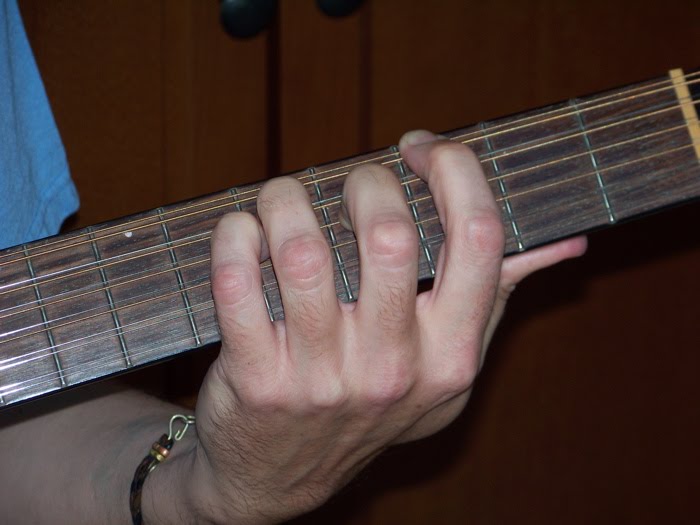
My hand does stuff like this, I suppose. But this isn't a typical pose.


These are typical poses. I'm fretting a chord we'll call G 6th (no 3rd). And meanwhile, my right hand is flat-picking and strumming (there's a Fender thin blue confetti pick in there somewhere).


Then changing chords - a sort of G maj 7th happening here.


Or fingerpicking the Takamine C-128. Great old guitar.

Among the many things my hands do, one of the most familiar for me is playing guitar. I want first to describe some of the everyday characteristics of playing guitar, for me, and then go into more about the perception and sensation, and then, I hope, get a bit into why Merleau-Ponty’s hand examples bug me so much.

Most days, I play for around an hour. I have (somewhat embarrassingly) nine guitars: three 12-string, a classical, an acoustic-electric classical, two acoustic 6-strings, a hollow-body electric, and a bass guitar. There are guitars in three rooms of the house. When we leave for any length of time, I bring a guitar, or two, with me. So, yes, I love guitars.

I have to say, playing a guitar feels great to me. This is definitely an acquired pleasure, because the first few times a person frets a guitar, it feels foreign and often hurts a bit. You grow accustomed (you also grow callouses), and you develop “muscle memory” of chord forms, of fret locations, string tensions – a wide range of variables that also vary from instrument to instrument. Fretting the doubled strings on a 12-string guitar, for instance, requires a modulation of fingering and firmer muscle tension.

The pleasure of playing the guitar is not only musical, but tactile. I’m charmed by the familiar flow of a piece that I know well, following the rhythm and the picking and fretting patterns. When I pick up a guitar, I fall into one of these songs – almost always, the first song I play is one of mine. I suppose playing a song again that you’ve played hundreds of times can feel routine, a too-familiar song can become boring to play, especially if there aren’t musical or physical challenges to it, or if the situation takes away its emotional meaning. When I play for myself, though, I choose whatever I like, and often enough, my own stuff has both musical and technical challenges. (In the pictures, I’m playing “To the Sunrise” on the 12-string, and “Morgan’s Song” and “Late Afternoon Lullaby” on the classical.)

It’s characteristic of my playing that I fret across wide stretches of the fretboard. I developed this habit in part because of the strange way I learned to play – by painstakingly working out the fingering of every position of every chord in a chord encyclopedia my brother gave me as a present. The stretchier chords feel good to me, in part because I have long hands and fingers. (Plus, I think the weird chords are fun to show off to people.)

**

I’ve habituated to the guitar, developed a style of playing and a capacity for expression. This happens through attunement to guitars and guitars’ sounding out, through repeated perception. Borrowing from Sara Ahmed’s Queer Phenomenology, I can get at something of the institution (the being-instituted) of all this, along three dimensions of orientation. First, is the orientation that is there in the placement of things in the field of perception – whether, how, and where and when the guitar is there for me. Second, is the orientation in the background that already normatively lays out this scene – the guitar as a cultural artifact; the material, social, and political conditions of its production, distribution, purchase; the history of musical instruments in households; etc. Third, is the orientation that these other two found, through my repeated acts of perception and play, my ongoing appropriation of guitars in this setting and constituting of a guitar-world (if I can call it that).

I want to talk about what this means for, and to, and of, my hands, and my hands’ histories and habits. My hands do not just “touch,” as Merleau-Ponty discusses. They do not merely “palpate” or “caress.” Through these and all their other intimacies with the tangible, hands perceive and sense – that is, they actively grasp, and are held within and by, the tangible. The familiarity of “Morgan’s Song” (the oldest one of mine) is dispersed across my hands, my arms, my body, and the body and strings of the guitar. I know this because it is not the same on another instrument than it is on the old Takamine classical I first played it on. (I ascribe co-authorship of most songs to the instrument.) Playing the tune, I comport myself in relationship to the instrument. The guitar guides my hands, draws my fingers to touch – “here, now here, now up here...” No doubt, this is another seduction of sensation, of fingers, of the musical that vibrates between us two – guitar, and me.

It is as if we merge, we flow together, my fingers become the fingers of the guitar, the fingers of the fretboard. “As if...” because I can’t lose myself entirely, never release entirely my fingers’ will or their “I can...” I don’t need to enter into the bizarre experimental setting Merleau-Ponty depicts. My left hand and right hand, intertwined with the guitar’s song and sound, warmth, density and vibration, encounter the tension of the strings pushing back, their resistance and their suppleness. I feel this contact as the string’s, as the neck’s, and then as mine, and though the two never coincide (he’s right about that), it’s not due to my own perceptual “blind spot.” At least, not only. I am not the final perceiver just because I am perceivable. I am not the final grasp on the world, or the ultimate touch or caress of the world, because I am touched and caressed.

Thursday, June 17, 2010

wild meaning

What The Visible and the Invisible boils down to is an attempt to evoke the origination of meaning, signification, and expression - the nascence of our experience of truth. Merleau-Ponty himself didn't get far, since he died - as the probably apocryphal but lovely story goes, while reading Descartes.

I translated an article a few years ago that argued that the issue is translation. Expression in language is a translation of what Merleau-Ponty resorts to calling the wild meaning or wild being of our pre-reflective experience.

We do not see, do not hear the ideas, and not even with the mind’s eye or with the third ear: and yet they are there, behind the sounds or between them, behind the lights or between them, recognizable through their always special, always unique manner of entrenching themselves behind them,... (VI, 151)

The very end of the chapter everybody in the Merleau-Ponty biz talks about goes like this:

In a sense the whole of philosophy, as Husserl says, consists in restoring a power to signify, a birth of meaning, or a wild meaning, an expression of experience by experience, which in particular clarifies the special domain of language. And, in a sense, as Valéry said, language is everything, since it is the voice of no one, since it is the very voice of the things, the waves, and the forests. (VI, 155)

That's pretty, but, as is so often the case with Merleau-Ponty, even in the stuff he actually finished and published, it's ambiguous. Since his point is that experience is ambiguous, and our giving expression to it disambiguates it in a particular direction, creates/discovers in it a provisional truth, then his own ambiguous writing is itself evocative. That's one thing I've always both deeply admired and been quite irritated by.

The human work of expression - and philosophy is just the account of how this work takes place - is this disambiguation or translation of what Merleau-Ponty calls "mute things" or "mute experience." He takes this from Husserl in the Cartesian Meditations, so I'll have to go back to that again (he was apparently reading that, Husserl's "Origin of Geometry" essay, and something by Descartes as he was working this out).

But I woke up last night trying to figure out what this idea of "mute experience" or "mute things" means. The philosophy which proposes that expression in language translates and gives voice to the mute things could seem to be a bad humanism - that is, a humanism that privileges the human source of meaning as not only our source of meaning, but the source of meaning. Clearly, Merleau-Ponty is trying not to do that - we're passive in our activity, after all, and for our expressions to express the mute things, they can't be merely ours.

Why assume things are mute? Why assume wild being is inarticulate - if that's what "mute" means? What does "mute" mean, for that matter? (That too could be considered a pun, but watch out for that smuggled-in dualism, bub!)

If I (to wit, a human) were to make the case that the mute things converse, that they disambiguate themselves, I'd probably be making the same humanistic mistake: this would obviously be my own account of their articulation.

I think I have the biggest problem buying "mute" things and "mute" experience when I consider music. Human beings play music, but music isn't a human phenomenon, it's a natural phenomenon - related to vibration, proportion, harmony. As much as we overlay all this with our musical expressions, music only happens because the universe is built this way. (I hasten to add that this is not a cosmological question, it's about how meaning arises.) I have a hard time admitting to writing a tune, because the tune is already implicit in - well, you might say, in physics, but let's continue to say wild being. Any tune is implicit in it. Any sequence of tones of any duration, spanning any register, including those we don't hear, is, simply, there.

This makes "mute" very hard for me to fathom, and I think pushing that a little further might help me figure out something about my take on the relationship between my subjection to "wild being" (e.g., that I vibrate, that bits of me vibrate aurally, in particular) and my active perceiving of others, the world, things (e.g., someone singing, music, guitars omg guitars), and to musical meaning. The passion at the heart of this leads me again to want an erotic account.

Tuesday, June 15, 2010

more on flesh from Merleau-Ponty

Attempting an entirely novel account of perception, meaning, and truth, Merleau-Ponty begins to work up this notion of flesh. Only it's not a notion, it's more like an "element" in the ancient Greek sense, he says. Anyway, a key part of his discussion is that to be capable of vision we must be of the visible, as a common flesh. Our individual vision, our capacity to see things, arises by way of our being among those visible things. So while to us, at least before we reflect on it, our vision may seem sovereign, totally within our control, Merleau-Ponty attempts to evoke this implication of ourselves in the visible.

Vision, he says, in the first place is narcissistic for me individually. It opens to a world that addresses and seems to be about and for my vision. However, there's another side to it:

as many painters have said, I feel myself looked at by thing things, my activity equally is passivity – which is the second and more profound sense of the narcissism: not to see in the outside, as the others see it, the contour of a body one inhabits, but especially to be seen by the outside, to exist within it, to emigrate into it, to be seduced, captivated, alienated by the phantom, so that the seer and the visible reciprocate one another and we no longer know which sees and which is seen. (The Visible and the Invisible, 139)

I'm hooked. Seduction is perfect for describing this.

Double narcissism: to see and to be seen -- to approach the world with my abrupt, overly frank look, to look right into and upon things, to make things show themselves to me, naked; and to be looked upon, to have my seeing seduced by the things, by their nakedness. Seduction is, after all, reciprocal. The seducer draws me in, tugs upon me and reveals me naked, and my naked repose in the seducer’s sight of me seduces the seducer. In seduction there is that moment, that “element” of intertwining flesh, flesh that moves flesh through traversing the distance between us, pulling us by our flesh to one another’s, to the flesh of the seduction itself.

What this wants is not an aesthetics of perception, but an erotics – an account of perception, sensation, of flesh awake, sentient and captivated through flesh, by flesh. Any flesh, all flesh. So I wasn't merely being provocative in Montreal. And when I wrote my old erotic poem about blood fruit, I was really on to something. (I wonder if I was reading Merleau-Ponty then, too?)

This may seem weird at first, but consider some instances.

I scan for beauty, searching out something to please my eyes. I set this direction, I set out into this constituted beauty-world. If I come across a stand of scarlet lilies, I'm stopped in my tracks. This is a flower I'm particularly enamored of, one I fixate on, dream about even. And there they are! My quest for beauty has led me to be stunned, done in, entangled. The lilies have me in their petals, and I feel held fast in place, drawn and unable to pull away.


I really love white peaches. I'm stupid for white peaches. I grab a peach, intending to violate it utterly, you know, eating it, and as I bring the peach close to my mouth, its perfume, the velvet skin soft in my hand, reclined in my fingertips, and as I lay my lips upon it, I give myself over to the peach. It fills my mouth, it drips sweetly over my tongue, drenches my chin, my fingers, and I'm transfixed, mad with desire. There is nothing else in the world for me in that moment but the flesh of the peach, this flesh becoming my flesh.

(Man oh man oh man, do I love white peaches.)


So I'm going to work further on an erotics of perception and see where that goes. Fleshly, I suppose!