The conclusion of Marion’s book leaves me totally suspicious of the entire text, and most troublingly of the integrity of the phenomenological descriptions throughout – including those I found compelling and harmonizing with my own. I’m very concerned about the appearance of any affinity between this completely corrupt and intellectually dishonest account and my own.
I was suspicious of Marion’s start. He developed his account of “the erotic phenomenon” and “the erotic reduction” (my emphasis – and I’ll get to that in a bit) on the basis of the question “Does anyone out there love me?” and the threat of futility. That seemed rather dichotomous (i.e., either someone loves me, or life is futile), but did seem to me to evoke the risk of erotic love, and the contingency and ambiguity of erotic experience.
He then turned this question and this dichotomy toward the desire for eternal assurance of love, which struck me immediately as a strange and phenomenologically ungrounded move, but I took it in stride to let him have his word. The “lover’s advance,” the expression of desire, Marion determined, is properly an advance that is eternal.
He then turns toward failures of love: lying, deception, flirtation, infidelity – as my previous post noted, by imparting ethical ideas into the phenomenon of the erotic, without identifying the context of these ethical judgments, admitting them to be judgments, or admitting to the arbitrary normativity of this account. At that point, he’s clearly gone far beyond the circumspect bracketing necessary to a phenomenological description.
In the final chapter, Marion resolves the paradox of the desire for eternal love (the same desire he imposed on the erotic phenomenon in the first place) by saying that love between two lovers is vain, futile, a lie, unless they have a child – flesh of their flesh, yet not their flesh; an ongoing extension of their love beyond their love and their deaths. So add to the normative, imposed, anti-phenomenological account of the erotic phenomenon the necessity that the only properly erotic encounter is a procreative one.
Not content with that, Marion then goes on to mark how hopelessly contingent the issue of a child is. The couple may be barren (thus, their love futile and a lie); the couple may choose not to procreate (thus, their love futile and a lie); the child may die, or may not love them back, or they may not love the child (thus, their love futile and a lie). So the only way that love can be true, and avoid being a lie, he says, is in the… Wait for it…
… final judgment, which can only be by…
… God, whose love is so great that obviously, God’s the best lover.
This is not a phenomenology. Note that, from the start, the entire project takes as its focus “the erotic phenomenon.” There is only one, because Marion construed love, from the start, strictly and only from the cultural tradition of Catholicism. That makes this a theology of heterosexual child-bearing love in service to God, and not a phenomenology.
So, unless he just got lucky with some of his nicer descriptions (the description of faithfulness is really very good, for instance, even though its totally insincere), how can I take up any of these descriptions? All of them are infected by this ideology, and the fact that he never admits of it makes the infection all the more pernicious. The book is rotten to its core.
Or, in the immortal words of David Mamet, “fuck you you fucking fuck!”
Incidentally (no doubt), the book was translated by a professor from Franciscan University in Steubenville, Ohio. Back in Pittsburgh, I was briefly involved in the local chapter of the National Abortion Rights Action League. Catholic Pittsburgh was a battle ground in the nasty early-90s anti-abortion-rights crusade, and every week Franciscan would round up folks from Steubenville and bus them 50 miles or so to Pittsburgh to harass and yell at the women entering Planned Parenthood and other clinics. The more of this book I read, the more I thought about those people from the place I used to call Stupidville.
Wednesday, July 07, 2010


Tuesday, July 06, 2010
on what an erotic phenomenon might or might not be
I'm really starting to part company with Marion's account. I'm not even going to touch the stuff on addressing the lover in speech and the connection he makes to theology and to the New Testament. Suffice to say that it seems really strange to claim a connection between the erotic phenomenon and a religious text that's not even 2000 years old. Nobody had erotic sensations before then?
What becomes painfully evident is that Marion's account is incapable of phenomenologically evoking or describing the erotic phenomenon, because it is chock full of presuppositions about the kinds of sensations that can be erotic (sexual, specifically, and heterosexual, and normatively, intercourse), but also the kinds of desire and erotic encounter that can be regarded as legitimately loving.
That said, he does some very interesting stuff about “lying,” which covers, for him, the ways we deceive one another about our love... by which he means, again inscribing the account with heavily normative presuppositions, heterosexual, monogamous relationships. So, one kind of “lie” is “sweet talk,” by which one proposes to another all the signs of love (which he says don't signify anything), thus evoking desire, which the sweet-talker does not carry through with. This could be exemplified by flirting. So, how is flirting a “lie”? Only if our love-talk, our erotic talk, always necessarily morally intends to offer one another the desire, arousal, and encounter of flesh to flesh. But he must mean flesh here in a totally literal, non-phenomenological sense. Sweet talk is a lie only if the moral standard for arousing talk is that it issue in the literally physical consummation of desire in intercourse. There's more: still worse than sweet talk is actual infidelity, when not only is the arousal a “lie” because ... er, because now the lie is that one loves, when one already has a lover.
So: it's as though the only kind of erotic connection we can have is in actual physical co-presence, and also that the only legitimately erotic encounter we can have (note!) is monogamous sexual intercourse.
And then, he says, we sometimes go even further outside of these boundaries, when, for instance, we become erotically interested in being, say, tied up or spanked, or, still worse yet, when we “transgress the borderline between sexes” (165). So now, the only legitimately erotic phenomenon, and the only love that counts as love, is monogamous, heterosexual, “plain vanilla” sexual intercourse (did I mention, to orgasm, and no further? cuz, that too).
From Marion's perspective, then, all those random arousals we undergo, and that we sometimes provoke and enjoy; and all non-monogamous, non-intercourse erotic encounters; are not really erotic phenomena, because, according to Marion, we cannot love in those ways (maybe you thought you were, but you were wrong, apparently. Thanks for the tip, Jean-Luc). Which tells us exactly the boundaries of his concept of love.
Monogamy, fidelity, flirtation, excitement, desire, and perversion, are far more complicated phenomena of human love, as well as of erotic experience, than Marion gives them credit for, to be sure – to say nothing of orientation, for crying out loud. Or gender! Or peaches!
If you wanted to account phenomenologically for the erotic, you would bracket all that you regard as real or settled about it. That's the basic step in phenomenology - the bracketing of the "natural attitude." Marion hasn't done it. I haven't done it completely, but I think I'm in a better position than he is. (He's even presuming that flesh means flesh of bodies that are human, for purposes of this account.)
Monday, July 05, 2010
naked arousal, eroticized flesh, orgies, food, etc.
As flesh, I take on a body in the world; I become sufficiently exposed so that the things of the world have an advantage over me, such that they make me feel, experience, and even suffer their dominance and their presence.
But, as soon as it is a matter of feeling, and feeling in my flesh not just things, but another flesh, there is no longer anything to perceive, and the flesh can expose itself without translation, immediately to a flesh. And the flesh that exposes itself to another flesh, without a thing, without being, without anything as intermediary, shows itself naked – the nude-to-nude encounter of one flesh with another. This modification of the flesh, which passes from its perceptive functions to its nude phenomenality, eroticizes my flesh and thus radicalizes the erotic reduction. (The Erotic Phenomenon, 111, 113)
More good stuff from Marion, as usual with some other stuff (not discussed here) that I could do without, and missing some dimensions I think are crucial. Marion rightly says that a double passivity eroticizes flesh - I become my flesh when the flesh of the other passively accedes to my flesh, and in so doing, delivers me into my own flesh. But his notion of the erotic reduction is, I think, too specific to a dimension of human experience, as though "the erotic" and love can only be interhuman, and, really, inter-couple. Again, I'm approaching the erotic as the element of our foundational intimacies, of sensation and subjection.
So I would say that we are naked, exposed, feeling immediately the dominance and presence of other flesh always, and that our perceptual competence never fully overtakes or reduces this encounter to active perception and grasping. Not our reach, but our naked flesh exceeds our grasp. Of course, we spend a lot of time and energy covering our nakedness, protecting and preserving our bodies, exerting what we imagine is sovereign authority and control over our persons. But as the saying goes, we’re all naked under our clothes. Some of us are even quite embarrassed by our more intimate and naked pleasures (even more than our pains, is my observation of our typical social behavior). Then again, few people would probably really want to watch me eat a peach in my wanton arousal.
To go even further, I confess to getting a lot of enjoyment from other people’s enjoyments, and, yes, arousal from their arousal. (Usually I express this in socially acceptable ways, unlike, for instance, now.) When you recline in your arousal and pleasure, passively acceding to your flesh and the flesh of the other, you are naked to me – whether or not I am, in that moment, “the other” in the “nude-to-nude encounter;” to be in the presence of your arousal, and to be open to your arousal, means I join in that encounter, too.
This is (a) HoooooT!, and (b) an account of the intimacy of shared pleasures of many kinds. It certainly makes having dinner together pretty exciting.
The thing is, we know this, don’t we? Eruptions of arousal and intimacy happen all the time, all over the place. Some dinners we call “orgies” for this reason, especially more voluptuous dinners, the ones after which we sigh with the fatigue of pleasure. When I described the erotic joy of teaching, what else was I describing but those moments when so many of us in the classroom become nakedly aroused at the contemplation, the sensuous encounter with an idea, especially a beautiful and seductive idea. (And there are beautiful and seductive ideas. Stop looking at me like that.)
Sunday, July 04, 2010
the lover, becoming amorous, seduction
To qualify as a lover, I do not have to perform love’s perfect advance: by definition no one can promise that, since it depends on no cause whatsoever, not even my will; but in order to be qualified as a lover, I have only to decide to perform love’s advance, a decision that depends solely on me, even though it always plays out at the limits of my abilities. (The Erotic Phenomenon, 91)
In deciding that I love in advance and without reciprocity, without knowing what the other thinks of it, or even if the least other knows anything about it, I have the sovereign freedom to make myself a lover – to make myself amorous. I become amorous simply because I want to, without any constraint, according to my sole, naked desire. (The Erotic Phenomenon, 93
Among the many problems with Marion's book so far is, I think, a problem of level of description. In my view, his account of the lover and the decision to "perform love's advance," remains egoistic and voluntaristic in ways that miss something about the erotic. I'm finding odd points of connection in his account and what I'm fleshing out myself (hah!), but also occasionally exasperating points of disconnect, and this is becoming one of them.
I do like the description of how to become a lover, if what we're talking about is the decision to act, the decision to profess or to pursue, the decision to open to the other. I’m suggesting that, sensuously, we’re already erotically entangled prior to some such “decision.” Consider: how did you decide to become amorous? did you decide? Or did you find an entanglement already underway? I wouldn’t deny we do have to make a choice about what Marion calls “love’s advance,” but I don’t believe I decide to love peaches (I doubt he’d allow that I could love peaches); I believe peaches overtake me. I can forego them, and I suppose I could try to despise them, but at that point, we’re not talking about a decision to become amorous, so much as a decision to act. I didn't decide to desire white peaches, and in that way, I'm at a loss to explain it, to myself or to anyone else. Others who love white peaches just smile knowingly and nod; others who don't look confused and shake their heads.
(That post-decision stuff could be worked out nicely through Ahmed's account of orientation.)
In an earlier section, Marion exasperated me with his account of seduction, distinguishing it from the (proper) erotic reduction by saying the seducer seduces only to a point, the point of leading the other to love, and thus assures reciprocity. Again, don’t buy it. Couldn’t there be such a thing as mutual seduction? And isn’t seduction built into the erotic entanglement of flesh itself? I think he’s smuggling in ethical assumptions about what seduction means or intends and the moral significance of that act’s intent. I understand the goal is to lead to a “decentering” of the ego under the erotic reduction – the move to the other as center. That’s imparting a very particular spin on the entire description, one again drawn from a set of assumptions about proper, moral erotic relations.
In contrast, and more positively, I’m using the term seduction to mean a sensuous relation of flesh to flesh. You, or a peach, or a crimson lily, seduce me – not by tricks and temptations, not to tease, not to beguile me – but by the appeal of flesh to flesh, the responsiveness of flesh to flesh, which has at its heart need and desire, pleasure and pain. I am seduced by and as flesh that would touch/be touched. This is not contrary to the (proper) relation of love that decenters. The peach doesn’t egoistically tease me and then withdraw. The peach decenters me, because the pleasure of eating the peach loses me my control.
So while Marion’s accounts for the motives of lovers – loving to love, loving to the last, loving without limit and without expectation – (1) when we love flesh, this too is expectationless and limitless, and also decentering, (2) when we are seduced by flesh, it draws from us this response, (3) as Marion says of the erotic reduction, it is not objects we love – but (I say) flesh; the flesh of the peach isn’t an object, but a foreign body that I entangle with, by eating, by inviting the other into me; your flesh isn’t an object either, but another foreign body…
See? Egoist, voluntarist. He's addressing how a sovereign I becomes the lover, through an erotic reduction of ordinary mundane life to the erotic realm of experience. He's not talking about my susceptibility to being seduced, because I am of flesh-desiring flesh and always already erotically entangled.
Friday, July 02, 2010
erotic entanglements and the mouth of desire
In The Erotic Phenomenon, Jean-Luc Marion addresses the erotic from the standpoint of the “erotic reduction” that seeks, Descartes-like, an assurance of the ego’s being loved. It asks the question “Does anyone out there love me?” (He repeats the question innumerably, along with the similar, opposite question: “What’s the use?” – the one expressing the hope, if that’s the word, for “assurance” that the other question’s proposal of vanity will be shown false. The Cartesianism of this is powerfully expressed throughout. It’s one of the things I don’t like about it.)
One way to look at the erotic, that I draw from Marion, is that it is something we await, that we dwell in fruitless anticipation for. It is not a self-creation. I cannot be my own erotic counterpart, on my own – that is, self-sufficiently as a Being-for-self or a solus ipse. Just can’t be done.
Let’s use this as an account of the erotic of sensation: sensation asks “Does anyone out there love me?” of what it senses, and we can describe the relation to the sensible and sensed as an erotic love. Our flesh loves flesh, loves to be touched and to touch, to taste, to be tasted?, to smell, to hear, etc., etc. Rather than an aesthetic approach to perception – “toward what shall I turn my (sovereign, voluntary) attention? What pleases me?” – we’d start with an erotic approach to sensation – “how can I be? how can I be loved by flesh, such that flesh sustains me?” Just like in Marion’s approach to human love relationships, this erotic attachment to flesh, to the visible and the invisible-visible (the visceral, per Drew Leder) represents our non-self-sufficiency, our need as well as our desire. Pleasure and pain are erotic entanglements of flesh. This pain happening now in my left ankle, following a couple miles’ walk to and from the farmers’ market, assures me of my fleshly being, of my fleshly non-self-sufficiency (“I need that ankle to persist in its being, for me to still have an ankle and the possibility of walking, whether it hurts me or not”; “I need the flesh of me to be, and to be sustained by the flesh of being, and this pain expresses this need”; “I desire to walk, I desire peaches, I desire sun and air”).
This can all be (all of this is) anticipated, analyzed, scrutinized, regimented, surveilled, and disciplined by scientific and social practices of all sorts. But it can’t be replaced, and it can’t be made by me. It made me. It continues to make me. I continue to await its arrival. I live always in anticipation of the arrival of flesh, and upon its arrival, I continue to await its (next) arrival. We could call this erotic anticipation something like “protention,” but that would be to treat it as the directed, self-determined, egoistic act of consciousness. Even “anticipation” is saying something distorting, but mere “openness” doesn’t provide enough of a sense of direction.
I live in the subjunctive case, with its hint of the passive voice: I would touch, I would be touched, I would enter, I would be entered… Our erotic connection to one another: we are flesh that would touch, that would be touched, that would enter, that would be entered – everyone, by everyone, by everything. To acknowledge this, is to acknowledge every way we suffer or inflict pain, every way we receive or give pleasure. Which is every way we sense anything at all.
So it’s not just that any pleasure or pain can be anticipated. If I pour a glass of whisky and set it on the table in front of me, I can begin already to have sensory responses to my anticipation. My mouth may already tingle a bit from recalling drinking this whisky in the past, or, if it’s a new one to me, in some combination recalling and searching out. My mouth prepares the way for this new visitor, whom we hope will please us. My mouth is for this whisky; it would taste it, it would encounter the whisky’s flesh with its own flesh. It awaits the erotic entanglement of drinking the whisky; it is the mouth of desire.
desire & recognition
How does desire take place between us? How do we become aware of it, in one another, for one another? How does desire arise – as eruption, disruption, constituted meaning, expression? How can I recognize desire in your look? What is shown to me in your look? How does your gaze, your face, your posture, even in concealing itself, reveal desire? How do I know how to look for it? (Why do I look for it? Why do I look for it in your gaze, your face, and your posture?)
[The following is based on a true story. The names have been - well, omitted - because it's not really relevant to the story. You can use your own name and the name of your sweetie, if you like, and see if this works for you. I'd like to know, either way, because of what I'm trying to identify. Those who know this story about me, personally, and know who was involved, will know who was involved and what happened next. Those who don't, won't. So there.]
[This also deals mainly with the visual aspect of recognizing desire. I think mutual desire of sighted people very often begins there, so I think that's an okay place to start. Caveat: the gazing, looking, etc., of this description should be taken as metaphorical. We also recognize desire in gesture, in words, in scents, and of course in touch.]
[Oh, and the next post will probably be about whisky.]
I caught sight of something in your eyes, something that momentarily paused my scanning gaze. I was looking for something, scanning inquiringly, but asking a different question. That’s perhaps what I noticed – that something else was expressed in your eyes, in your face, than in others, or in the space around. That moment of pause founded a space, itself, between and enveloping us.
And then, another time, I saw that something, or something like it, again. And again, as our gazes crossed one another, that space was founded. Again, and again. I started to wonder about this expression and this space between us, asking about its meaning, and whether the meaning that I seemed to find there was real – that is, whether it was a genuine and shared meaning, whether how it seemed to mean to me was how it meant to you. My look began to ask that question, to propose it as a meaning, tentatively suggesting to you: “Are you not, just a bit, like me, charmed?” (That’s how I recall this feeling. I recall also that it felt like something shockingly intimate was happening. Other people were around. Did they see it too? Or was I only imagining it after all?... But I know that I wasn’t imagining it; the facts are in by now.)
This meaning, this charm, how did it get there? How was it founded in these crossing looks? I suppose I could get at this by asking who looked first. I’m suspicious of that move, though, because I think it’s a chicken-and-egg question. The looks took place, is the more appropriate description of my experience. Still, where, in the looks themselves, or elsewhere, beyond, behind, beneath, and how, and through what auspices, was this mutual affection founded?
I know now, also, that our affinity grew, that succeeding looks, succeeding words, became more meaningful. The look became, as we sometimes say, “knowing.” Then, I think, it started to become evident to others. (I know it did. The facts are in.) They saw it, too – this shared emerging meaning between and enveloping us, that we both made efforts to conceal. Our efforts were clumsy, too cautious, posed indifference that was obviously affected.
How do we come to desire one another? How do our individual, inquiring looks become the shared meaning? I want to say, our expressions meet one another and find their partner in expression, find an expression to attach to or join with. I looked for your eyes to ask me what I was asking with my look, and couldn’t help my eyes widening at the sight of yours, couldn’t help myself being caught in your gaze – and for that instant, I forgot everything.
Even though, at the time, neither of us was sure, nor even really believed that we were heading this direction, we continued to express our inchoate, tacit, inquiring, tentative desire for one another: “Is this pleasing to you? Do I present to you a lovely aspect? Do you see what I would give to you?” The look asks: slightly wider eyes, which turn brighter from reflecting light, and thus shine or twinkle at one another (which is also, of course, charming); our faces open, and perhaps our lips part, just slightly. We seem to catch sight of these expressions of inquiry, and imagine, or guess, what they are asking. Meanwhile our own faces also ask.
Turning our regard turns us as well, toward one another. When we face one another it is not only as faces, after all – we turn embodied looks to one another, and the space of those looks envelopes our bodies. The space of desire has its own field of energy – so we call attraction “magnetic” and the energy of desire “electric” and so forth – a field of meaning whose energy is produced through our expression and perception. It is also uniquely our energy, which I think we also know from being with various couples and feeling the energy they themselves produce, and being able to distinguish it from others, from our own, etc. At first, too, this new energy is jolting, just because it is new, or because recognizing desire shocks us.
album of the day: Dear Catastrophe Waitress

Whiplash, much? Straight back into chamber pop! Hah!
Belle and Sebastian (who famously took their name from a French children's TV program) are just about my favorite current indie band. (I probably say that about a different band every four days, but you know what? They can bite my...)
Well, that didn't set the right mood at all, did it?
Then again, I'm not sure what the right mood would be for Belle and Sebastian. Their lead singer and chief songwriter, Stuart Murdoch, has a disarming manner of performing both of those tasks, leading Belle & Sebastian to have, in turn, a most disarming manner.
Again, there's perversion, as in the first track on the album - and my favorite - "Step Into My Office, Baby," which is a cutely sung sing-songy song about sexual harassment, and accepting it as a means of advancement in the workplace. Sung by a guy, about a female boss, this just stomps all over a particular kink button of mine - you know, the one labeled "The Nubile Paperboy Delivers For The Bored 30-Something Housewife..." (You know about that one, right?)
If that's not your thing, then perhaps you'd enjoy the sweet sad longing of "If She Wants Me"
If I could do just one near perfect thing I’d be happy.
They’d write it on my grave, or when they scattered my ashes.
On second thought, I’d rather hang around and be there with my best friend,
If she wants me.
No? Well, how about "I'm a Cuckoo"?
I'd rather be in Tokyo
I'd rather listen to Thin Lizzy-oh
And watch the Sunday gang in Harajuku
There's something wrong with me, I'm a cuckoo
Any band that refers to Thin Lizzy (and yes, the song quotes the guitar line from "The Boys Are Back In Town") is worth at least some of your attention. Belle & Sebastian may be altogether too precious for some, but in the right mood, at the right time, generally mornings about 10, you could do a hell of a lot worse.
I think they're a very self-aware band. Murdoch's lyrics and angelic voice are postured to create a surreal effect. It works very well, and although it's clearly an effect, it's a delightful effect.
Thursday, July 01, 2010
album of the day: Lust for Life

I had a friend in Pittsburgh whose fondest fangirl memory was of Iggy Pop spitting on her from the stage. I don't remember if it was deliberate, let alone aimed, but she felt it was special.
In a weird way, that kind of sums up Iggy Pop's appeal. I don't mean to suggest that Iggy Pop's punky music is just for body-fluid/humiliation fetishists, though I imagine that helps. I do mean that at his best, Iggy's appeal is sensually, psychically, and musically lewd and lascivious. Just about everything named, described, or alluded to on this 1977 album should get you arrested.
Every so often, this is just the thing I need to hear. I played this a ton, several years ago, when I was going through a lot of punk, in part as a cleansing procedure. I realize that wallowing in filth like "Lust for Life" ("Here comes Johnny Yen again/with the liquor and drugs/and the flesh machine...") or "Sixteen," or measuring one's perversity against "Some Weird Sin" ("... the sight of it all/makes me sad and ill/that's when I want/some weird sin...") or even "Fall In Love With Me" seems an odd way to purify one's soul. But for some of us, it works.
Iggy Pop spanned musical generations. With the Stooges, he embodied the culture of sex, drugs, and rock-and-roll with reckless self-destructive abandon, often leaving the stage after a show bloodied and lacerated. The punk scene took a lot of their cues from this. But by '77, punk had started to domesticate, and this album, co-written with David Bowie, points again to the future of harder-edged rock. I'd almost go so far as to call this one of the first post-punk records.
Every song, but I think most effectively the title track, has inescapable hooks and infectious rhythm - like good punk should. But on others, that's met with cool, angular, smooth Bowie-esque melody: on "Tonight" there's a clear line between an opening screeching punk vocal and Iggy's David Bowie impression throughout the rest of the tune. (It sounds like a David Bowie song, too - which it is.) On "Tonight" the effect is disconcerting, but otherwise, you'll hear that now-familiar cooled-down punky stuff that have made so much money for Green Day.
Wednesday, June 30, 2010
album of the day: Begin to Hope

Regina Spektor is not allowed in the house, mainly for her own protection.
People use words like "quirky" and "idiosyncratic" to describe Regina Spektor ad nauseam, and possibly also ad nauseum, at least, her own. She takes a unique approach, especially to singing, but those terms sound like diminutives, like pats on the head of our little weird Russian singer-songwriter chick.
She's more badass than that, for one thing. She started out anti-folk, and the vaguely punkish roots of that musical influence still pop up, in both her penchant for repetitive lines of lyrics and in some of the earthy and goofy imagery of the lyrics. For instance, on one of the more intriguingly written lyrics on the album, for "20 Years of Snow," (which seems to be about trying to maintain some degree of innocence), she is concerned that:
This place is full of dirty old men
And the navigators with their mappy maps
And moldy heads and pissin' on sugar cubes
This is the song following the gorgeous piano and vocal on "Apres Moi," and is succeeded by "That Time," which develops a series of scenes of odd youthful urban behavior (to wit, cultivating strange habits for fun) before letting you know the song is actually about drug abuse. She has range, is my point. In fact, the best song on this album is one of the most conventional stylistically - the heartbreaking song of love's destructive power, "Samson" (it begins "You are my sweetest downfall/I loved you first, I loved you first").
We first encountered Regina Spektor at the annual Bridge School benefit concert a few years back, and after we got over our initial sense of "whathe? Did she just say "loogy"? (which she did), we were thoroughly enamored. Still are. Good eats!
"dissolute and lustful substance"
[T]he body as the power of Einfühlung is already desire, libido, projection-introjection, identification. The esthesiological structure of the human body is thus a libidinal structure, the perception a mode of desire, a relation of being and not of knowledge. (Nature, 210)
In the conclusion of the Nature lecture courses, Merleau-Ponty discusses libidinal desire. There is, in addition, a direct reference back to the language of the chapter “The Body in its Sexual Being” (“Le corps comme être sexue”) in the Phenomenology of Perception. I think those discussions provide reasonable textual support to the position that desire, libido, and the erotic are central to Merleau-Ponty’s account of ontology, in particular, his account of wild Being and wild meaning.
I take the position that an account of wild Being and wild meaning that starts from desire and the erotic, should dwell there for some time, should account for desire and the erotic, or evoke them. But the erotic, as I’m developing it, is not restricted to phenomena of love or sex. Libidinal desire is primary, primal, orientating, activating, provoking – but is far more interestingly seducing, enflaming. Slipping past the erotic without giving it its due, without focusing attention on it, leaves our account half-complete, or, if you like, flaccid. (You probably don't like. I understand. I promise to be as - let's say, robust - as possible.)
The lecture notes are, naturally, sketchy. But from the bits and pieces, we can draw some helpful directions.
Thus there is an indivision of my body, of my body and the world, of my body and other bodies, and of other bodies between them... Indivision of my body and of other bodies; of its cavities, reliefs, and those of other bodies, and of these between them. (Nature, 279)
... the libido precisely is not a univocal orientation toward a sexual organ, but a fantastic polymorphism, a possibility of diverse ‘sexual positions.’... Thus the sexual is coextensive with the human not as a unique cause, but as a dimension outside of which nothing remains. (Nature, 282)
What Alphonso Lingis criticizes in Merleau-Ponty's account is that it deals exclusively with the projected world of "competence" - the world we constitute about us, containing things we then make use of for our projects. Lingis suggests the need for (and then pursues) describing those times when there is not this projected world, but something less "real," and more "phantasmal." For instance:
In slackening its hold on the levels and layout of objectives, wandering among the obsessive presences and haunting absences of erotic space, [our body] materializes for itself as a dissolute and lustful substance. (Foreign Bodies, 24
Oh, do I love the phrase "dissolute and lustful substance." It strikes me as totally accurate. This is how we undergo being captured by the erotic. Drawn up, spread out, stretched, as by hands, my body tingles in erotic space, touched everywhere by a fog of delectation and desire. A fog of heat, a heat like an open fire that is somehow miraculously inside me, burning to get out. My vision unfocuses, goes slightly numb, slightly stupid. I hear less, but louder – your breath, my breath, my heart beating up my neck and down my throat, inhaling us, inhaling the heat rising from us and the smoke of its fuel. My throat thickens, smoky, hot.
I feel feint, slack, aching, derealized, liquid, steam, impossible to be solid and fluid and ether at once, but impossibly it is so. A hazy recognition this can’t go on forever, and that there is still some way to move this liquid body and its skin of fire, shuddering some way with, toward, entangled. Where? There, anywhere, there. A there that is everywhere at once, whole bodies reached, impossibly, instantly, in one touch that is here and there and there, and everywhere, and nowhere. Liquid, fire, the aching elements fitting the shape of the body they fill, filling the body they shape.
Of course we ache. Our bodies transubstantiate and dissolve in the erotic, are borne along in its liquid fire, floating, thrashing, drowning. We ache to touch, to be touched; we ache not touching, not touched. The fire either way.
Tuesday, June 29, 2010
album of the day: Until We Felt Red

Kaki King is a brilliant guitarist who fuses several styles of guitar music and techniques to create her own stuff. What I most like about her is prominently represented on this 2006 album, her third.
In fact, it's prominently represented in one song on this album, "You Don't Have To Be Afraid." There is one line of lyrics: "You don't have to be afraid of the pain inside you." It is sung against a suite of music all developing the same basic theme, played with totally different tones, and even on different instruments, from ethereal space music to grungy rock with a side of psychedelia; with, in between, funk and jazz.
Many of the tracks are musically subtle, trancelike, sort of slow raga pieces, where tonalities slowly shift and don't particularly adhere to a typical song structure. But she'll puncture the mood of these, raking across the strings like Pete Townshend, or thumping bass notes out.
Two of my favorites on this are "First Brain," an instrumental, and "Second Brain," which again has a brief lyric:
Ten years, two-thousand stomach aches;
If I get one every other day,
Are we to have another century of guitar when the best instrument in the world is still the piano?
I have no idea what that means, really, except that it's followed by a lengthy and complex guitar solo that, again, features about 9 different ways you can play a guitar. My guess is that she's making a bit of a point about the guitar's musical flexibility - especially when you play it, as she often does, like a harp, or a hammer dulcimer, or a drum.
There is an overall mood to this, as to her other music that I'm aware of. It's... a bit unsettled, or maybe I mean unsettling. Much of it is very pretty, most of it is very slow-tempo, which makes it feel like it's easy to follow, but then, it's not easy to follow because it's not worked out in familiar chord progressions. (People who can hear what a lot of my stuff does can probably understand why I'd have affinity for her music.) And then a bend, a scrape, an unexpected slide, and you're not sure where you are, or where you were.
hands' desire
The distinctive feature of the living being is that nothing appeases its vital tension, as if any realization were at the same time a failure and as if any point of arrival were at the same time a point of departure... Desire defines the very essence of the living being. (Renaud Barbaras, "Life, Movement, and Desire," p. 15
Reading a very dense article by Renaud Barbaras this morning, I kept thinking about hands. When he got into the section on desire, what came to mind is lovers’ hands, and how lovers’ hands love. If you’re lucky, you’ve had some profound experiences of this. It reveals the paradox in Barbaras’ account.
Rapt, entwined, our bodies press to one another, welling with desire – a desire that arrives or becomes within us, if the flesh is willing. Even if the encounter is planned, even staged, the advent of desire cannot be. Induced, seduced, entrapped even? – but not invented. It arrives from a dimension, or from the element, of flesh, of carnality. But then, why? Barbaras says, because desire is the fundamental movement of our flesh, impelling us into the world, unto the flesh it finds for us there, striving for the impossible satisfaction of this insatiable tension.
A moment comes when my hands are no longer instruments of my intentions, but creatures of desire, arriving and departing, alighting here to barely touch, there to stroke, to pinch or clutch, to grasp, to hold, to hold down. Flesh willing, hands become flesh-desiring flesh, as if hands could eat and drink, as if hands themselves desired.
Yet hands do not desire; they are, in themselves, only potential for touching, stroking, pinching, clutching, grasping, holding, holding down. These are potentials that we can habituate, over which we can acquire technical skill or mastery, to become “good at...” They become at times our deliberately directed instruments of typing, or of testing the water temperature... And of course, we hold those whose hands they are responsible for what those hands have done – our hands are not invisible, after all.
And yet, again, hands insatiably feel and move, and in this way are always flesh-desiring flesh. I don’t think we unconsciously palpate a favorite object as a fetish or proof to ourselves that we and the world still exist. The patina rubbed onto those familiar objects is the trace of our hands’ desire, which is our desire, which is the desire of flesh. Because I don’t think it’s wrong to say our hands’ desire is the desire of flesh our hands desire. In our passionate clutch, our hands express the desire of our lovers’ flesh, the desire to be touched, a desire that is of the flesh.
Thursday, June 24, 2010
album of the day: Entanglements

If you're a fan of chamber pop, and you don't know Parenthetical Girls, you should go out and get this album immediately. This is billed as a song cycle, and has typical pop song themes of love, loss, passion, mortality, messiah complexes, and so on.
It also has your typical contemporary pop instrumentation: guitar, piano, strings, clarinet, flute, oboe, synthesizer,... Wait, oboe?
I'm lying. Nothing about this album is typical of pop music, except that they cover a song, and that they borrow liberally from other pop songs - especially lyrical quotations and little bits of riffs. And the song they cover? "Windmills of Your Mind," from the 1968 original version of The Thomas Crowne Affair. These guys - the Parenthetical Girls, I mean; Zac Pennington and Jeremy Cooper, who started out calling themselves Swastika Girls - these guys are friggin' nuts.
There is a driving anarchic joy to this whole record. At any turn, it feels as if absolutely anything could happen. You simply have to listen to it. It's like Burt Bacharach on acid.
I found them entirely by sheer coincidental predestination. I was looking for weird band names in the racks of Indie Alternate cds at a store in Berkeley. I couldn't imagine what "Parenthetical Girls" would mean. And to think, they could've been Swastika Girls.
I quickly
pressed unto us flesh still sickly sweet
with scents of love
but lost of this lust
exactly what becomes of us?
I'm about to say something quite risqué, so go somewhere else if you need to.
Ready?
Songs often have visceral effect. I feel a song somewhere in my body, sometimes very locally even. This is one of those songs. It strikes the prostate. I am not making that up.
Burt Bacharach on acid. Prostate stimulation. Oboes. What more do I need to say?
Wednesday, June 23, 2010
album of the day: Bird and Diz

These recordings of the great bebop tandem of Charlie Parker and Dizzy Gillespie were central to my introduction to modern jazz, back at UNC Charlotte. They document the last time Bird and Diz recorded together in a studio, all recorded apparently on one day in June 1950.
The set is typical bebop: two blues, two songs based on the changes to "I Got Rhythm," two other tunes of uncertain provenance, and a pop standard. The setting is also typical bebop: rhythm section, trumpet and sax.
Two things stick out about this album. One is the presence of Buddy Rich on drums. He wasn't a bebop drummer. Far from it, as his out-of-place and sometimes genuinely disorienting solos on these tracks make clear. He was a terrific swing drummer, but therein lies the problem. Most critical appraisal of these recordings counts Rich as their main flaw, which I wouldn't deny. I know I read once somewhere that the only reason these recordings happened is that having Rich on the set was the cost producer Norman Granz demanded to record the rest of them. This is almost assuredly nonsense, since Granz's Verve records was Parker's home at the time, and Granz reveled in recording Bird with all kinds of backgrounds. I also read that Rich insisted on playing, and that Parker (who was the leader) was in a mood not to care.
The other point of interest is the presence of Thelonious Monk on piano. Holy jumpin', do I adore Thelonious Monk. He is indeed another hero of mine... but I'll leave that for another day. Though he's under-recorded here, and has little space for solos, he leaves an indelible impression. While Rich's solos disorient by being out-of-place, Monk's comping and other fiddly bits he gets to do provide a constant jostle, keeping things from being settled.
Not that "being settled" is ever a good description of bebop - which is why I love it so much. Parker and Gillespie gleefully trounce all over these tunes, pulling off incredible feats of filigree and musical tension, then tossing off humorous musical quotations or riffs. The fine recording quality capture the devil-may-care attitude of the music, which always so carefully hid the serious, even studious musicianship and composition that went into the solos.
Tuesday, June 22, 2010
album of the day: Grace

Now Jeff Buckley, he's not allowed in the house.
Son of mercurial singer-songwriter Tim Buckley, who died in 1975 of a heroin overdose, Jeff Buckley died in mysterious circumstances in 1997, having completed and released only one album.
This doesn't seem like a debut album. It seems like the third album - the one after the critical and sales hit of the first album, and the critical failure and commercial success of the second, once the weariness of touring, the cynicism of the music biz, and the relentless demands of fans and the press have twisted your soul.
It took guts and a tremendous ego to pull this off. And I think he did it.
Likely the best-known track from the album is Buckley's cover of Leonard Cohen's "Hallelujah." It's a great song that's been done a dozen different ways, but I don't think anyone plays it like this. Buckley's is a self-conscious tour de force, a military exercise off the coast, just on the legit side of international borders. By which I mean it's a provocation, and one I think Buckley ultimately would have had the firepower to live up to.
The reason I think so is songs like "So Real" and "Grace," which are the kind of well-appointed numbers that back up Buckley's degree of aggression. His guitar work is free, inquisitive, alert, if imprecise at times - reaching and stretching, nubile and coy. His voice is an outrage. He's his father's and Robert Plant's lovechild, I swear it - at turns angelic, boyish, crying, raging, raving, plaintive, and - this is the kicker - disaffected. Dude could emote.
The production of the whole album just screams "1994!" at the top of its lungs - every bit of the sound field is jam packed with sound, for one thing. That contributes still further to the feeling of this being an outright challenge to the music world. It's as lush as you'd ever want an album to be, and the setting only increases the impression that you're hearing the music of an angel - a very fallen, very put-upon, disconcertingly sexy angel.
hands, touching, and the erotics of playing guitar
... we spoke summarily of a reversibility of the seeing and the visible, of the touching and the touched. It is time to emphasize that it is a reversibility always imminent and never realized in fact. My left hand is always on the verge of touching my right hand touching the things, but I never reach coincidence; the coincidence eclipses at the moment of realization, and one of two things always occurs: either my right hand really passes over to the rank of the touched, but then its hold on the world is interrupted; or it retains its hold on the world, but then I do not really touch it – my right hand touching, I palpate with my left hand only its outer covering. (The Viz, 147f)
This example has always bugged me. It bugs a lot of people. It seems to place the hand in a strange place, less active and more abstract. I'm working out another approach, in line with what I've been writing lately about the erotics of sensation and our foundational intimacies with flesh.

My hand does stuff like this, I suppose. But this isn't a typical pose.


These are typical poses. I'm fretting a chord we'll call G 6th (no 3rd). And meanwhile, my right hand is flat-picking and strumming (there's a Fender thin blue confetti pick in there somewhere).
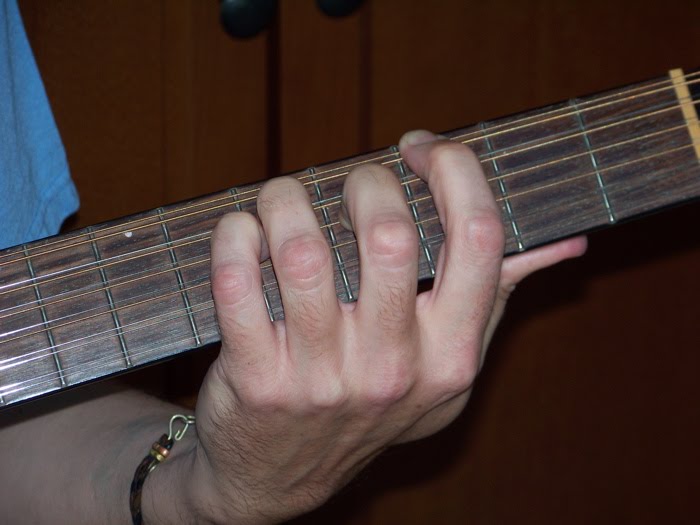
Then changing chords - a sort of G maj 7th happening here.


Or fingerpicking the Takamine C-128. Great old guitar.
Among the many things my hands do, one of the most familiar for me is playing guitar. I want first to describe some of the everyday characteristics of playing guitar, for me, and then go into more about the perception and sensation, and then, I hope, get a bit into why Merleau-Ponty’s hand examples bug me so much.
Most days, I play for around an hour. I have (somewhat embarrassingly) nine guitars: three 12-string, a classical, an acoustic-electric classical, two acoustic 6-strings, a hollow-body electric, and a bass guitar. There are guitars in three rooms of the house. When we leave for any length of time, I bring a guitar, or two, with me. So, yes, I love guitars.
I have to say, playing a guitar feels great to me. This is definitely an acquired pleasure, because the first few times a person frets a guitar, it feels foreign and often hurts a bit. You grow accustomed (you also grow callouses), and you develop “muscle memory” of chord forms, of fret locations, string tensions – a wide range of variables that also vary from instrument to instrument. Fretting the doubled strings on a 12-string guitar, for instance, requires a modulation of fingering and firmer muscle tension.
The pleasure of playing the guitar is not only musical, but tactile. I’m charmed by the familiar flow of a piece that I know well, following the rhythm and the picking and fretting patterns. When I pick up a guitar, I fall into one of these songs – almost always, the first song I play is one of mine. I suppose playing a song again that you’ve played hundreds of times can feel routine, a too-familiar song can become boring to play, especially if there aren’t musical or physical challenges to it, or if the situation takes away its emotional meaning. When I play for myself, though, I choose whatever I like, and often enough, my own stuff has both musical and technical challenges. (In the pictures, I’m playing “To the Sunrise” on the 12-string, and “Morgan’s Song” and “Late Afternoon Lullaby” on the classical.)
It’s characteristic of my playing that I fret across wide stretches of the fretboard. I developed this habit in part because of the strange way I learned to play – by painstakingly working out the fingering of every position of every chord in a chord encyclopedia my brother gave me as a present. The stretchier chords feel good to me, in part because I have long hands and fingers. (Plus, I think the weird chords are fun to show off to people.)
**
I’ve habituated to the guitar, developed a style of playing and a capacity for expression. This happens through attunement to guitars and guitars’ sounding out, through repeated perception. Borrowing from Sara Ahmed’s Queer Phenomenology, I can get at something of the institution (the being-instituted) of all this, along three dimensions of orientation. First, is the orientation that is there in the placement of things in the field of perception – whether, how, and where and when the guitar is there for me. Second, is the orientation in the background that already normatively lays out this scene – the guitar as a cultural artifact; the material, social, and political conditions of its production, distribution, purchase; the history of musical instruments in households; etc. Third, is the orientation that these other two found, through my repeated acts of perception and play, my ongoing appropriation of guitars in this setting and constituting of a guitar-world (if I can call it that).
I want to talk about what this means for, and to, and of, my hands, and my hands’ histories and habits. My hands do not just “touch,” as Merleau-Ponty discusses. They do not merely “palpate” or “caress.” Through these and all their other intimacies with the tangible, hands perceive and sense – that is, they actively grasp, and are held within and by, the tangible. The familiarity of “Morgan’s Song” (the oldest one of mine) is dispersed across my hands, my arms, my body, and the body and strings of the guitar. I know this because it is not the same on another instrument than it is on the old Takamine classical I first played it on. (I ascribe co-authorship of most songs to the instrument.) Playing the tune, I comport myself in relationship to the instrument. The guitar guides my hands, draws my fingers to touch – “here, now here, now up here...” No doubt, this is another seduction of sensation, of fingers, of the musical that vibrates between us two – guitar, and me.
It is as if we merge, we flow together, my fingers become the fingers of the guitar, the fingers of the fretboard. “As if...” because I can’t lose myself entirely, never release entirely my fingers’ will or their “I can...” I don’t need to enter into the bizarre experimental setting Merleau-Ponty depicts. My left hand and right hand, intertwined with the guitar’s song and sound, warmth, density and vibration, encounter the tension of the strings pushing back, their resistance and their suppleness. I feel this contact as the string’s, as the neck’s, and then as mine, and though the two never coincide (he’s right about that), it’s not due to my own perceptual “blind spot.” At least, not only. I am not the final perceiver just because I am perceivable. I am not the final grasp on the world, or the ultimate touch or caress of the world, because I am touched and caressed.
Monday, June 21, 2010
album of the day: The Royal Scam

Steely Dan are bona fide pop music legends, weirdos, and perverts. I mean that in the nicest possible way, as most of my friends would confirm for you without hesitation. Their music draws from whatever they want at the time - blues, jazz, pop standards, anything, even, occasionally, rock. They are allowed in the house under certain conditions.
This may not be their best work. There are three relatively much less interesting songs compared to their usual: "The Caves of Altamira," "Everything You Did" and the title track. But the key phrase there is "compared to their usual." Their usual is better than most.
And the best numbers on here are legit pop-rock classics. Unless you know Steely Dan, you probably don't know "Don't Take Me Alive" or "Sign in Stranger," which is sad, because they're excellent songs about everyday topics like surviving a siege or having surgery to change your appearance and avoid detection. And then there's "Kid Charlemagne," which is a very good song about the fun and frolic of dealing drugs, including ruining people's lives, bugging out when about to be busted, and of course guns, cash, and chemistry. (It's kind of like working for BP.)
I play this frequently, in the main because I have such a soft spot for "The Fez" and for "Haitian Divorce." I'm not sure what "The Fez" is supposed to be about, other than the speaker's quirky insistence on wearing a fez while having sex ("never gonna do it without the fez on..."), and you know, if that's your thing, I can't see anything against it. "Haitian Divorce" is a funk-influenced song that offers listeners tips on how to resolve marital disputes through sanctioned cuckoldry.
Saturday, June 19, 2010
dinner
I can't really give full verbal expression to what goes on in my kitchen sometimes.
Gratin de pommes de terre à la dauphinoise

Innocent Yukon Gold potatoes, totally unaware what fate has in store for them, prior to adding boiled milk, cream, gruyère, nutmeg, white pepper custard.

With the custard added. This is the potato equivalent of a weapon of mass destruction at this point. I decided to get tricky, and temper the egg with some boiled milk, then dump the egg back into the milk, add the nutmeg, etc., and most of the gruyère, then reduce that into an actual custard. (Escoffier has you toss all the ingredients together unblended before bunging the whole into the oven. Not sure it would make that much difference, but this was pretty smooth.)

After 45 minutes in a moderate oven. If you lived here, you'd have quadruple bypass by now. (Only you wouldn't, because it's been about a year since the last gratin, hence the urgency to do this tonight.)

The notorious arugula, white peach, pignola, white pepper, and chèvre salad. Eat your friggin' heart out.

The filet, plated, with the madeira and green peppercorn sauce, sautéed mushrooms, and the gratin. Killer-diller.
new song - Variably
This is a ballad in E.
I'm repeating the song info from the Soundclick page: This is a tune I just sort of came across while doing fingerpicking exercises, and since then I haven't been able to stop playing it. I think it's too pretty. I mean, it's nice, lovely even, but where's the challenge?
There are a couple of flubbs in this recording, but my main reason for putting it out into the Interwebs is to see if I can stop obsessing over it.
(Sorry that the widget just plays and plays and plays. All the Soundclick widgets except this one are totally broken, and this one just autostarts. Still, it's good for my chart position!)


Friday, June 18, 2010
album of the day: Wincing the Night Away

Is angsty pop-rock really necessary? What happens when angsty pop-rock grows up?
The Shins offer answers to these questions in this 2007 release. The first is, yes. Whether you think so or not. The reasons angsty pop-rock is necessary are basically twofold. As a civilization, we're still producing new generations of angsty teens and young adults. That happens when people reproduce, apparently. Plus, somebody's got to give vent to melodramatic emotion, which, it would seem, continues to exist as a psychological and cultural phenomenon.
The answer to the second is, it doesn't. And that's the way it should be.
"Australia" is what hooked me. I was downloading Shins tunes, following a musical hunch, looking for new stuff, and the first one I started to grasp was this one, brimming with energy. Not every track had the same bounce and spirit, but everything I found felt alert, upright, anxious and at attention. Not just energy, but welled-up, tensed energy, ready to spring.
(Which, along with the band's name, reminds me of an elementary school playground game we used to play. It was our own version of those games where you throw an inflated rubber ball at someone, and if you hit them, they were "out." Some people call this game "dodge ball" or "battle ball." In fourth grade we played this against a brick wall of our school, on a strip of grass about 10 feet deep and 30 feet long. The players lined up right against the wall, and the pitcher would hurl a baseball at the players' shins. Those who were hit were "out." To say the least.)
The first several times through "Australia," I didn't really catch the lyrics, except for the very end: "starved of oxygen/ so give me your hand/ and let's jump out the window." And I thought, well, that's rather an odd sentiment at the conclusion of such a catchy tune.
Turns out, the dark expression of the theme - it's actually more about breaking free of restrictions or repressions - is common to the whole album. For instance, in describing a quintessential angsty moment - making the fateful decision to fall into tangled sex - in "Sealegs": "when that dead moon rises again/ be no time to stall or protocol to hem us in darling." (Morrissey, I'm thinking. The Smiths are still hanging around.)
Perhaps a question for another time is why I seem to need angsty pop-rock. Cuz I do.
On the other hand, the Shins have become mainstream in their popularity after crossover media exposure, and thus have lost at least 90% of their credibility among the angst-ridden demographic their stuff would seem to be perfectly suited to. No doubt that demographic have moved on to something else. With any luck, the Shins won't drink the Kool-Aid, become flaccid, and go on to years of impotent but lucrative popularity.
Thursday, June 17, 2010
album of the day: Rain Dogs

Tom Waits is my hero. This album is one reason why.
I don't think any of his work tops this 1985 album. It follows the pattern of his records starting in the 70s and continuing basically through Mule Variations in 1999, with a couple exceptions along the way. The songs alternate between gut-bucket blues played on all kinds of weird instruments, and heart-wrenching ballads of remorse, lost love, and desperate loneliness. Waits' genius is that he writes and performs both astoundingly well.
I think Waits is underappreciated as a musician and singer, largely because of the voice he trained to sound ruined, and in the process, ruined, and because of the affected drunken style of his playing (especially on piano), which eventually led him to be a drunk. It's a strange story. Mainly to set himself apart, and to embody and act out the songs he was writing about the citizen-detritus he encountered as a down-and-out musician, he staged a persona. By the 80s, Tom Waits' performance persona and his actual life and consciousness were hard to distinguish.
That's not why he's my hero. In fact, it would be tragic, if he hadn't eventually gotten his head straight and figured out how to live with himself and with the world, more or less. Actually, I think most observers agree that the secret to Tom Waits' being alive, if not also of his success, is his wife Kathleen Brennan. (Rain Dogs marks their first collaboration as songwriters - which continues until now.)
He's my hero because he lays bare wounded souls he has seen, without exploiting them, and without really approving of their desperation, bad judgment, ill temper, what have you. He romanticizes them, for sure, but this only serves to humanize them, I feel; plus the surrealist streak in his music, lyrics, and performance keep you off-kilter, keep judgment in suspense, and this makes the work have power, and have you face some very deeply sad, troubling, beautiful, and absurd aspects of life that most of us prefer to ignore.
This album features mad French guitarist Marc Ribot, who plays angular, tangential solos that make very little sense whatsoever (he's sort of the album's resident Eric Dolphy), and Keith Richards plays on a couple numbers as well. There's a horn section on one track, a trombone on another, bass sax on yet another, marimba, accordion, bowed saw, and bangy-rattly things of various kinds. This is another reason I love Tom Waits - I call it the "fuckitity" of his music: "Bowed saw? Sure - fuck it!"
wild meaning
What The Visible and the Invisible boils down to is an attempt to evoke the origination of meaning, signification, and expression - the nascence of our experience of truth. Merleau-Ponty himself didn't get far, since he died - as the probably apocryphal but lovely story goes, while reading Descartes.
I translated an article a few years ago that argued that the issue is translation. Expression in language is a translation of what Merleau-Ponty resorts to calling the wild meaning or wild being of our pre-reflective experience.
The very end of the chapter everybody in the Merleau-Ponty biz talks about goes like this:
That's pretty, but, as is so often the case with Merleau-Ponty, even in the stuff he actually finished and published, it's ambiguous. Since his point is that experience is ambiguous, and our giving expression to it disambiguates it in a particular direction, creates/discovers in it a provisional truth, then his own ambiguous writing is itself evocative. That's one thing I've always both deeply admired and been quite irritated by.
The human work of expression - and philosophy is just the account of how this work takes place - is this disambiguation or translation of what Merleau-Ponty calls "mute things" or "mute experience." He takes this from Husserl in the Cartesian Meditations, so I'll have to go back to that again (he was apparently reading that, Husserl's "Origin of Geometry" essay, and something by Descartes as he was working this out).
But I woke up last night trying to figure out what this idea of "mute experience" or "mute things" means. The philosophy which proposes that expression in language translates and gives voice to the mute things could seem to be a bad humanism - that is, a humanism that privileges the human source of meaning as not only our source of meaning, but the source of meaning. Clearly, Merleau-Ponty is trying not to do that - we're passive in our activity, after all, and for our expressions to express the mute things, they can't be merely ours.
Why assume things are mute? Why assume wild being is inarticulate - if that's what "mute" means? What does "mute" mean, for that matter? (That too could be considered a pun, but watch out for that smuggled-in dualism, bub!)
If I (to wit, a human) were to make the case that the mute things converse, that they disambiguate themselves, I'd probably be making the same humanistic mistake: this would obviously be my own account of their articulation.
I think I have the biggest problem buying "mute" things and "mute" experience when I consider music. Human beings play music, but music isn't a human phenomenon, it's a natural phenomenon - related to vibration, proportion, harmony. As much as we overlay all this with our musical expressions, music only happens because the universe is built this way. (I hasten to add that this is not a cosmological question, it's about how meaning arises.) I have a hard time admitting to writing a tune, because the tune is already implicit in - well, you might say, in physics, but let's continue to say wild being. Any tune is implicit in it. Any sequence of tones of any duration, spanning any register, including those we don't hear, is, simply, there.
This makes "mute" very hard for me to fathom, and I think pushing that a little further might help me figure out something about my take on the relationship between my subjection to "wild being" (e.g., that I vibrate, that bits of me vibrate aurally, in particular) and my active perceiving of others, the world, things (e.g., someone singing, music, guitars omg guitars), and to musical meaning. The passion at the heart of this leads me again to want an erotic account.
I translated an article a few years ago that argued that the issue is translation. Expression in language is a translation of what Merleau-Ponty resorts to calling the wild meaning or wild being of our pre-reflective experience.
We do not see, do not hear the ideas, and not even with the mind’s eye or with the third ear: and yet they are there, behind the sounds or between them, behind the lights or between them, recognizable through their always special, always unique manner of entrenching themselves behind them,... (VI, 151)
The very end of the chapter everybody in the Merleau-Ponty biz talks about goes like this:
In a sense the whole of philosophy, as Husserl says, consists in restoring a power to signify, a birth of meaning, or a wild meaning, an expression of experience by experience, which in particular clarifies the special domain of language. And, in a sense, as Valéry said, language is everything, since it is the voice of no one, since it is the very voice of the things, the waves, and the forests. (VI, 155)
That's pretty, but, as is so often the case with Merleau-Ponty, even in the stuff he actually finished and published, it's ambiguous. Since his point is that experience is ambiguous, and our giving expression to it disambiguates it in a particular direction, creates/discovers in it a provisional truth, then his own ambiguous writing is itself evocative. That's one thing I've always both deeply admired and been quite irritated by.
The human work of expression - and philosophy is just the account of how this work takes place - is this disambiguation or translation of what Merleau-Ponty calls "mute things" or "mute experience." He takes this from Husserl in the Cartesian Meditations, so I'll have to go back to that again (he was apparently reading that, Husserl's "Origin of Geometry" essay, and something by Descartes as he was working this out).
But I woke up last night trying to figure out what this idea of "mute experience" or "mute things" means. The philosophy which proposes that expression in language translates and gives voice to the mute things could seem to be a bad humanism - that is, a humanism that privileges the human source of meaning as not only our source of meaning, but the source of meaning. Clearly, Merleau-Ponty is trying not to do that - we're passive in our activity, after all, and for our expressions to express the mute things, they can't be merely ours.
Why assume things are mute? Why assume wild being is inarticulate - if that's what "mute" means? What does "mute" mean, for that matter? (That too could be considered a pun, but watch out for that smuggled-in dualism, bub!)
If I (to wit, a human) were to make the case that the mute things converse, that they disambiguate themselves, I'd probably be making the same humanistic mistake: this would obviously be my own account of their articulation.
I think I have the biggest problem buying "mute" things and "mute" experience when I consider music. Human beings play music, but music isn't a human phenomenon, it's a natural phenomenon - related to vibration, proportion, harmony. As much as we overlay all this with our musical expressions, music only happens because the universe is built this way. (I hasten to add that this is not a cosmological question, it's about how meaning arises.) I have a hard time admitting to writing a tune, because the tune is already implicit in - well, you might say, in physics, but let's continue to say wild being. Any tune is implicit in it. Any sequence of tones of any duration, spanning any register, including those we don't hear, is, simply, there.
This makes "mute" very hard for me to fathom, and I think pushing that a little further might help me figure out something about my take on the relationship between my subjection to "wild being" (e.g., that I vibrate, that bits of me vibrate aurally, in particular) and my active perceiving of others, the world, things (e.g., someone singing, music, guitars omg guitars), and to musical meaning. The passion at the heart of this leads me again to want an erotic account.
Wednesday, June 16, 2010
album of the day: Jazz Icons: Charles Mingus Live in '64

The album of the day is actually the DVD of the day. Sue me.
I'm not a jazz historian, but I do know a few things about modern jazz. One thing I think I know is that nobody was writing like Charles Mingus in the late 50s and 60s. Many of his compositions, and many of my favorites, are programmatic tone-poems, musical depictions of events, people, places, even concepts. I believe his music owes a lot to Duke Ellington, but translated through bebop and other more modern developments, and bent a bit by Mingus' own strange imagination and sensibilities. So, where Ellington would give us a beautiful suites like "Black and Tan Fantasy" or lovely standards like "Sophisticated Lady" or "Prelude to a Kiss," and you can hear the influence of Ellington's melodies throughout Mingus' corpus, once churned through the Mingus mind, out comes something like "Meditations on Integration," a long, often discordant suite in this set.
This was the tune new to me from these 1964 studio and concert performances from Europe. The "Meditations," recorded in a studio in Belgium, runs to well over 10 minutes, has several stylistic and melodic shifts, and constant changes in rhythm, tempo, and above all, emotional meaning.
And that's the secret to Mingus, I think. His work packs an emotional wallop at times, and he was able to both musically contemplate and allow space for soloists to just blow. The overall impression, especially watching the band work out, is of a very serious and reflective approach, which just happens to also be tremendously vigorous and athletic.
And varied. On "Meditations," Mingus plays the bass by bowing, plucking, strumming, whacking the strings with the bow, scratching the strings with the bow, then with his fingers, or caressing them with his fingertips or the palm of his hand, tapping or scratching the face of the bass, tapping the strings below the bridge. Oh, and bending the strings off of the fretboard, fretting them on the side of the neck. It doesn't look like he's doing this to do it - not like, say Reid Anderson of the Bad Plus, who (this is their aesthetic, after all) just seems to be playing around with what music can be. It's purposeful, and directed toward the ideas he wants to present about integration. And they are not, not every one, all happy thoughts.
Another typical Mingus moment on the DVD: They jump into "Parkeriana," a tribute to Charlie Parker, based on Dizzy Gillespie's "Ow!" (which is based, like approximately 17% of all bebop tunes, on "I Got Rhythm"). They play the headpiece, and then the soloists all jump in and start on themes from Charlie Parker. Trumpeter Johnny Coles starts in, Mingus starts frowning, and puts a halt to the whole thing. Then Mingus rips into a furious version of "Take the A Train," which they play for 10 minutes, until, out of concern for Eric Dolphy's sanity, they cool it.
(Maybe I'll do an Eric Dolphy disc once I've recovered. Yipes. After the first number, "So Long Eric," from the Belgian date, I had to blurt out, "Well, that was great, until Eric screwed everything up!" Which he did! He was playing in entirely the wrong tempo, and in the wrong key, and for whatever reason Mingus had the band follow him, before they had to work out how to return to the actual song. Eric Dolphy is not for everyone.)
Tuesday, June 15, 2010
more on flesh from Merleau-Ponty
Attempting an entirely novel account of perception, meaning, and truth, Merleau-Ponty begins to work up this notion of flesh. Only it's not a notion, it's more like an "element" in the ancient Greek sense, he says. Anyway, a key part of his discussion is that to be capable of vision we must be of the visible, as a common flesh. Our individual vision, our capacity to see things, arises by way of our being among those visible things. So while to us, at least before we reflect on it, our vision may seem sovereign, totally within our control, Merleau-Ponty attempts to evoke this implication of ourselves in the visible.
Vision, he says, in the first place is narcissistic for me individually. It opens to a world that addresses and seems to be about and for my vision. However, there's another side to it:
I'm hooked. Seduction is perfect for describing this.
Double narcissism: to see and to be seen -- to approach the world with my abrupt, overly frank look, to look right into and upon things, to make things show themselves to me, naked; and to be looked upon, to have my seeing seduced by the things, by their nakedness. Seduction is, after all, reciprocal. The seducer draws me in, tugs upon me and reveals me naked, and my naked repose in the seducer’s sight of me seduces the seducer. In seduction there is that moment, that “element” of intertwining flesh, flesh that moves flesh through traversing the distance between us, pulling us by our flesh to one another’s, to the flesh of the seduction itself.
What this wants is not an aesthetics of perception, but an erotics – an account of perception, sensation, of flesh awake, sentient and captivated through flesh, by flesh. Any flesh, all flesh. So I wasn't merely being provocative in Montreal. And when I wrote my old erotic poem about blood fruit, I was really on to something. (I wonder if I was reading Merleau-Ponty then, too?)
This may seem weird at first, but consider some instances.
I scan for beauty, searching out something to please my eyes. I set this direction, I set out into this constituted beauty-world. If I come across a stand of scarlet lilies, I'm stopped in my tracks. This is a flower I'm particularly enamored of, one I fixate on, dream about even. And there they are! My quest for beauty has led me to be stunned, done in, entangled. The lilies have me in their petals, and I feel held fast in place, drawn and unable to pull away.

I really love white peaches. I'm stupid for white peaches. I grab a peach, intending to violate it utterly, you know, eating it, and as I bring the peach close to my mouth, its perfume, the velvet skin soft in my hand, reclined in my fingertips, and as I lay my lips upon it, I give myself over to the peach. It fills my mouth, it drips sweetly over my tongue, drenches my chin, my fingers, and I'm transfixed, mad with desire. There is nothing else in the world for me in that moment but the flesh of the peach, this flesh becoming my flesh.
(Man oh man oh man, do I love white peaches.)

So I'm going to work further on an erotics of perception and see where that goes. Fleshly, I suppose!
Vision, he says, in the first place is narcissistic for me individually. It opens to a world that addresses and seems to be about and for my vision. However, there's another side to it:
as many painters have said, I feel myself looked at by thing things, my activity equally is passivity – which is the second and more profound sense of the narcissism: not to see in the outside, as the others see it, the contour of a body one inhabits, but especially to be seen by the outside, to exist within it, to emigrate into it, to be seduced, captivated, alienated by the phantom, so that the seer and the visible reciprocate one another and we no longer know which sees and which is seen. (The Visible and the Invisible, 139)
I'm hooked. Seduction is perfect for describing this.
Double narcissism: to see and to be seen -- to approach the world with my abrupt, overly frank look, to look right into and upon things, to make things show themselves to me, naked; and to be looked upon, to have my seeing seduced by the things, by their nakedness. Seduction is, after all, reciprocal. The seducer draws me in, tugs upon me and reveals me naked, and my naked repose in the seducer’s sight of me seduces the seducer. In seduction there is that moment, that “element” of intertwining flesh, flesh that moves flesh through traversing the distance between us, pulling us by our flesh to one another’s, to the flesh of the seduction itself.
What this wants is not an aesthetics of perception, but an erotics – an account of perception, sensation, of flesh awake, sentient and captivated through flesh, by flesh. Any flesh, all flesh. So I wasn't merely being provocative in Montreal. And when I wrote my old erotic poem about blood fruit, I was really on to something. (I wonder if I was reading Merleau-Ponty then, too?)
This may seem weird at first, but consider some instances.
I scan for beauty, searching out something to please my eyes. I set this direction, I set out into this constituted beauty-world. If I come across a stand of scarlet lilies, I'm stopped in my tracks. This is a flower I'm particularly enamored of, one I fixate on, dream about even. And there they are! My quest for beauty has led me to be stunned, done in, entangled. The lilies have me in their petals, and I feel held fast in place, drawn and unable to pull away.
I really love white peaches. I'm stupid for white peaches. I grab a peach, intending to violate it utterly, you know, eating it, and as I bring the peach close to my mouth, its perfume, the velvet skin soft in my hand, reclined in my fingertips, and as I lay my lips upon it, I give myself over to the peach. It fills my mouth, it drips sweetly over my tongue, drenches my chin, my fingers, and I'm transfixed, mad with desire. There is nothing else in the world for me in that moment but the flesh of the peach, this flesh becoming my flesh.
(Man oh man oh man, do I love white peaches.)
So I'm going to work further on an erotics of perception and see where that goes. Fleshly, I suppose!
Monday, June 14, 2010
album of the day: Giant Steps

The first studio album of all original John Coltrane compositions, Giant Steps was pretty aptly named. It arrived just as Coltrane's second stint with Miles Davis was ending, and Coltrane finally had no other choice for developing his own music but to become and remain a band leader. It also marks a creative beginning for Coltrane and for the future of jazz.
My copy (cd re-issue, 1999) includes the original liner notes, where Coltrane is liberally quoted regarding his writing. Seems like he spent a lot of time fooling around at the piano, until some progression caught his ear, then he worked that up into a tune, found variations, worked those up, etc. This allows me the harmless and ridiculous boast that I write very much the same way Coltrane did, only with guitar instead.
All Music Guide's review is a bit over-the-top on this one. Yes, Coltrane was developing a form of jazz that brought solo musicians into more focus, and thus de-emphasized (and eventually did away with) written melodic tunes. And yes, Coltrane's approach to solos was tremendously innovative and damned weird. But I don't think this album, good as it is, is a radical departure so much as a coherent, cohesive development.
(And if you want to talk about a new way to play a sax solo, well, compare these 1959 recording dates to the 1960 and '61 dates that formed My Favorite Things. Trane put some serious work into his control and concept in those months, is my take.)
It's excellent on its own terms, and the band are superb. I mean, Paul Chambers on bass, you can't beat that. Plus I love love love hearing the emerging new Coltrane sound in tracks like "Countdown" and the title track. Dee-lish!
philosophy is sexy
Really, it is! Here's Merleau-Ponty on why:
Seriously, that's hot. I love it when philosophy happens in a conference or a classroom. It's unfortunately rare, because I think a great deal of what happens in conferences and classrooms has already been tamed, domesticated, penned up (now, see, that's a nice pun right there). I always want to just go into a room and think, right there in front of everybody, hopefully with most everybody - because you can't really do it alone.
When it happens, we're opened up to the world, to words, to meaning, to Being as Merleau-Ponty says, and to one another. Either because it takes so much energy and adrenalin to get there, or because getting there releases so much energy and adrenalin, there's a rush. Something is emerging, an understanding is being conceived (another good pun). Hence the joy, as well.
Reading The Visible and the Invisible is bringing me back this feeling (when it's not annoying the heck out of me), that the past couple years of dread have dampened. I hope I can keep that going as the Fall term approaches, remember what it felt like in class sessions of a couple years ago - especially in the Theory of Knowledge class, when we had days we reached a point that all we could do was laugh, just burst out in laughter. Damn, that's wonderful.
Is that what it felt like to be a rock star?
... But from this it follows that the words most charged with philosophy are not necessarily those that contain what they say, but rather those that most energetically open upon Being, because they more closely convey the life of the whole and make our habitual evidences vibrate until they disjoin. (The Visible and the Invisible, p. 102)
Seriously, that's hot. I love it when philosophy happens in a conference or a classroom. It's unfortunately rare, because I think a great deal of what happens in conferences and classrooms has already been tamed, domesticated, penned up (now, see, that's a nice pun right there). I always want to just go into a room and think, right there in front of everybody, hopefully with most everybody - because you can't really do it alone.
When it happens, we're opened up to the world, to words, to meaning, to Being as Merleau-Ponty says, and to one another. Either because it takes so much energy and adrenalin to get there, or because getting there releases so much energy and adrenalin, there's a rush. Something is emerging, an understanding is being conceived (another good pun). Hence the joy, as well.
Reading The Visible and the Invisible is bringing me back this feeling (when it's not annoying the heck out of me), that the past couple years of dread have dampened. I hope I can keep that going as the Fall term approaches, remember what it felt like in class sessions of a couple years ago - especially in the Theory of Knowledge class, when we had days we reached a point that all we could do was laugh, just burst out in laughter. Damn, that's wonderful.
Is that what it felt like to be a rock star?
Friday, June 11, 2010
album of the day: Let's Dance

It's no surprise Let's Dance is one of David Bowie's most commercially successful albums, since it was designed to be. The hit singles are all iconic 80s dance-pop songs, drawing heavily from the dawning New Wave movement that an earlier incarnation of Bowie had inspired.
It certainly has its 80s-tastic moments, and it has its flaws. "Ricochet" and the cover of "Criminal World" aren't terribly interesting, for instance.
But to me, the key to this album, and the reason "Modern Love" and "Let's Dance" (and even "China Doll") have lasted, is the brilliant move of hiring Stevie Ray Vaughan to play lead guitar. Vaughan was still struggling with Double Trouble around Austin, and supposedly driving delivery trucks to make ends meet. His brief, choppy, pulsing solos give those tracks a weird lacerating feel that has remained interesting and lively. Nobody would use those effects any more, especially not the absurd echo effect, and the heavy use of chorus pedal is straight outta New Wave, but still, I submit, without him, this disc would be pretty tame stuff.
Not bad stuff, just tame stuff. Some reviews I've read today suggested that Bowie's lyrics keep this from being a Duran Duran album. Sure. Back then, Bowie probably could have sung Yellow Pages listings for dry cleaners and made it sound freaky. Plus I think most of the songs have good bones.
The scary part? 1983. This thing is 27 freaking years old, and that's very hard to fathom.
Wednesday, June 09, 2010
reading _The Visible and the Invisible_
Despite my misgivings, I'm going back to Maurice Merleau-Ponty's unfinished manuscript of The Visible and the Invisible, the book he was writing when he died. Why misgivings? The extant manuscript is about 150 pages that amount to an introduction of the task of the book. The task of the book was to be an inquiry into the source of meaning and truth, as well as a kind of archeology of meaning and truth. Big league stuff.
The Merleau-Ponty academic establishment (Lauren's word: fandom) has pursued this book relentlessly. Especially during the 90s, it seemed that any academic conference discussion of Merleau-Ponty led straight to rather florid speculations about what appear to many to be the key notions on which Merleau-Ponty's account of meaning rest. These words, chiasm, intertwining, irreversibility, and flesh, are all really evocative, especially flesh (I'm a big fan of flesh, and indeed of flesh).
This speculation, especially at its most florid, always bugs me. It's weird that it does. I'm as kinky as the next guy - no, now that I think of it, I'm probably kinkier than the next guy - but the way people wrote and talked about flesh struck me as unseemly and profligate. For one thing, we can't know what Merleau-Ponty was going to write about all this stuff. Often enough, when the going got rough in this business, people would refer to the "Working Notes" published as an appendix to the book, and go on to use these (generally quite sketchy) phrases as the basis for an interpretation. As bizarre as it is to make pronouncements of things like "Plato's theory of ____," to take an unfinished work as the starting point, and proceed this way... it just seems licentious.
Yes, I said "licentious." I said "licentious."
And here is Claude Lefort, in the Editor's Foreword:
The "new work" Lefort predicts has kept trying to say what is unsaid as though it were proper to this maddeningly fractured book, at least as far as the Merleau-Ponty gang are any indication. Grrrr! Grrrrr!
Meanwhile, what do you do with a 150 page dead letter? Read it, I guess, but I don't think I'll write back.
The Merleau-Ponty academic establishment (Lauren's word: fandom) has pursued this book relentlessly. Especially during the 90s, it seemed that any academic conference discussion of Merleau-Ponty led straight to rather florid speculations about what appear to many to be the key notions on which Merleau-Ponty's account of meaning rest. These words, chiasm, intertwining, irreversibility, and flesh, are all really evocative, especially flesh (I'm a big fan of flesh, and indeed of flesh).
This speculation, especially at its most florid, always bugs me. It's weird that it does. I'm as kinky as the next guy - no, now that I think of it, I'm probably kinkier than the next guy - but the way people wrote and talked about flesh struck me as unseemly and profligate. For one thing, we can't know what Merleau-Ponty was going to write about all this stuff. Often enough, when the going got rough in this business, people would refer to the "Working Notes" published as an appendix to the book, and go on to use these (generally quite sketchy) phrases as the basis for an interpretation. As bizarre as it is to make pronouncements of things like "Plato's theory of ____," to take an unfinished work as the starting point, and proceed this way... it just seems licentious.
Yes, I said "licentious." I said "licentious."
And here is Claude Lefort, in the Editor's Foreword:
Thus again we discover death in the work, because its power is bound to its final impotency, because all the routes it opens and will always keep open are and will be without issue. In vain we try to brush aside the menace of this death: we imagine that what the work could not say others will say in the future, but what is has not said belongs properly to it, and the thoughts it awakens will be inscribed only far from it in a new work, by virtue of a new beginning. The meaning it dispenses always remains in suspense; the circle it traces circumscribes a certain void or absence.
The "new work" Lefort predicts has kept trying to say what is unsaid as though it were proper to this maddeningly fractured book, at least as far as the Merleau-Ponty gang are any indication. Grrrr! Grrrrr!
Meanwhile, what do you do with a 150 page dead letter? Read it, I guess, but I don't think I'll write back.
Monday, June 07, 2010
montreal - part three: sketch of a note on the state of academia
At the EPTC conference, one person thanked me for my paper and added that it was good to hear me give a paper again. It had been a while since I'd been to any kind of general continental philosophy conference. But that, and the general discourse of the conference, triggered another kind of reflection for me, on the business of academic conferences in general.
People who go to academic philosophy conferences might be aware of the phenomenon of Projects. Projects give everyone something automatically to talk about. Most papers are prefaced by allusion to an overarching Project the presenter has, of which this presentation is a part. After a presentation, there's often a comment, and the commentator will often relate to the paper in terms of his or her Project. Then there's a Q&A session, during which most questioners ask about the paper in relation to their own Projects. Projects pervade. Projects are everywhere!
And that's good. It gets things done. It gets people published. It gets them book contracts. It even gets some of them tenure. And this gives them greater access to resources for... more Projects.
And that's good. Philosophical Projects are good.
From my contingent standpoint, it's harder to take philosophical Projects seriously. I didn't win a tenure-track job. I didn't publish (much). So I didn't get more access to resources. I got more contingency. When I fully recognized this, my energy turned toward making precarious academic labor a little less precarious in whatever way I could - which isn't a philosophical Project in most respects.
Besides which, I can't help but notice some ways that philosophical Projects obstruct. They intrude on various conversations and interactions. Constant reference back to one's own Project makes a lot of the discussion following papers rather non-discursive. It can reach the level of being 8 people in a room, each talking to himself or herself.
What I've been able to do, in contrast, and following the rhythm of my labor (contrasted with the academically productive labor of the Projecting class), is more local and has less reference to the ongoing academic philosophical 'discussion.' For lack of a better name for them, I'll provisionally call the kind of philosophical engagement I mean philosophical behaving or conduct. The goal has less to do with public demonstration of my Project being publication-worthy or me being tenure-worthy, and more to do with trying to practice, to demonstrate, and to teach ways of living that are more self-reflectively provisional. It's not easy to maintain recognition of where my understanding falls apart, or of how little I know. It's humbling, but it's also just difficult because of how much of our everyday experience we take for granted. That's the sort of thing I mean by philosophical conduct.
It's odd. Among continental philosophers, especially among phenomenologists, there's often talk about our reflections are connected to lived experience. This is so in two dimensions: reflection begins from and should in the end be brought back to lived experience. I take it that the lived experience in question is not only the lived experience of tenure and promotion, nor even the lived experience of teaching. In effect, ultimately, and somewhat embarrassingly, I think it means we should be concerned about the state of people's souls.
Sunday, June 06, 2010
montreal - part two: conferring and not conferring
Our main reason for going to Montreal was the conference of the Society for Existential and Phenomenological Theory and Culture, a group that does so-called continental philosophy.
Conferences are funny things. Now that I'm firmly in the fringe of academic philosophy, and have almost nothing to gain or lose by going to these things, I'm pretty impatient with them. If I don't see a session on the schedule that is absolutely interesting to me, I don't go to any session. I wander around.
We spent almost all of one day walking around Montreal, from our hotel to Concordia University where the conference was being held, then back over to McGill (which was having spring convocation), then up into Parc Mont Royal a bit, just wandering, getting the feel of that part of the city on an ordinary day. Montreal is lovely - at least, those bits (like any city, it has its share of disused industrial tracts and post-industrial overlays, inconveniently located housing projects, and so forth). All the houses around there looked about 200 years old, including those that clearly weren't. It's the same kind of houses you'd see in old parts of DC (Georgetown, mainly), but with something about them that seemed a little, ya know, French.
I could never figure out where I was, the whole time we were there. This is very unusual. I have an excellent sense of direction, and have a strong proclivity for mentally mapping a place. But Montreal through me off somehow. I think it had to do with the density and busy-ness of the streets in the central city, and the fact that every block seemed to have two or three high-end restaurants, boutiques, a bar, a hotel, a bank, and a place festooned in neon inviting you to come in for "danse contact" (often also indicated by a silhouette on a sign). That made it hard to read the streets, and so I kept thinking I was going the wrong way, or indeed kept going the wrong way.
My Duquesne pal Dave "Dave" Koukal organizes a mini-conference within the conference (with Astrida Niemanis, a Canadian philosophy person) called "Back to the Things Themselves." The purpose of the conference is to engage in phenomenological description as a basic part of phenomenological philosophy - something not often done in most continental philosophy conferences.
I went to the first Back to the Things Themselves conference, ages ago, in New Hampshire, organized by three people. I came back from it really jazzed by the experience and told all sorts of people that this was the way phenomenology should be discussed by academic philosophers. There was one more conference organized by the initial group, but then it faded away. Over the years, Dave and I talked about starting our own conference along the same lines. One thing and another happened, and we never did that. So Dave and Astrida started putting this together as part of EPTC about 4 years ago.
All in all, it was a strong conference, and a strong conference within the conference. We went to a bunch of papers, almost all very good, and only saw one discussion break down into total chaos (following the presentation by a Cow State Santa Claus alum who went on to earn his PhD this year; the chaos was not his fault, and in fact had basically nothing to do with his paper). My paper went well, and the commentary was good and the discussion was interesting. I was surprised by the feedback I got. The paper has some very provocative bits about pain, strong smells, and sex (not as part of one single experience), but what people kept remarking on was my comment in the Q&A about not wanting to get involved in Merleau-Ponty's last, unfinished book, called The Visible and the Invisible. Maybe they were being tactful.
Luckily, I don't have that problem. But what I do have is more to say about academic philosophy, which will be the subject of my next, and final installment.
Subscribe to:
Posts (Atom)