... to Napoleon Bonaparte, 239 years old today!
, and to Julia Child, who woulda been 94
, and to India, independent in 1947
, and to the Congo, independent in 1960
, and many many more! Turns out it's also Oscar Peterson's, Sir Walter Scott's and Thomas de Quincey's birthday (I didn't know that until this morning), Rose Marie's as well, and also the anniversary of the opening of the Panama Canal. Also: Debra Messing (who was also born in 1968, but I don't think she's 26 like I am), Ben Affleck (meh), Flyers goalie Marty Biron. It's also the day Catholics observe the Assumption of Mary.
Us, we're going to Modesto. Ah, Modesto. Nothing more to be said, really.
Except this: Among these people whose birthday I share, Napoleon and Ben Affleck are not allowed in the house. Neither, also, are India or the Congo, or the Panama Canal. It's not that big an apartment. The Assumption takes up far more room than you'd probably expect.
Friday, August 15, 2008


Wednesday, August 13, 2008
tax tip!
Looking to save on your income taxes this year - and next year, and next, and next?
Incorporate! Two-thirds of large corporations in the US avoid high corporate income taxes (among the highest among affluent societies) by simply not paying them! Think of the savings!
Why, if a couple earning $65,000 in joint wages were instead to file as a major corporation, their federal tax burden could be reduced from $8800 to $0 - almost 100% savings!
Incorporate! Two-thirds of large corporations in the US avoid high corporate income taxes (among the highest among affluent societies) by simply not paying them! Think of the savings!
Why, if a couple earning $65,000 in joint wages were instead to file as a major corporation, their federal tax burden could be reduced from $8800 to $0 - almost 100% savings!
coming soon: birthday dinner
I don't want to tip my hand much about the plans for my birthday bash on Saturday. (My birthday is actually on Friday, but the orgy bacchanal dinner bacchanal will be on Saturday.) I want most things to surprise my eaters...
however, I can say the following.
Ten courses.
2 amuses gueules, one involving shrimp.
hors-d'ouevre to be named later
soup course: consommé à la portugaise (which means it's gots tomatoez innit)
a cold entrée
a salad festooned with flowers
a warm entrée
a sorbet
fancy main course with fancies
fruit and cheese
The precise nature of the dishes I intend to keep as secret as I can. One of the amuses will be quite amusing indeed, if I can pull off the preparation. And I can, because I am the philosopher-chef! I am saucier than thou!
however, I can say the following.
Ten courses.
2 amuses gueules, one involving shrimp.
hors-d'ouevre to be named later
soup course: consommé à la portugaise (which means it's gots tomatoez innit)
a cold entrée
a salad festooned with flowers
a warm entrée
a sorbet
fancy main course with fancies
fruit and cheese
The precise nature of the dishes I intend to keep as secret as I can. One of the amuses will be quite amusing indeed, if I can pull off the preparation. And I can, because I am the philosopher-chef! I am saucier than thou!
Thursday, July 31, 2008


jokes
Brought to you by random coincidence,
Doc Nagel's Top 100 Things
22. Jokes. I just love 'em.
Apparently, the world's oldest joke is a Sumerian fart joke, which I don't find particularly funny.
I just saw this this morning, which is timely, because last night my loveliest Lauren was regaling self, Christina and Guerin (on the occasion of X-ina's birthday) with jokes. She's a really good joke teller, and, when pressed, can dredge up absolute oodles of 'em. My friend Imj can also tell a joke like nobody's business, and, without any instigation at all, will launch gag barrages at innocent bystanders.
I cannot tell jokes. I have no head for them. I can write satire, but mainly I can interject what Imj described once as "cognitive dissonance." Still, I'm evidently funnier than the ancient Sumerians.
21. Multiple-course dinners. I just love 'em.
Speaking of birthdays, I'm planning a gigantic dinner party for mine, coming up in a couple weeks. At present, I'm sure of only one of the amuses gueules and nearly certain about an entrée.
I started taking cooking seriously years ago, to give myself something to make the world seem right when nothing else did. I've put together a handful of huge food orgies, including a 9 course dinner, that I'm going to try to surpass, at least in tastiness, this time. It takes hours and hours to eat that amount, so you really have to prepare people ahead of time and be realistic about the size of each course. We're starting at around 3, but I figure the main course won't be until 9.
But man, it's fun cooking that much stuff, matching dishes, giving the meal a real sense of direction.
Doc Nagel's Top 100 Things
22. Jokes. I just love 'em.
Apparently, the world's oldest joke is a Sumerian fart joke, which I don't find particularly funny.
I just saw this this morning, which is timely, because last night my loveliest Lauren was regaling self, Christina and Guerin (on the occasion of X-ina's birthday) with jokes. She's a really good joke teller, and, when pressed, can dredge up absolute oodles of 'em. My friend Imj can also tell a joke like nobody's business, and, without any instigation at all, will launch gag barrages at innocent bystanders.
I cannot tell jokes. I have no head for them. I can write satire, but mainly I can interject what Imj described once as "cognitive dissonance." Still, I'm evidently funnier than the ancient Sumerians.
21. Multiple-course dinners. I just love 'em.
Speaking of birthdays, I'm planning a gigantic dinner party for mine, coming up in a couple weeks. At present, I'm sure of only one of the amuses gueules and nearly certain about an entrée.
I started taking cooking seriously years ago, to give myself something to make the world seem right when nothing else did. I've put together a handful of huge food orgies, including a 9 course dinner, that I'm going to try to surpass, at least in tastiness, this time. It takes hours and hours to eat that amount, so you really have to prepare people ahead of time and be realistic about the size of each course. We're starting at around 3, but I figure the main course won't be until 9.
But man, it's fun cooking that much stuff, matching dishes, giving the meal a real sense of direction.
Monday, July 28, 2008
and now, incivility
With any luck, Emerson was actually right about something when he wrote that "foolish inconsistency is the hobgoblin of little minds." After having written about civility (to be precise, calls for civility, that is, demands for certain critical ideas to remain unspoken, as though criticism was always uncivil), today I have a question sparked by two recent news stories about radio asswipe Michael Savage.
(Obviously, I'm not interested in being civil toward him.)
The stories both concern protestors calling for Savage to be fired or his show pulled off the air because of some hateful, badly misinformed, deliberately and idiotically outrageous statement of his. Most recently, he claimed autism is over-diagnosed and the real problem many of these kids have is the lack of an abusive father. (Really, I am not making it up. Savage's concept of fatherly guidance is to tell his kids to not be morons.)
The punchline is, the program is losing individual advertisers, but not losing revenue. He's very popular. The market, in short, has spoken, and what it is saying is: There's a whole hell of a lot of people in the US who really love being lied to, very loudly, by abusive shitheads.
Therein lies my question. Is this what people want in radio entertainment? Where is the fun in it? I'm tempted, but resist, imputing that the pleasure is in having someone express one's hateful, asinine urges, a sort of Two Minutes' Hate by proxy.
My other question is how I can get in on this kind of action, because for Savage and Limbaugh and Imus and O'Reilly (and a bunch o' others) it's quite lucrative. I'm qualified, too: I can yell, I have irrational hatreds (mostly of the Philadelphia Flyers, but we can build on that), I could even write my own material. I think I have the vocabulary down, too: "moron," "destroying America," "nutcases," "whiners."
I'll work cheap, too, to start. I'll take $100,000 a year, and be happy with it! That's a big savings over a lot of the professional screamers out there.
(Obviously, I'm not interested in being civil toward him.)
The stories both concern protestors calling for Savage to be fired or his show pulled off the air because of some hateful, badly misinformed, deliberately and idiotically outrageous statement of his. Most recently, he claimed autism is over-diagnosed and the real problem many of these kids have is the lack of an abusive father. (Really, I am not making it up. Savage's concept of fatherly guidance is to tell his kids to not be morons.)
The punchline is, the program is losing individual advertisers, but not losing revenue. He's very popular. The market, in short, has spoken, and what it is saying is: There's a whole hell of a lot of people in the US who really love being lied to, very loudly, by abusive shitheads.
Therein lies my question. Is this what people want in radio entertainment? Where is the fun in it? I'm tempted, but resist, imputing that the pleasure is in having someone express one's hateful, asinine urges, a sort of Two Minutes' Hate by proxy.
My other question is how I can get in on this kind of action, because for Savage and Limbaugh and Imus and O'Reilly (and a bunch o' others) it's quite lucrative. I'm qualified, too: I can yell, I have irrational hatreds (mostly of the Philadelphia Flyers, but we can build on that), I could even write my own material. I think I have the vocabulary down, too: "moron," "destroying America," "nutcases," "whiners."
I'll work cheap, too, to start. I'll take $100,000 a year, and be happy with it! That's a big savings over a lot of the professional screamers out there.
Thursday, July 24, 2008
silence!
I'm still more vaguely annoyed than analytically critical of the fact that Dauenhauer comprehends silence sub specie human signification and expression. I have to keep in mind that my annoyance has to do with the overly-rationalistic and cognitivist slant I infer or impute to this approach. First of all, I could be wrong. Secondly, it may not matter that much. Third, I may have to admit that the phenomenon he's describing and naming as silence simply isn't what I have in mind.
One sense of silence I find myself desperately resisting is the notion of silence as either refraining from entering discourse, or of being prohibited from entering discourse - where discourse is mainly political. For instance, in Art & Fear his bizarre screed on 20th and 21st century art, Paul Virilio tells us that:
Assuming for the moment that this isn't insane raving*, Virilio's point seems to me to be that silence has been stripped of its signification and power, stripped down to meek acquiescence. This seems to have happened as a result of the cultural, aesthetic, and perceptual domination of audio-visual media. In order to be heard, it seems, one must also be seen, and vice-versa. To appear to exist in the era of multimedia, one (something, someone) must be in multimedia.
Now, this last bit doesn't seem all that outrageous. Baudrillard says much the same thing (and while we're at it, cf. the character "Mike Teavee" in various incarnations of Willy Wonka and the Chocolate Factory). So the first question is how this has had the alleged effect on silence Virilio claims. And the second question is, what kind of a phenomenon is silence, such that this could happen to it?
That's where he loses me. At the level of mass media, I guess I can admit that silence has lost authority, power, cultural meaning, the capacity to mean. If you like.
I spend a lot of time with people, or more specifically, person: my loveliest Lauren. A lot of that time is silent, in more of the sense Dauenhauer gives it. Does that silence have only the character described by Virilio? I suppose that's for us to determine, isn't it? (Not that I think we individually command our own expressions' meanings, but simply that, in this case, we can express silence toward one another or with one another more meaningfully than Virilio's analysis of mass media and art seems to offer.)
So, if I don't want silence to be reduced to the realm of human expression, and if I don't think silence can be overdetermined by media culture, and if silence manifestly isn't the absence of sound (something that not even the most profoundly deaf experiences, since sound is also vibration), then what the heck is it?
There's a grossly semantic level to this. I can stipulate what I want to name silence and go about my business. But phenomenologically, if I aim to say what the phenomenon of experiencing silence means or is, I can't rely on stipulation. I have to evoke that experience as such - but as such a what?
*Virilio's text is written like that. I think it was the text of a couple lectures, so I can't be sure he wasn't actually yelling at the audience. In any case, that's how it felt to read it. I kept asking myself why he was yelling at me. Meanwhile: SHUT UP! SHUT UP! SHUT UP!
One sense of silence I find myself desperately resisting is the notion of silence as either refraining from entering discourse, or of being prohibited from entering discourse - where discourse is mainly political. For instance, in Art & Fear his bizarre screed on 20th and 21st century art, Paul Virilio tells us that:
Nowadays, everything that remains silent is deemed to consent, to accept without a word of protest the background noise of audio-visual immoderation -- that is, of the 'optically correct'. But what happens as a result to the SILENCE OF THE VISIBLE under the reign of the AUDIO-VISIBLE epitomized by television, wildly overrated as television is? How can we apply the terms of Paul Valéry's aphorism in considering the question, not of the silence of art so dear to André Malraux, but of the DEAFNESS of the contemporary arts in the era of multimedia? (p. 71)
Assuming for the moment that this isn't insane raving*, Virilio's point seems to me to be that silence has been stripped of its signification and power, stripped down to meek acquiescence. This seems to have happened as a result of the cultural, aesthetic, and perceptual domination of audio-visual media. In order to be heard, it seems, one must also be seen, and vice-versa. To appear to exist in the era of multimedia, one (something, someone) must be in multimedia.
Now, this last bit doesn't seem all that outrageous. Baudrillard says much the same thing (and while we're at it, cf. the character "Mike Teavee" in various incarnations of Willy Wonka and the Chocolate Factory). So the first question is how this has had the alleged effect on silence Virilio claims. And the second question is, what kind of a phenomenon is silence, such that this could happen to it?
That's where he loses me. At the level of mass media, I guess I can admit that silence has lost authority, power, cultural meaning, the capacity to mean. If you like.
I spend a lot of time with people, or more specifically, person: my loveliest Lauren. A lot of that time is silent, in more of the sense Dauenhauer gives it. Does that silence have only the character described by Virilio? I suppose that's for us to determine, isn't it? (Not that I think we individually command our own expressions' meanings, but simply that, in this case, we can express silence toward one another or with one another more meaningfully than Virilio's analysis of mass media and art seems to offer.)
So, if I don't want silence to be reduced to the realm of human expression, and if I don't think silence can be overdetermined by media culture, and if silence manifestly isn't the absence of sound (something that not even the most profoundly deaf experiences, since sound is also vibration), then what the heck is it?
There's a grossly semantic level to this. I can stipulate what I want to name silence and go about my business. But phenomenologically, if I aim to say what the phenomenon of experiencing silence means or is, I can't rely on stipulation. I have to evoke that experience as such - but as such a what?
*Virilio's text is written like that. I think it was the text of a couple lectures, so I can't be sure he wasn't actually yelling at the audience. In any case, that's how it felt to read it. I kept asking myself why he was yelling at me. Meanwhile: SHUT UP! SHUT UP! SHUT UP!
Tuesday, July 22, 2008
quarterly results
Given recent troubling economic newz, I thought it would be a good idea to present Doc Nagel, Inc.'s quarterlies. This is important information for investors, because, obviously, if a corporation is profitable, stockholders' wealth increases, and if a corporation isn't profitable, the corporation lays off workers. The people who take the big risks in a market economy have to know whether they're going to be richer, or whether other people are going to be destitute. Without that information, it would be very difficult for extremely wealthy people to continue to balance their stock portfolios in order to make damned sure that they continue to be extremely wealthy. They would be more or less at the mercy of economic forces that they could not control, and which would determine their chances for a livelihood or a decent standard of living. Terrible to contemplate.
Anyway.
Doc Nagel, Inc.'s diversified industries remain fundamentally sound. Doc Nagel, Inc. U continues to offer on-line fake degrees in fields ranging from A to Z. Okay, so no one has matriculated at Doc Nagel, Inc., U in months and months, but considering the degrees are absolutely free!, we're not losing any money there. The political satire department has, as all our shareholders know, been closed since 2003, when the satire bubble burst. We are exploring options for starting that operation up again, with a more cautious approach to the market. And no more free massages and lattes. The outrageous perks of the satire boom are a thing of the past. Quit whining. Finally, we look forward to a strong third quarter from our music department. We can't say why.
I realize this looks more like a projection than a report of earnings. One might think I was evading the issue.
So I am proud to announce that we anticipate no layoffs for the coming quarter. Effective immediately, there will be temporary long-term across-the-board productivity-center personnel permanent-position scale-backs, from which we hope to attain a 40% reduction in costs associated with compensation packages. Because the scale-backs are temporary and long-term, we can anticipate no serious reduction in productivity, since the remaining productivity-center personnel will absorb tasks. As a result, we are now able to project a fiscal-year balance.
Printed, bound copies of our complete quarterly report and fiscal year projections are available from our finance department at the address below.
Finance Department
c/o Complaints Department
ATTN: Arthur
Doc Nagel, Inc.
Turlock, CA 95380
Anyway.
Doc Nagel, Inc.'s diversified industries remain fundamentally sound. Doc Nagel, Inc. U continues to offer on-line fake degrees in fields ranging from A to Z. Okay, so no one has matriculated at Doc Nagel, Inc., U in months and months, but considering the degrees are absolutely free!, we're not losing any money there. The political satire department has, as all our shareholders know, been closed since 2003, when the satire bubble burst. We are exploring options for starting that operation up again, with a more cautious approach to the market. And no more free massages and lattes. The outrageous perks of the satire boom are a thing of the past. Quit whining. Finally, we look forward to a strong third quarter from our music department. We can't say why.
I realize this looks more like a projection than a report of earnings. One might think I was evading the issue.
So I am proud to announce that we anticipate no layoffs for the coming quarter. Effective immediately, there will be temporary long-term across-the-board productivity-center personnel permanent-position scale-backs, from which we hope to attain a 40% reduction in costs associated with compensation packages. Because the scale-backs are temporary and long-term, we can anticipate no serious reduction in productivity, since the remaining productivity-center personnel will absorb tasks. As a result, we are now able to project a fiscal-year balance.
Printed, bound copies of our complete quarterly report and fiscal year projections are available from our finance department at the address below.
Finance Department
c/o Complaints Department
ATTN: Arthur
Doc Nagel, Inc.
Turlock, CA 95380
Friday, July 18, 2008
the animal world, the human world, and the philosopher's fallacy
This is starting to look like a theme.
Today I spent some time with Maurice Merleau-Ponty's Phenomenology of Perception, tracking down the role of silence in his account of speech and expression. In this chapter, he performs his usual trick of interpreting as the imposition of a dualism two competing accounts of a human phenomenon (meaningful speech in this case). He presents on one hand, what he boils down to the mechanistic, causal account of speech as an objective phenomenon (neurological, biological, behavioristic), and on the other hand, a purely subjective phenomenon (a meaningful and internal process of the thinking soul). Then he shows that the phenomenon itself, the lived experience of our meaningfully speaking to one another, is accounted for by neither, and hence that speech, like all other human phenomena, is "ambiguous."
Along the way, Merleau-Ponty also addresses the human world as such as a world of meaningful interactions and conduct, rather than a world of causal relations or of thoughts, and expresses this ambiguous situation as follows:
Speech is one of the ways in which human being transcends the given, the mechanical, the determined, but speech is also conditioned by the given, the mechanical, and the determined. In short, you can't speak unless you've got the brain, mouth, teeth, larynx, diaphragm, but you also can't speak unless you've got something to speak about, something to express. In this way, he says, we both transcend but do not elude "the simplicity of animal life."
In my opinion, Merleau-Ponty is not one of the worst offenders among philosophers who dismiss or ignore the animal world, or the animal in the human. But he is clearly stating that all human phenomena, to be human, cannot be reducible to the animal. That means animal life hasn't the expressive or transcendent character human life has.
The key significance of this distinction, and of the phenomenon of speech, is that
First off, I think he's dead wrong about the impossibility of painting about painting. There are some obvious cases in modern art, but in a deeper way, isn't all painting also an essay on the possibility of painting, and in that sense a painting about painting? (That is, if it's the capacity for self-reflection and being-for-itself that he's concerned about - and he is, he says so - then painting seems clearly to engage in that project, thank you very much.) He's also wrong about "every philosopher" hoping to exhaust the expressive power of speech by uttering some final truth. No doubt many do, but it's a strained reading of many, and couldn't be more incorrect regarding, say, Nietzsche.
That said, there's two big chocolate chips of truth in this cookie:
(1) The obvious self-reflectiveness of speech, unique among human expressive activity, is how it is that Reason is accorded its privilege. This is tautologous, it seems to me, but not emptily so. Reason is here defined, or at least delimited, by its expression in speech; that is, Reason is here understood as rational speech. So this notion could be re-stated: Because we speak about the world and our experience of it, and because we speak in particularly structured ways, those structured ways of speaking are our constant template for speaking sensibly. (All kinds of Kant stuff happening here that I won't go into for the moment, except to say that the content of this tautology is different for Merleau-Ponty than it is for Kant.)
The phenomenon of Reason has to be explained in terms of Reason being a product of speech, not (only?) a presupposition or precondition. Hence, we can't understand Reason or speech without going back to their origin in expressivity - the meaningfully lived interrelations of self-others-world.
(2) Speech, if it projects us in the direction of truth, leads us into the temptation to consider truth as a final attainment one of us might someday reach. Our utterances never reach truth in that sense, and the principle of that pursuit may itself be absurd. This is because our utterances are always conditioned by the beings that we are: neither purely animal nor purely rational, neither biological beings nor spiritual beings. Consequently, our speech, like all our expressions, says more than it should say, more than it is at liberty to say, and less than it wants to say, less than it apparently says.
Now if this is how it is for us as animals of words - animals of expressions, of lived interrelations of self-others-world - then why in principle would it not be so for animals of other expressions? I think that implicit in this account of the human phenomenon of speech is a blurring or erasing of the line demarcating the human from the non-human realms of lived experience. There simply seems to be no distinction fast enough to separate forms of expression absolutely, unless we slip back into relying on the rationalistic, dualistic notion of consciousness as mental stuff.
I'm going to go talk to my cats now.
Today I spent some time with Maurice Merleau-Ponty's Phenomenology of Perception, tracking down the role of silence in his account of speech and expression. In this chapter, he performs his usual trick of interpreting as the imposition of a dualism two competing accounts of a human phenomenon (meaningful speech in this case). He presents on one hand, what he boils down to the mechanistic, causal account of speech as an objective phenomenon (neurological, biological, behavioristic), and on the other hand, a purely subjective phenomenon (a meaningful and internal process of the thinking soul). Then he shows that the phenomenon itself, the lived experience of our meaningfully speaking to one another, is accounted for by neither, and hence that speech, like all other human phenomena, is "ambiguous."
Along the way, Merleau-Ponty also addresses the human world as such as a world of meaningful interactions and conduct, rather than a world of causal relations or of thoughts, and expresses this ambiguous situation as follows:
Everything is both manufactured and natural in man, as it were, in the sense that there is not a word, not a form of behavior which does not owe something to purely biological being - and which at the same time does not elude the simplicity of animal life, and cause forms of vital behavior to deviate from their pre-ordained direction, through a sort of leakage and through a genius for ambiguity which might serve to define man. (p 189)
Speech is one of the ways in which human being transcends the given, the mechanical, the determined, but speech is also conditioned by the given, the mechanical, and the determined. In short, you can't speak unless you've got the brain, mouth, teeth, larynx, diaphragm, but you also can't speak unless you've got something to speak about, something to express. In this way, he says, we both transcend but do not elude "the simplicity of animal life."
In my opinion, Merleau-Ponty is not one of the worst offenders among philosophers who dismiss or ignore the animal world, or the animal in the human. But he is clearly stating that all human phenomena, to be human, cannot be reducible to the animal. That means animal life hasn't the expressive or transcendent character human life has.
The key significance of this distinction, and of the phenomenon of speech, is that
speech implants the idea of truth in us as the presumptive limit of its effort... Even if this is pushing the principle beyond its limits and reducing things to the absurd, even if a linguistic meaning can never be delivered of its inherence in some word or other, the fact remains that the expressive process in the case of speech can be indefinitely reiterated, that it is possible to speak about speech whereas it is impossible to paint about painting, and finally that every philosopher has dreamed of a form of discourse which would supersede all others, whereas the painter or the musician does not hope to exhaust all possible painting or music. Thus there is a privileged position accorded to Reason. But if we want to understand it clearly, we must begin by putting thought back among the phenomena of expression. (p 190)
First off, I think he's dead wrong about the impossibility of painting about painting. There are some obvious cases in modern art, but in a deeper way, isn't all painting also an essay on the possibility of painting, and in that sense a painting about painting? (That is, if it's the capacity for self-reflection and being-for-itself that he's concerned about - and he is, he says so - then painting seems clearly to engage in that project, thank you very much.) He's also wrong about "every philosopher" hoping to exhaust the expressive power of speech by uttering some final truth. No doubt many do, but it's a strained reading of many, and couldn't be more incorrect regarding, say, Nietzsche.
That said, there's two big chocolate chips of truth in this cookie:
(1) The obvious self-reflectiveness of speech, unique among human expressive activity, is how it is that Reason is accorded its privilege. This is tautologous, it seems to me, but not emptily so. Reason is here defined, or at least delimited, by its expression in speech; that is, Reason is here understood as rational speech. So this notion could be re-stated: Because we speak about the world and our experience of it, and because we speak in particularly structured ways, those structured ways of speaking are our constant template for speaking sensibly. (All kinds of Kant stuff happening here that I won't go into for the moment, except to say that the content of this tautology is different for Merleau-Ponty than it is for Kant.)
The phenomenon of Reason has to be explained in terms of Reason being a product of speech, not (only?) a presupposition or precondition. Hence, we can't understand Reason or speech without going back to their origin in expressivity - the meaningfully lived interrelations of self-others-world.
(2) Speech, if it projects us in the direction of truth, leads us into the temptation to consider truth as a final attainment one of us might someday reach. Our utterances never reach truth in that sense, and the principle of that pursuit may itself be absurd. This is because our utterances are always conditioned by the beings that we are: neither purely animal nor purely rational, neither biological beings nor spiritual beings. Consequently, our speech, like all our expressions, says more than it should say, more than it is at liberty to say, and less than it wants to say, less than it apparently says.
Now if this is how it is for us as animals of words - animals of expressions, of lived interrelations of self-others-world - then why in principle would it not be so for animals of other expressions? I think that implicit in this account of the human phenomenon of speech is a blurring or erasing of the line demarcating the human from the non-human realms of lived experience. There simply seems to be no distinction fast enough to separate forms of expression absolutely, unless we slip back into relying on the rationalistic, dualistic notion of consciousness as mental stuff.
I'm going to go talk to my cats now.
academia is full of academics
I teach philosophy for a living, but it's more serious than that. I have a Ph.D. in philosophy. I read philosophical books. Philosophy is entangled in my life in all kinds of ways.
I'm also involved in this thing called academia, which is best described as an institution. In this institution are a whole bunch of academics. What are academics? For purposes of this entry, they are people who spend oodles of time interpreting the world as if it belonged to their own academic discipline, or to some academic discipline. They also spend oodles of time talking and writing about academia, and for some reason I read some of this stuff, for instance, the Chronicle of Higher Education's multi-authored blog called "Brainstorm." For the most part, I'm not sure why I read this. If you take a look at it, you'll ask the same question, I bet.
In addition to academics, academia is populated by other people whom academics think of as being "students," or "staff," or "librarians," or "adjuncts" (that is, other faculty who have no job security, few or no benefits, little or no autonomy over their labor, etc.). Academics develop presumptive characterizations of the lives, attitudes, behaviors, and motivations of these people on the basis of their being identified as one of these types. Students, for instance, are or should be people whose primary interest and central life pursuit is study.
I know, I know, it's hilarious. It gets funnier, though, because as a result of these presumptions, academics are continually stunned to find, for instance, that college students don't read much for pleasure. What next? Will surveys reveal that students aren't actually riveted to their seats by faculty lectures? Or that students don't regard faculty as brilliant sages? Maybe students even drink to excess from time to time!
Is there an explanation for this?
Obviously, I don't buy the neo-con bullshit that labels academics as "elites." Academics have no real power, and no real wealth. They couldn't drive a political agenda if all the reins of power were handed to them. They don't even have the ability to generate acolytes. The germ of truth in this otherwise slanderous stereotype is that academics behave with fairly astounding, and blinding, self-importance. Sometimes it's truly obnoxious, but for the most part it's expressed in mundane ways the Brainstorm column makes painfully evident: constant amazement that the world doesn't correspond to the well-reasoned conceptualization developed by highly trained minds.
I'm also involved in this thing called academia, which is best described as an institution. In this institution are a whole bunch of academics. What are academics? For purposes of this entry, they are people who spend oodles of time interpreting the world as if it belonged to their own academic discipline, or to some academic discipline. They also spend oodles of time talking and writing about academia, and for some reason I read some of this stuff, for instance, the Chronicle of Higher Education's multi-authored blog called "Brainstorm." For the most part, I'm not sure why I read this. If you take a look at it, you'll ask the same question, I bet.
In addition to academics, academia is populated by other people whom academics think of as being "students," or "staff," or "librarians," or "adjuncts" (that is, other faculty who have no job security, few or no benefits, little or no autonomy over their labor, etc.). Academics develop presumptive characterizations of the lives, attitudes, behaviors, and motivations of these people on the basis of their being identified as one of these types. Students, for instance, are or should be people whose primary interest and central life pursuit is study.
I know, I know, it's hilarious. It gets funnier, though, because as a result of these presumptions, academics are continually stunned to find, for instance, that college students don't read much for pleasure. What next? Will surveys reveal that students aren't actually riveted to their seats by faculty lectures? Or that students don't regard faculty as brilliant sages? Maybe students even drink to excess from time to time!
Is there an explanation for this?
Obviously, I don't buy the neo-con bullshit that labels academics as "elites." Academics have no real power, and no real wealth. They couldn't drive a political agenda if all the reins of power were handed to them. They don't even have the ability to generate acolytes. The germ of truth in this otherwise slanderous stereotype is that academics behave with fairly astounding, and blinding, self-importance. Sometimes it's truly obnoxious, but for the most part it's expressed in mundane ways the Brainstorm column makes painfully evident: constant amazement that the world doesn't correspond to the well-reasoned conceptualization developed by highly trained minds.
Wednesday, July 16, 2008
good economic news!
really! kinda! if you turn it sorta this way...
At long last, Federal Reserve Bank chairman Ben Bernanke has something positive to say about the financial and economic situation: Fannie Mae and Freddie Mac won't go belly-up. We can all breathe a collective sigh of relief, now that the housing mortgage market is safe.
Or, no, wait. What happened is that the Federal Reserve Bank, which is not part of the Federal Government, but sets fiscal policy for the entire country, has gotten a promise of more bailout money (that is, tax dollars from you and me) to shore up the very troubled $5 trillion in mortgage holdings owned by Fannie and Freddie - which in turn are independent corporations established by the government to guarantee home loans.
It's like the FDIC, which insures bank deposits in case of bank failings. If FDIC doesn't have sufficient funds to guarantee that magical $100,000 per depositer in a failed bank, the federal government will pretty much have to pony up the needed scratch, because, if they don't, the whole system could collapse (in principle; I'm not suggesting that this is imminent, because, as Phil Gramm has noted, we wouldn't want to become a nation of whiners. That's just like us ungrateful peasants. Housing market collapses, jobs evaporating, inflation booming, energy costs soaring, and we complain about the government not stepping in sooner. What do we expect, anyway? The government has been telling us all along that there's no danger of recession and that the fundamentals of our economy are all strong. Now that they aren't, we have the nerve to start whining. "Waaah! I don't have a job! Waaah! They foreclosed on my over-priced only-chance house and now I live in a tin can! Waaah! Waaah!" Suck it up, America! Go back to work, or, if you don't have a job, go get one. If there isn't one, go back to school to get re-trained. If you can't afford college, get a student loan. Borrow your way out of debt and bankruptcy. It's the American way!).
Saying Fannie Mae and Freddie Mac aren't going to fail anytime soon is like saying the defense department is reasonably assured that they'll get funded next year.
Still, it's the first piece of good economic news we've had in a while, so let's celebrate. I'm thinking of taking out a loan, myself, as nothing more than an expression of my economic and political self-determination. Wooo!
Or, no, wait. What happened is that the Federal Reserve Bank, which is not part of the Federal Government, but sets fiscal policy for the entire country, has gotten a promise of more bailout money (that is, tax dollars from you and me) to shore up the very troubled $5 trillion in mortgage holdings owned by Fannie and Freddie - which in turn are independent corporations established by the government to guarantee home loans.
It's like the FDIC, which insures bank deposits in case of bank failings. If FDIC doesn't have sufficient funds to guarantee that magical $100,000 per depositer in a failed bank, the federal government will pretty much have to pony up the needed scratch, because, if they don't, the whole system could collapse (in principle; I'm not suggesting that this is imminent, because, as Phil Gramm has noted, we wouldn't want to become a nation of whiners. That's just like us ungrateful peasants. Housing market collapses, jobs evaporating, inflation booming, energy costs soaring, and we complain about the government not stepping in sooner. What do we expect, anyway? The government has been telling us all along that there's no danger of recession and that the fundamentals of our economy are all strong. Now that they aren't, we have the nerve to start whining. "Waaah! I don't have a job! Waaah! They foreclosed on my over-priced only-chance house and now I live in a tin can! Waaah! Waaah!" Suck it up, America! Go back to work, or, if you don't have a job, go get one. If there isn't one, go back to school to get re-trained. If you can't afford college, get a student loan. Borrow your way out of debt and bankruptcy. It's the American way!).
Saying Fannie Mae and Freddie Mac aren't going to fail anytime soon is like saying the defense department is reasonably assured that they'll get funded next year.
Still, it's the first piece of good economic news we've had in a while, so let's celebrate. I'm thinking of taking out a loan, myself, as nothing more than an expression of my economic and political self-determination. Wooo!
Monday, July 14, 2008
thinking out loud
I'm working on a project on silence, for a paper for the Society for Phenomenology and Human Sciences. I've finished working through a book by Bernard Dauenhauer called Silence, which was helpful. I have some fundamental differences of opinion with Dauenhauer about the meaning of silence. But I'm also noticing, reading along, a more fundamental difference, that is very hard to come to terms with.
Phenomenology is a philosophical approach that attempts to describe and analyze lived experience and its meaning, tracing from that up towards the constitution of objectivity, reality, theory, and even truth. I like to think of phenomenology as the attempt to account for how it is that there is meaning, a world, others, objects, reality, theory, or truth for us. It avoids the positivist presumption that there just is reality out there, and all we try to do is match our concepts to it - naive realism.
But phenomenology, no less than any other philosophical approach, is deeply, tacitly, committed to a philosophical notion of rationality and experience. It's a slippery problem, but I don't think it's impossible to do something about it, even though it seems endemic to the "discipline" of philosophy.
The problem is what I am tempted to call the philosopher's fallacy, namely, the assumption that experience at all levels is fundamentally about, fundamentally for, and fundamentally directed toward the cognitive, theoretical achievement of rational sense of the world. One reason I think this is a fallacy is that philosophical writing from Plato onward has always made a point of distinguishing the philosopher's pursuit of truth from the ordinary person's vague, derivative, or distorted picture of reality. (In many cases, this is expressed frankly in terms of the philosopher's superiority to ordinary people.) Only rarely does a philosopher mention that the ordinary person's picture of reality suffices for the ordinary person. Alfred Schutz notes that, especially in the modern world, the ordinary person's picture of reality contains completely unreflected contradictions, and that these contradictions themselves aren't a problem.
So, going back to phenomenology, it shouldn't be taken for granted that experience really does have this cognitive trajectory. Plus, if philosophers would spend some time being honest about their daily lives, they might notice how little of their own time is spent in pursuit of truth, and how much of it is spent undergoing summer heat or immersed in CRT radiation. I might even argue that most of what we experience isn't about or for anything remotely cognitive in that rationalistic sense. I eat potato chips because they're salty, crunchy, oily, and go well with peanut-butter and jelly sandwiches, not for the sake of the truth.
Another way to look at this that I've been thinking about is that the philosopher's fallacy reduces our being to our cognitive being, and takes us out of the animal world we also live in. Now, perhaps we can't directly enough communicate with the non-human world to be able to philosophize with bats, cats, or even dolphins and chimpanzees (some of us would prefer bonobos, but they're probably not into philosophy). But does that give good reason to conclude that non-humans don't experience the world as meaningful, too? Or that our experience and its meaningfulness is so very different from theirs, that we we need concepts like reality and truth to describe it?
This last point has come to mind because Dauenhauer analyzes silence from a totally anthropocentric stance. Silence is, he says, an "active human performance." That puts the entire description and analysis under the categories of the signifying, the symbolic, the human-cognitive, the meaning-as-truth-pursuing. If pressed, I suppose I'd grant that Alexander and Arthur (5 month old kittens) don't have conversations, and so don't enact silence as anticipatory of someone else's utterance. I might even grant that kittens don't utter. But can they, do they, enact silence as anticipatory and (as Dauenhauer later calls it, in reference to Merleau-Ponty) interrogatory ways, standing silent before the world? Perhaps they don't then speak of the world, at least, not in ways that correspond to human speaking. But can they, do they act meaningfully in the world?
More to the point, for what I'm trying to write: Can human silence not be less than cognitively directed toward that sense-making, rational thinking? Even if it can't be outside of the realm of the meaningful, and can't be entirely disconnected from utterance (as Dauenhauer's account has it, and I think he's right, at least about human silence), must it be interrogative in its end?
Or, to quote Satchel Paige (apparently): Sometimes I sits and thinks, and other times I just sits.
Phenomenology is a philosophical approach that attempts to describe and analyze lived experience and its meaning, tracing from that up towards the constitution of objectivity, reality, theory, and even truth. I like to think of phenomenology as the attempt to account for how it is that there is meaning, a world, others, objects, reality, theory, or truth for us. It avoids the positivist presumption that there just is reality out there, and all we try to do is match our concepts to it - naive realism.
But phenomenology, no less than any other philosophical approach, is deeply, tacitly, committed to a philosophical notion of rationality and experience. It's a slippery problem, but I don't think it's impossible to do something about it, even though it seems endemic to the "discipline" of philosophy.
The problem is what I am tempted to call the philosopher's fallacy, namely, the assumption that experience at all levels is fundamentally about, fundamentally for, and fundamentally directed toward the cognitive, theoretical achievement of rational sense of the world. One reason I think this is a fallacy is that philosophical writing from Plato onward has always made a point of distinguishing the philosopher's pursuit of truth from the ordinary person's vague, derivative, or distorted picture of reality. (In many cases, this is expressed frankly in terms of the philosopher's superiority to ordinary people.) Only rarely does a philosopher mention that the ordinary person's picture of reality suffices for the ordinary person. Alfred Schutz notes that, especially in the modern world, the ordinary person's picture of reality contains completely unreflected contradictions, and that these contradictions themselves aren't a problem.
So, going back to phenomenology, it shouldn't be taken for granted that experience really does have this cognitive trajectory. Plus, if philosophers would spend some time being honest about their daily lives, they might notice how little of their own time is spent in pursuit of truth, and how much of it is spent undergoing summer heat or immersed in CRT radiation. I might even argue that most of what we experience isn't about or for anything remotely cognitive in that rationalistic sense. I eat potato chips because they're salty, crunchy, oily, and go well with peanut-butter and jelly sandwiches, not for the sake of the truth.
Another way to look at this that I've been thinking about is that the philosopher's fallacy reduces our being to our cognitive being, and takes us out of the animal world we also live in. Now, perhaps we can't directly enough communicate with the non-human world to be able to philosophize with bats, cats, or even dolphins and chimpanzees (some of us would prefer bonobos, but they're probably not into philosophy). But does that give good reason to conclude that non-humans don't experience the world as meaningful, too? Or that our experience and its meaningfulness is so very different from theirs, that we we need concepts like reality and truth to describe it?
This last point has come to mind because Dauenhauer analyzes silence from a totally anthropocentric stance. Silence is, he says, an "active human performance." That puts the entire description and analysis under the categories of the signifying, the symbolic, the human-cognitive, the meaning-as-truth-pursuing. If pressed, I suppose I'd grant that Alexander and Arthur (5 month old kittens) don't have conversations, and so don't enact silence as anticipatory of someone else's utterance. I might even grant that kittens don't utter. But can they, do they, enact silence as anticipatory and (as Dauenhauer later calls it, in reference to Merleau-Ponty) interrogatory ways, standing silent before the world? Perhaps they don't then speak of the world, at least, not in ways that correspond to human speaking. But can they, do they act meaningfully in the world?
More to the point, for what I'm trying to write: Can human silence not be less than cognitively directed toward that sense-making, rational thinking? Even if it can't be outside of the realm of the meaningful, and can't be entirely disconnected from utterance (as Dauenhauer's account has it, and I think he's right, at least about human silence), must it be interrogative in its end?
Or, to quote Satchel Paige (apparently): Sometimes I sits and thinks, and other times I just sits.
Thursday, July 10, 2008
civility in public dialogue
Civility is the last refuge of a scoundrel.*
Lately I've been leafing through the Association for the Study of Higher Education's Reader on university and college management. It's recommended by Marc Bousquet, author of How The University Works, his trenchant, decidedly one-sided, and in my view almost entirely accurate analysis of the day-to-day economic and social relations of production in US higher education. Bousquet recommends reading the ASHE tome (it's 600 pages) to see how administrators have learned to think about higher education institutions.
One major theme is an eerily Hobbesian notion of higher education as a wild state of nature, an anarchical tumult in need of leadership, direction, and control. That basic ideological move puts the reader in the position of interpreting everything that takes place on a college campus as the result of a manager's having worked out some method for reining in the wild impulses of the folks roaming freely across the campus (faculty and students) and turning them toward some productive purpose. So, anything that appears to that reader as contrary to that reader's chosen purpose, that reader's direction and control, appears as an outbreak of anarchy and wildness.
One way this manifests itself in the everyday life of the institution has been bugging the shit out of me for a couple years now: calls for "civility." It never fails that faculty statements of dissent - even when they are logically and dispassionately composed - are met with replies from administrators calling for more civil discourse. (I will leave aside for now the actual content of administrator's responses, which in my opinion most often tend to be disingenuous when they aren't completely evasive or dismissive.) It's annoying when administrators complain that faculty are being shrill or disruptive, but I'm most appalled at the accusations that faculty are being overly argumentative or confrontational. Academic discourse is argumentative and confrontational. That's what academic conferences are all about. It's not the most socially pleasant behavior, I confess, but it's part of how we're all trained to act.
In any event, the call for civility is clearly a thin veil for a quite different discursive agenda. On one level, it's a scolding to the naughty boys and girls in the faculty who backtalk. On another, it's another form of evasion. It's also a revoltingly passive-aggressive act, a dismissal of the issue on the basis of an alleged objection to the tone of voice. Most importantly (and this is something I don't think all my colleagues quite dig), the demand for civility is an imposed restriction on discourse, with a broad, ambiguous meaning and power-effect. It attempts to restrict not only what one says, how one says it, in what forum and in what context, but also who speaks, when, how often. The demand is to meet the criterion of civility called for by the one demanding it - a criterion always left unstated (this is the key to the ambiguity of the power of the demand). It attempts to determine the speakable and the unspeakable, the (legit) speaker and one spoken to (and of). All of which is why it's the most popular item in the catalogue from Althusser-Foucault Power Tools.
I should point out I'm not referring to any particular incident of the last couple years. This is a trend, in political dialogue as well as in university governance (how many times have we heard politicos calling for more "civility" in Congress - as though how politely they address one another is as important as whether they're voting to spend federal money on continuing a hopeless military campaign, for instance). It's akin to the way appeals to the value of "free speech" are used to push a political agenda - but that's another story, I suppose.
*Apologies to Johnson.
Lately I've been leafing through the Association for the Study of Higher Education's Reader on university and college management. It's recommended by Marc Bousquet, author of How The University Works, his trenchant, decidedly one-sided, and in my view almost entirely accurate analysis of the day-to-day economic and social relations of production in US higher education. Bousquet recommends reading the ASHE tome (it's 600 pages) to see how administrators have learned to think about higher education institutions.
One major theme is an eerily Hobbesian notion of higher education as a wild state of nature, an anarchical tumult in need of leadership, direction, and control. That basic ideological move puts the reader in the position of interpreting everything that takes place on a college campus as the result of a manager's having worked out some method for reining in the wild impulses of the folks roaming freely across the campus (faculty and students) and turning them toward some productive purpose. So, anything that appears to that reader as contrary to that reader's chosen purpose, that reader's direction and control, appears as an outbreak of anarchy and wildness.
One way this manifests itself in the everyday life of the institution has been bugging the shit out of me for a couple years now: calls for "civility." It never fails that faculty statements of dissent - even when they are logically and dispassionately composed - are met with replies from administrators calling for more civil discourse. (I will leave aside for now the actual content of administrator's responses, which in my opinion most often tend to be disingenuous when they aren't completely evasive or dismissive.) It's annoying when administrators complain that faculty are being shrill or disruptive, but I'm most appalled at the accusations that faculty are being overly argumentative or confrontational. Academic discourse is argumentative and confrontational. That's what academic conferences are all about. It's not the most socially pleasant behavior, I confess, but it's part of how we're all trained to act.
In any event, the call for civility is clearly a thin veil for a quite different discursive agenda. On one level, it's a scolding to the naughty boys and girls in the faculty who backtalk. On another, it's another form of evasion. It's also a revoltingly passive-aggressive act, a dismissal of the issue on the basis of an alleged objection to the tone of voice. Most importantly (and this is something I don't think all my colleagues quite dig), the demand for civility is an imposed restriction on discourse, with a broad, ambiguous meaning and power-effect. It attempts to restrict not only what one says, how one says it, in what forum and in what context, but also who speaks, when, how often. The demand is to meet the criterion of civility called for by the one demanding it - a criterion always left unstated (this is the key to the ambiguity of the power of the demand). It attempts to determine the speakable and the unspeakable, the (legit) speaker and one spoken to (and of). All of which is why it's the most popular item in the catalogue from Althusser-Foucault Power Tools.
I should point out I'm not referring to any particular incident of the last couple years. This is a trend, in political dialogue as well as in university governance (how many times have we heard politicos calling for more "civility" in Congress - as though how politely they address one another is as important as whether they're voting to spend federal money on continuing a hopeless military campaign, for instance). It's akin to the way appeals to the value of "free speech" are used to push a political agenda - but that's another story, I suppose.
*Apologies to Johnson.
Tuesday, July 08, 2008
cat tower project
Well, we built a floor-to-ceiling cat scratching post and climbing tower. It was much less than half the cost of buying one, including buying tools. I took about 10 hours for the two of us, totally inexperienced, to build it, and that includes doing all the cutting, carpeting, and so on. Not bad. Here's a photo journal of the construction process:

stuff to build it
They played on the tower for about an hour last night and a little this morning, before it got hideously hot. Siesta time now.

stuff to build it
box construction
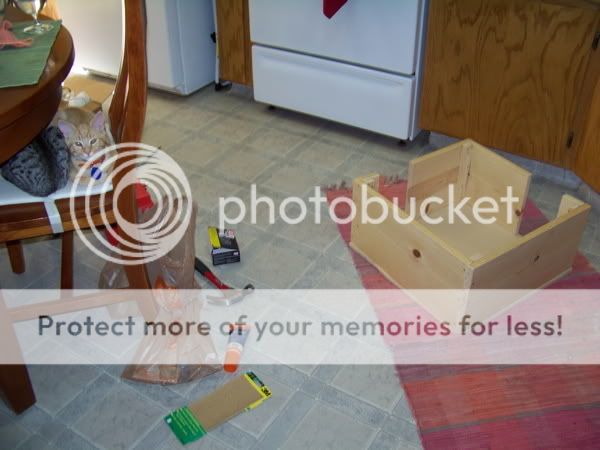
nailing the box together [the box is ridiculously overbuilt, with supports in the four corners and around the hole in the top, where the 8-foot 4x4 post goes]

carpeted interior, two doorways for kitty egress/exit/ambush

carpeting exterior of box

Alexander helping out

Arthur helping out

what would we do without their carpeting supervision?

or without Arthur's quality control?
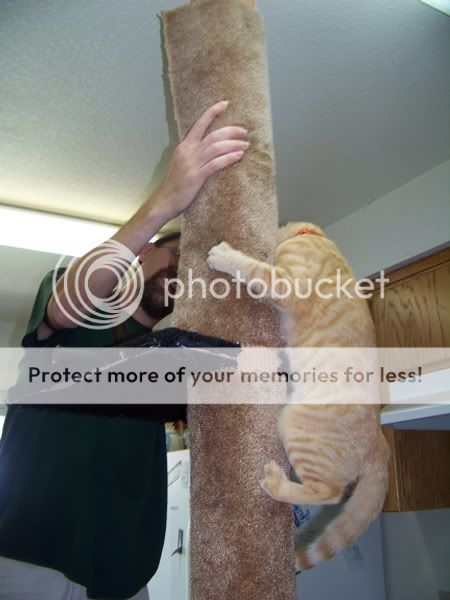
luckily, it passed
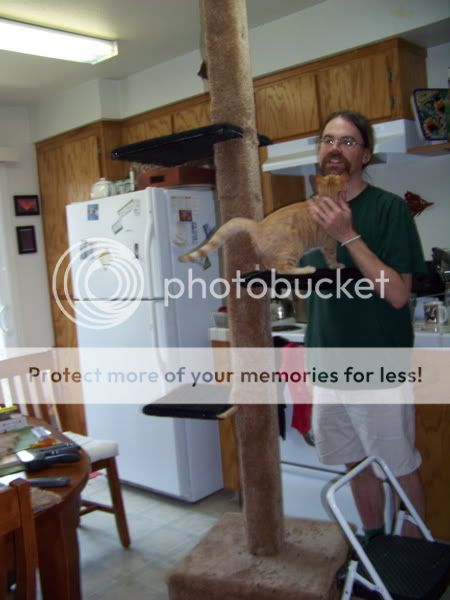
They played on the tower for about an hour last night and a little this morning, before it got hideously hot. Siesta time now.
Sunday, July 06, 2008
fifth of July
Yesterday was the fourth anniversary of Lauren and I cohabiting. We celebrate three anniversaries, in fact, but to me, the fifth of July is most important.
July 5, 2004 wasn't the best day of our lives together. I had spent the previous week moving my effects out of a household that had been broken for longer than I care to think about, and myself out of a relationship that had been broken at least as long. Lauren arrived late that afternoon with a carload of her stuff, moving out of another unhappy relationship. We were both terribly excited, which masked some of the overwhelming stress and uncertainty. It was a tough way to start a life together, but we made it, and created a beautiful, delighting life.
In retrospect, that says a lot about how we love one another and why suddenly it's been four years together. We've had a tremendously happy time together, most of the time. But also a lot of terrible times, a lot of sad and distressful times. This isn't earth-shattering. Everybody goes through difficulty. The beauty and delight abide, always.
What keeps coming to mind for me lately is that no matter how stressed, paranoid, upset, angry, confused, or certain of doom I have been, of all the people in the world, Lauren always gives me hope and joy. The hope and joy she gives make it possible for life to be open, free, meaningful, and make it possible for me to fight the good fights I have to, and to smile. That hope and joy, and grasping hold of that hope and joy, of the possibility for happiness, is what the fifth of July represents to me.
July 5, 2004 wasn't the best day of our lives together. I had spent the previous week moving my effects out of a household that had been broken for longer than I care to think about, and myself out of a relationship that had been broken at least as long. Lauren arrived late that afternoon with a carload of her stuff, moving out of another unhappy relationship. We were both terribly excited, which masked some of the overwhelming stress and uncertainty. It was a tough way to start a life together, but we made it, and created a beautiful, delighting life.
In retrospect, that says a lot about how we love one another and why suddenly it's been four years together. We've had a tremendously happy time together, most of the time. But also a lot of terrible times, a lot of sad and distressful times. This isn't earth-shattering. Everybody goes through difficulty. The beauty and delight abide, always.
What keeps coming to mind for me lately is that no matter how stressed, paranoid, upset, angry, confused, or certain of doom I have been, of all the people in the world, Lauren always gives me hope and joy. The hope and joy she gives make it possible for life to be open, free, meaningful, and make it possible for me to fight the good fights I have to, and to smile. That hope and joy, and grasping hold of that hope and joy, of the possibility for happiness, is what the fifth of July represents to me.
Thursday, July 03, 2008
guess it's summer
One lull later...
Been down to LA and back. We went down to LA for fresh air. The smoke from the wildfires was so thick last week that you really couldn't see down the road. I went for a typical lengthy summer walk one morning, and was sick the rest of the day. The weather in LA was lovely, the skies blue. Now we're back. 'sokay.
NHL free agency period began July 1. Penguins losing key players left and right.
This morning I rooted through my Yahoo bulk message folder, and found two comments sent by my loyal readers had been sent to purgatory. Yahoo email either is or ought to be notorious for misdirecting mail as spam and spam as mail. Anyway, straightened that out.
Results aren't in yet, but I've been fooling around with alternate guitar tunings. I was playing them on an old beater I bought for my office, and was getting a tad sick of the way it sounded. I brought it down to LA with us, played it in all kinds of odd tunings, retuned it to standard, played at Lauren's grandmother's weekly Saturday family gathering, and complained every so often about the sound and the difficulty of the action. I started talking about wanting a better 6-string steel string guitar.
On Sunday, after retuning it for the sixth or twelfth time the D string snapped. I restrung it, which turned out to be an ironic act, because Monday I finally decided that enough was enough, and we took it to a Sam Ash in Torrance and traded it in on a spanking-new Takamine.
I am now the proud owner of said guitar, which hasn't a name yet. I'm getting used to the sound and the feel of a steel 6-string, because although it's the most common kind of guitar, I've had least experience playing them. It's like a new toy. No, I suppose it is a new toy.
Been down to LA and back. We went down to LA for fresh air. The smoke from the wildfires was so thick last week that you really couldn't see down the road. I went for a typical lengthy summer walk one morning, and was sick the rest of the day. The weather in LA was lovely, the skies blue. Now we're back. 'sokay.
NHL free agency period began July 1. Penguins losing key players left and right.
This morning I rooted through my Yahoo bulk message folder, and found two comments sent by my loyal readers had been sent to purgatory. Yahoo email either is or ought to be notorious for misdirecting mail as spam and spam as mail. Anyway, straightened that out.
Results aren't in yet, but I've been fooling around with alternate guitar tunings. I was playing them on an old beater I bought for my office, and was getting a tad sick of the way it sounded. I brought it down to LA with us, played it in all kinds of odd tunings, retuned it to standard, played at Lauren's grandmother's weekly Saturday family gathering, and complained every so often about the sound and the difficulty of the action. I started talking about wanting a better 6-string steel string guitar.
On Sunday, after retuning it for the sixth or twelfth time the D string snapped. I restrung it, which turned out to be an ironic act, because Monday I finally decided that enough was enough, and we took it to a Sam Ash in Torrance and traded it in on a spanking-new Takamine.
I am now the proud owner of said guitar, which hasn't a name yet. I'm getting used to the sound and the feel of a steel 6-string, because although it's the most common kind of guitar, I've had least experience playing them. It's like a new toy. No, I suppose it is a new toy.
Tuesday, June 24, 2008
heroes
Doc Nagel's Top 100 Things
23. Heroes. I just love 'em.
George Carlin's death has me thinking about heroes, strangely, because in the grand scheme of things, Carlin wasn't a hero of mine, though he was close. I respected him a lot, and to me, he was incredibly funny. He was at the center of a landmark free speech/obscenity case, but wasn't really a participant - more the occasion or object.
I don't tend to regard heroes as paragons of virtue, or necessarily morally righteous. This is lucky for me, because I don't think any of mine would pass a virtue/righteousness test. I'm just whipping this out, so I might glaringly omit someone, but let's see if I can list them.
Lenny Bruce. Lenny was not only involved in a landmark free speech/obscenity case, but the only person ever convicted of obscenity in the US for any performance or publication not containing pornographic images (depending on your perspective, I suppose). His final appeal was granted posthumously. In any case, Lenny's act, and to a large degree his everyday behavior (if reports are, in the main, honest), focused on the moral contradictions of American culture and social life, by which he was in turns amused and horrified. And he made it all funny, until he stopped being funny. Lenny Bruce is such a hero to me, I even like his stuff after he stopped being a comic and became Lenny Bruce instead.
John Fahey. For my money, Fahey's guitar playing is the weirdest there could be, not because his playing techniques were particularly odd, but because his musical sensibilities and impulses were fundamentally crackers. I wouldn't say I aspire to play like Fahey. I don't think I'll ever be as good (even though Fahey wasn't really a technical virtuoso), but I'll never be that creative. Fahey also wrote bizarre, if not actually insane, rambling quasi-autobiographical screeds, some of which are published as a book called How Bluegrass Music Destroyed My Life.
Frank Lloyd Wright. Almost everything Wright said about architecture, especially his own, was either an outright lie or self-promotional puffery. I don't care. He was reportedly mercurial in his relationships with other people, often instantly enraged by loved ones, employees, and employers. I don't care. He blithely ignored clients' design requirements or preferences, and imposed his own style, proportion, and uncomfortable furniture on them. I don't care. His places are drafty and they leak. I don't care. I can't go near or into a building designed by Frank Lloyd Wright without feeling whole, solid, ready, aware, lively, and inspired. They don't have to be particularly similar for this to happen, either: Fallingwater packs a huge wallop, but I feel much the same at the Marin County Civic Center.
Julia Child. I cut my teeth on Julia Child's cooking shows on TV when I was a kid. One of my earliest satirical ideas was a spoof of her shows, combined with Monty Hall's old joint, to be called Let's Bake A Seal. Her actual life story is pretty amazing. She was a defense intelligence agent after World War II, fell in love with another defense intelligence agent, who ended up stationed in Paris (I think under cover). So she played housewife awhile, got bored, and went to the Cordon Bleu cooking school. They came back to the states, and eventually she started teaching people to cook on TV. She made mistakes, she dropped stuff, and she wrote and showed you how to fix things when things went wrong. She was a brilliant cook, fearless but not flawless, and her recipes always work (even if they cheat somewhat).
John Meyer. After a year of being thoroughly bored in eighth grade, my junior high school put me in the higher level courses, which I think were called GT classes, for ninth. So it was that I had 9th grade US history with John Meyer, late morning, in a trailer out behind the main classroom building. In that trailer, he taught a lesson one particularly stifling hot, humid late spring morning, by turning the classroom into a sweatshop, dividing the class into production lines, and requiring us to manufacture "Happy Books." This was too much for the upper-middle-class white girls to handle, and the complaints came in from their folks. They hated him. I had a sudden realization that I wanted to teach for a living. I had AP European History with him in high school, which wasn't as revelatory, but was still one of a handful of classes that were taught by people who showed any respect at all for the emerging intellects of the students.
Tom Waits. If I could write lyrics like anybody I chose, it'd be like Tom Waits (and I suppose Kathleen Brennan, since they write most things together). If I could make music any way I liked, I would make music like Waits' - not the particular style, not all the racket, but the sheer fuckitity of his approach. He described what he started to do with music around 1990 or so as taking away all the stuff that's obviously musical, and making music out of what's left over. I admire the bejezus out of that. I wish I could do that. (Sometimes it happens when I teach, I think. It's cool as hell.)
Of course I've had other heroes, mainly hockey players like Mike Palmateer, but that was as a kid. I suppose some people outgrow having heroes at some point. I haven't, and I don't think I will (Fahey just became a hero a couple years ago).
23. Heroes. I just love 'em.
George Carlin's death has me thinking about heroes, strangely, because in the grand scheme of things, Carlin wasn't a hero of mine, though he was close. I respected him a lot, and to me, he was incredibly funny. He was at the center of a landmark free speech/obscenity case, but wasn't really a participant - more the occasion or object.
I don't tend to regard heroes as paragons of virtue, or necessarily morally righteous. This is lucky for me, because I don't think any of mine would pass a virtue/righteousness test. I'm just whipping this out, so I might glaringly omit someone, but let's see if I can list them.
Lenny Bruce. Lenny was not only involved in a landmark free speech/obscenity case, but the only person ever convicted of obscenity in the US for any performance or publication not containing pornographic images (depending on your perspective, I suppose). His final appeal was granted posthumously. In any case, Lenny's act, and to a large degree his everyday behavior (if reports are, in the main, honest), focused on the moral contradictions of American culture and social life, by which he was in turns amused and horrified. And he made it all funny, until he stopped being funny. Lenny Bruce is such a hero to me, I even like his stuff after he stopped being a comic and became Lenny Bruce instead.
John Fahey. For my money, Fahey's guitar playing is the weirdest there could be, not because his playing techniques were particularly odd, but because his musical sensibilities and impulses were fundamentally crackers. I wouldn't say I aspire to play like Fahey. I don't think I'll ever be as good (even though Fahey wasn't really a technical virtuoso), but I'll never be that creative. Fahey also wrote bizarre, if not actually insane, rambling quasi-autobiographical screeds, some of which are published as a book called How Bluegrass Music Destroyed My Life.
Frank Lloyd Wright. Almost everything Wright said about architecture, especially his own, was either an outright lie or self-promotional puffery. I don't care. He was reportedly mercurial in his relationships with other people, often instantly enraged by loved ones, employees, and employers. I don't care. He blithely ignored clients' design requirements or preferences, and imposed his own style, proportion, and uncomfortable furniture on them. I don't care. His places are drafty and they leak. I don't care. I can't go near or into a building designed by Frank Lloyd Wright without feeling whole, solid, ready, aware, lively, and inspired. They don't have to be particularly similar for this to happen, either: Fallingwater packs a huge wallop, but I feel much the same at the Marin County Civic Center.
Julia Child. I cut my teeth on Julia Child's cooking shows on TV when I was a kid. One of my earliest satirical ideas was a spoof of her shows, combined with Monty Hall's old joint, to be called Let's Bake A Seal. Her actual life story is pretty amazing. She was a defense intelligence agent after World War II, fell in love with another defense intelligence agent, who ended up stationed in Paris (I think under cover). So she played housewife awhile, got bored, and went to the Cordon Bleu cooking school. They came back to the states, and eventually she started teaching people to cook on TV. She made mistakes, she dropped stuff, and she wrote and showed you how to fix things when things went wrong. She was a brilliant cook, fearless but not flawless, and her recipes always work (even if they cheat somewhat).
John Meyer. After a year of being thoroughly bored in eighth grade, my junior high school put me in the higher level courses, which I think were called GT classes, for ninth. So it was that I had 9th grade US history with John Meyer, late morning, in a trailer out behind the main classroom building. In that trailer, he taught a lesson one particularly stifling hot, humid late spring morning, by turning the classroom into a sweatshop, dividing the class into production lines, and requiring us to manufacture "Happy Books." This was too much for the upper-middle-class white girls to handle, and the complaints came in from their folks. They hated him. I had a sudden realization that I wanted to teach for a living. I had AP European History with him in high school, which wasn't as revelatory, but was still one of a handful of classes that were taught by people who showed any respect at all for the emerging intellects of the students.
Tom Waits. If I could write lyrics like anybody I chose, it'd be like Tom Waits (and I suppose Kathleen Brennan, since they write most things together). If I could make music any way I liked, I would make music like Waits' - not the particular style, not all the racket, but the sheer fuckitity of his approach. He described what he started to do with music around 1990 or so as taking away all the stuff that's obviously musical, and making music out of what's left over. I admire the bejezus out of that. I wish I could do that. (Sometimes it happens when I teach, I think. It's cool as hell.)
Of course I've had other heroes, mainly hockey players like Mike Palmateer, but that was as a kid. I suppose some people outgrow having heroes at some point. I haven't, and I don't think I will (Fahey just became a hero a couple years ago).
Tuesday, June 17, 2008
but now for some lighter news
People living under rocks may not have heard yet that California's Supreme Court ruled that everyone, regardless of gender or sex, should have the right to marry any other consenting adult. Same-sex marriages became legal as of 5:01 pm yesterday.
As a result, my loveliest and I have come out of the closet. Yep, we're married. We've been married for just over two years. Lauren tells the compleat story in her blog, so go read that. It's okay, I'll wait here...
Dum dee-dum, dumbledy dum... Hmm.
Hoo-hah shamma-shamma tiddle-ee-dah. Whum-pa pah-dee-oo-skiddly-doo-dat spah! Oobly-scoobly-oo-bap-sh-bim-
uh... Shit, I didn't expect you back so soon. It's so embarrassing getting caught in the middle of private scat singing.
I still have grave misgivings about the institution of marriage. I didn't think much about the discriminatory practice of legal marriage versus domestic partnership until about 7 or 8 years ago, when voters in California approved Prop 22, "The Defense of Marriage Act," which was a purely symbolic act defining marriage as between a man and a woman. No county in the state was permitting same-sex marriage, so the proposition didn't change anything. It just gave a bunch of assholes the opportunity to be assholes.
My long-term objections to marriage have been less related to justice. I have never wanted to be married, in part because of my iconoclastic allergy to social institutions generally, but in larger part because of what I regard as the baggage of tradition that comes along with it. Marriage is just too culturally heavy. When you are introduced as a husband, for instance, a whole string of additional characteristics, roles, attitudes, and ways of relating are presumptively attributed to you. Sure, some particular person, who knows us well, would know that we don't play our roles quite straight, but the cultural norm and the general expectation is that "married" fits both persons into neatly, unproblematically defined categorical boxes.
(As long as I'm confessing to being married, I might as well also confess that I generally take out the trash, pay the bills, file the taxes, and I'm the primary bread-winner. On the other hand, I'm also the primary bread-baker, as well as cook, kitchen cleaner, and vaccuumer.)
I resent being put in a box. (This is one of my most cat-like characteristics. If I want to be in the box, I'll go get in the box myself. I don't need the likes of you putting me in the damn box! Now gimme some damn catnip!)
Now that California isn't discriminating against people when it comes to marriage, there's less of a pressing reason to hide the fact that we are married, and moreover, there's an opportunity to make the point, again, that this discrimination is immoral. Plus, same-sex marriage isn't entirely safe yet. A group of maniacs is trying to put a constitutional amendment on the November ballot to ban same-sex marriage.
As a result, my loveliest and I have come out of the closet. Yep, we're married. We've been married for just over two years. Lauren tells the compleat story in her blog, so go read that. It's okay, I'll wait here...
Dum dee-dum, dumbledy dum... Hmm.
Hoo-hah shamma-shamma tiddle-ee-dah. Whum-pa pah-dee-oo-skiddly-doo-dat spah! Oobly-scoobly-oo-bap-sh-bim-
uh... Shit, I didn't expect you back so soon. It's so embarrassing getting caught in the middle of private scat singing.
I still have grave misgivings about the institution of marriage. I didn't think much about the discriminatory practice of legal marriage versus domestic partnership until about 7 or 8 years ago, when voters in California approved Prop 22, "The Defense of Marriage Act," which was a purely symbolic act defining marriage as between a man and a woman. No county in the state was permitting same-sex marriage, so the proposition didn't change anything. It just gave a bunch of assholes the opportunity to be assholes.
My long-term objections to marriage have been less related to justice. I have never wanted to be married, in part because of my iconoclastic allergy to social institutions generally, but in larger part because of what I regard as the baggage of tradition that comes along with it. Marriage is just too culturally heavy. When you are introduced as a husband, for instance, a whole string of additional characteristics, roles, attitudes, and ways of relating are presumptively attributed to you. Sure, some particular person, who knows us well, would know that we don't play our roles quite straight, but the cultural norm and the general expectation is that "married" fits both persons into neatly, unproblematically defined categorical boxes.
(As long as I'm confessing to being married, I might as well also confess that I generally take out the trash, pay the bills, file the taxes, and I'm the primary bread-winner. On the other hand, I'm also the primary bread-baker, as well as cook, kitchen cleaner, and vaccuumer.)
I resent being put in a box. (This is one of my most cat-like characteristics. If I want to be in the box, I'll go get in the box myself. I don't need the likes of you putting me in the damn box! Now gimme some damn catnip!)
Now that California isn't discriminating against people when it comes to marriage, there's less of a pressing reason to hide the fact that we are married, and moreover, there's an opportunity to make the point, again, that this discrimination is immoral. Plus, same-sex marriage isn't entirely safe yet. A group of maniacs is trying to put a constitutional amendment on the November ballot to ban same-sex marriage.
Sunday, June 15, 2008
horrible news item
Well, this is just unspeakably awful. I don't have anything to say about it, it's not about me in any way, except that I live in Turlock, and I'm not prone to fits of anonymous pathos in any case. But it's striking, and it's leaving a kind of rottenness in my head, and so, I decided to share this story of totally revolting inhumanity from the Modesto Bee.
Before you click on the link: this ain't a joke. It's just horrible.
Before you click on the link: this ain't a joke. It's just horrible.
Saturday, June 14, 2008
weather report
We have two side bets going on this summer's weather. We've each picked the number of days we predict the temperature to reach or exceed 100 degrees, and we've each picked the number of deaths that will be blamed on heat. I realize the latter is ghoulish, but it's a way of coping.
Historically, the Central Valley could count on around 14-18 days of 100+ degrees every summer. Last year there were 28. The year before there were around 25. This year it's looking like it's going to be the hottest summer ever recorded here. Yesterday was the fifth day of 100 degree weather already, and this isn't the hot part of the year.
Meanwhile, the Gov issued a drought emergency last month, after the driest spring ever, and has now issued a state water emergency. What this does is allow for quick transfers of water from municipal systems that supply residential drinking water into the aqueducts and canals that serve agriculture. So the "water emergency" plan is a plan to find ways to use more water, not conserve it.
If you think there's an ironic twist to this story that I'm about to reveal, then DING DING DING! You win!
The Central Valley is the agricultural heart of the state, and in some ways of the nation and the world. To achieve this, in what is basically an arid seasonal grassland, the rivers that feed the San Joaquin are all dammed to form a tremendous series of reservoirs. Those reservoirs feed canals, generally open trenches, that stretch down the hills into the valley, which ranchers and farmers tap to flood irrigate. Flood irrigation is an ancient, inefficient method of watering crops by, as the name suggests, flooding the ground with water and letting it seep in (in this climate, this means a whole lot of evaporation loss, but that's another story).
The irrigated water seeps through the ground, waters the parched roots of almond trees and tomatoes and whatnot, and eventually reaches the groundwater table. This used to be just a couple dozen feet down, but after droughts in the late 80s and early 90s, it fell to just above its record low, where it has remained, through wet and dry years, ever since (it recovered somewhat during the huge El Niño year, but has sank rapidly since). Up and down the Valley, municipal water departments dig wells to tap the groundwater to feed to residents as drinking water. So you see the pattern: dam the rivers, irrigate the fields, the water sinks into the groundwater, it's pumped up, and we drink it (the health implications of our drinking this water are another story).
In other words, the water emergency declaration allows rapid transfer of water from the municipal systems, pumping groundwater up from wells dug to reach the water table which is replenished by irrigation of crops from reservoirs, and we're doing this because there's not enough water in the reservoirs. Not only will we be depleting the groundwater by tapping it to supply agricultural irrigation that we rely on to supply the groundwater, but we'll be recirculating the groundwater through all the petrochemicals that the ag biz dumps onto crops out here!
This will all work out fine, of course, as long as we have 5 or 6 winters in a row of well-above-normal snowfall in the Sierras - a pattern of weather that we can count on every 50 or 60 years or so.
Historically, the Central Valley could count on around 14-18 days of 100+ degrees every summer. Last year there were 28. The year before there were around 25. This year it's looking like it's going to be the hottest summer ever recorded here. Yesterday was the fifth day of 100 degree weather already, and this isn't the hot part of the year.
Meanwhile, the Gov issued a drought emergency last month, after the driest spring ever, and has now issued a state water emergency. What this does is allow for quick transfers of water from municipal systems that supply residential drinking water into the aqueducts and canals that serve agriculture. So the "water emergency" plan is a plan to find ways to use more water, not conserve it.
If you think there's an ironic twist to this story that I'm about to reveal, then DING DING DING! You win!
The Central Valley is the agricultural heart of the state, and in some ways of the nation and the world. To achieve this, in what is basically an arid seasonal grassland, the rivers that feed the San Joaquin are all dammed to form a tremendous series of reservoirs. Those reservoirs feed canals, generally open trenches, that stretch down the hills into the valley, which ranchers and farmers tap to flood irrigate. Flood irrigation is an ancient, inefficient method of watering crops by, as the name suggests, flooding the ground with water and letting it seep in (in this climate, this means a whole lot of evaporation loss, but that's another story).
The irrigated water seeps through the ground, waters the parched roots of almond trees and tomatoes and whatnot, and eventually reaches the groundwater table. This used to be just a couple dozen feet down, but after droughts in the late 80s and early 90s, it fell to just above its record low, where it has remained, through wet and dry years, ever since (it recovered somewhat during the huge El Niño year, but has sank rapidly since). Up and down the Valley, municipal water departments dig wells to tap the groundwater to feed to residents as drinking water. So you see the pattern: dam the rivers, irrigate the fields, the water sinks into the groundwater, it's pumped up, and we drink it (the health implications of our drinking this water are another story).
In other words, the water emergency declaration allows rapid transfer of water from the municipal systems, pumping groundwater up from wells dug to reach the water table which is replenished by irrigation of crops from reservoirs, and we're doing this because there's not enough water in the reservoirs. Not only will we be depleting the groundwater by tapping it to supply agricultural irrigation that we rely on to supply the groundwater, but we'll be recirculating the groundwater through all the petrochemicals that the ag biz dumps onto crops out here!
This will all work out fine, of course, as long as we have 5 or 6 winters in a row of well-above-normal snowfall in the Sierras - a pattern of weather that we can count on every 50 or 60 years or so.
Monday, June 09, 2008
california [kăl'ĭ-fôr'nyə], n.
California is a series of paint spills and beautiful, opportunistic cruelties along the West Coast of North America.
Sunday, June 08, 2008
what's that thing?
Doc Nagel's Top 100 Things
24. Clean kitchens. I just love 'em.
We're down in LA to visit, just around my loveliest's ma Allison's birthday. I roasted a leg of lamb with some potatoes for a belated birthday dinner tonight, and just spent a few minutes scouring the roasting pan. Cleaning a kitchen is satisfying work, for me, because I spend a lot of time making kitchens need to be cleaned. But mainly, I love a clean kitchen.
The roasting pan in question I had propped up in the sink to soak several hours ago. While generally tidying up after our 6th pinochle game of the weekend, I decided to clean the last of the dinner stuff, including the roasting pan. I needn't have. But sitting there on the edge of the sink, it gave me a look that said "Tomorrow morning, I'll be sitting in this sink, and someone waking up - maybe you - will see me sitting here, and I will look so forlorn, so filthy, so recalcitrantly in the way of the faucet, that you'll regret ever having roasted that so-called leg of lamb in me." So I Brilloed the heck outta that roasting pan, leaving the sink, if not clean, at least emptied of dirty dishes and pans.
I especially love a clean kitchen as a thing to walk into in the morning, in search of some form of caffeinated beverage and some form of bread product to call breakfast. Things in place, things clean, things ready to go - this is a special kind of bliss.
24. Clean kitchens. I just love 'em.
We're down in LA to visit, just around my loveliest's ma Allison's birthday. I roasted a leg of lamb with some potatoes for a belated birthday dinner tonight, and just spent a few minutes scouring the roasting pan. Cleaning a kitchen is satisfying work, for me, because I spend a lot of time making kitchens need to be cleaned. But mainly, I love a clean kitchen.
The roasting pan in question I had propped up in the sink to soak several hours ago. While generally tidying up after our 6th pinochle game of the weekend, I decided to clean the last of the dinner stuff, including the roasting pan. I needn't have. But sitting there on the edge of the sink, it gave me a look that said "Tomorrow morning, I'll be sitting in this sink, and someone waking up - maybe you - will see me sitting here, and I will look so forlorn, so filthy, so recalcitrantly in the way of the faucet, that you'll regret ever having roasted that so-called leg of lamb in me." So I Brilloed the heck outta that roasting pan, leaving the sink, if not clean, at least emptied of dirty dishes and pans.
I especially love a clean kitchen as a thing to walk into in the morning, in search of some form of caffeinated beverage and some form of bread product to call breakfast. Things in place, things clean, things ready to go - this is a special kind of bliss.
Thursday, June 05, 2008
another silly meme
At some point, this blog will return to usual programming. The Pittsburgh Penguins lost the Stanley Cup Finals to the Detroit Red Wings, 4 games to 2, last night. Sad ending to an incredibly inspiring season for arguably the team with the greatest young talent in the NHL. They'll be back, in some different configuration. We're just hoping our favorites stay with the team. Some will.
Anyway, this meme has been stolen from No Celery, Please. It doesn't seem to have a title, so I'll call it
Yet Another List of Random Factoids About a Human Being,
In this Case, Me
Accent: Midwest/Northern, altered slightly by natural mimicry and living in North Carolina (8 years), Pittsburgh (8 years) and California (*GULP* nearly 10 years).
Bra size: I don't know. I'll wear a skirt, among friends, but I've never gone full drag.
Chore I hate: Dusting, especially books and bookcases (allergies).
Dad’s name: Carl Richard
Essential make-up: Everything I say is essentially made up.
Favorite perfume: Home-brewed bay rum after shave!
Gold or Silver: Silver.
Hometown: Born in Toledo, raised until 13 in Maumee, Ohio.
Interesting fact: I was, at the time, reportedly the youngest person to earn a Doctorate in Philosophy at Duquesne University.
Job title: Lecturer, Philosophy Department, Cow State Santa Claus
Kids: Pets: Two four-month-old kittens from the same litter. Alexander (Alex, Brutus) and Arthur (Bruno, Honey Bear), a.k.a., The Smothers Brothers, a.k.a., The Katzenjammer Kids, a.k.a. The Flying Kittois Brothers, a.k.a., Boodahs, Monsters, etc., etc.
Living arrangements: Rented town house, 4 litter boxes (trying to work that down to 2)
Mom’s Birthplace: Cincinnati, Ohio.
Number of apples eaten in last week: None. It ain't friggin' apple season!
Overnight hospital stays: None. Hah! Been in the ER a coupla times, once as a kid with a 105 fever.
Phobia: Lightning. Tremendously socially anxious from time to time.
Question you ask yourself a lot: What am I forgetting?
Religious affiliation: Joke answer: Recovering Catholic. Earnest answer: [empty set]
Siblings: One older brother, one older sister.
Time I wake up: Teaching days: 6:30 am. Non-teaching days: depends on the Katzenjammer Kids.
Natural Hair color: Brown.
Vegetable I refuse to eat: I detest Brussels sprouts and lima beans, beets.
Worst habit: Self-loathing
X-rays: Sure, what've you got?
Yummy food I make: How much time have you got? I make a ton of different dishes. Last night: pasta with tomatoes, cannelini beans, olives, fresh basil, feta.
Zodiac sign: Leo, of course.
Anyway, this meme has been stolen from No Celery, Please. It doesn't seem to have a title, so I'll call it
In this Case, Me
Accent: Midwest/Northern, altered slightly by natural mimicry and living in North Carolina (8 years), Pittsburgh (8 years) and California (*GULP* nearly 10 years).
Bra size: I don't know. I'll wear a skirt, among friends, but I've never gone full drag.
Chore I hate: Dusting, especially books and bookcases (allergies).
Dad’s name: Carl Richard
Essential make-up: Everything I say is essentially made up.
Favorite perfume: Home-brewed bay rum after shave!
Gold or Silver: Silver.
Hometown: Born in Toledo, raised until 13 in Maumee, Ohio.
Interesting fact: I was, at the time, reportedly the youngest person to earn a Doctorate in Philosophy at Duquesne University.
Job title: Lecturer, Philosophy Department, Cow State Santa Claus
Living arrangements: Rented town house, 4 litter boxes (trying to work that down to 2)
Mom’s Birthplace: Cincinnati, Ohio.
Number of apples eaten in last week: None. It ain't friggin' apple season!
Overnight hospital stays: None. Hah! Been in the ER a coupla times, once as a kid with a 105 fever.
Phobia: Lightning. Tremendously socially anxious from time to time.
Question you ask yourself a lot: What am I forgetting?
Religious affiliation: Joke answer: Recovering Catholic. Earnest answer: [empty set]
Siblings: One older brother, one older sister.
Time I wake up: Teaching days: 6:30 am. Non-teaching days: depends on the Katzenjammer Kids.
Natural Hair color: Brown.
Vegetable I refuse to eat: I detest Brussels sprouts and lima beans, beets.
Worst habit: Self-loathing
X-rays: Sure, what've you got?
Yummy food I make: How much time have you got? I make a ton of different dishes. Last night: pasta with tomatoes, cannelini beans, olives, fresh basil, feta.
Zodiac sign: Leo, of course.
Friday, May 30, 2008
true and false things about me meme
me, meme-me-me-meme!
The rules of this game are very simple: list 10 odd true facts about yourself, along with 5 odd lies about yourself. Mix 'em up. Serve. Then let readers identify which are the true and which are the false. My loveliest done done it, so now I'm gonna done do it.
1. I became a philosopher in order to impress a woman.
2. I had a paper route in two different states.
3. I've never had a single guitar lesson.
4. I've never had a single cooking lesson.
5. I went to college by accident.
6. I don't really have any phobias.
7. I don't really have any fetishes.
8. My feet are size 13 A, with absolutely no arch.
9. An opthamologist once said that pictures of my astigmatism should be used in textbooks--as an example of just how bad it can get.
10. I never eat breakfast.
11. I dressed grunge six years before anybody knew there was grunge.
12. I loathe eggs but love a lot of foods/sauces made with them.
13. Chewing gum gives me a headache (nevertheless, I sometimes chew gum).
14. I go through periods where I really dislike chocolate--and others where I really love it.
15. I never lie about myself.
1. I became a philosopher in order to impress a woman.
2. I had a paper route in two different states.
3. I've never had a single guitar lesson.
4. I've never had a single cooking lesson.
5. I went to college by accident.
6. I don't really have any phobias.
7. I don't really have any fetishes.
8. My feet are size 13 A, with absolutely no arch.
9. An opthamologist once said that pictures of my astigmatism should be used in textbooks--as an example of just how bad it can get.
10. I never eat breakfast.
11. I dressed grunge six years before anybody knew there was grunge.
12. I loathe eggs but love a lot of foods/sauces made with them.
13. Chewing gum gives me a headache (nevertheless, I sometimes chew gum).
14. I go through periods where I really dislike chocolate--and others where I really love it.
15. I never lie about myself.
Tuesday, May 27, 2008
where the hell have I been?
Our buddies Christina (alt. X-ina) and Guerin got hitched this weekend at Ironstone Vineyards up in Murphys, CA. After 100 degree days the week before, it was overcast and drizzly this weekend, so the weather was perfect for an outdoor wedding.
It had the usual snafus weddings have. It started about a half-hour late, which meant that the song we wrote for X-ina, "Christina Sorting Records," played 3 times. It was scheduled as the music for the pre-processional seating of VIPs. The DJ played it promptly at 4, but nobody was ready, so he played it again, and then again once everyone had finally taken their places.
Ironstone has a pretty joint, and they make a couple exemplary wines, from grapes that don't grow on the premises. Ah, the California wine industry. Nothing could serve as a better example of our state, which is actually a series of misconstrued legends, lies, deceptions, and cruel acts of hucksterism.
It was a gorgeous wedding. There was wine a-plenty. Underage drinking. Drunken passes at newly-met acquaintances. Dancing a-go-go. No cake for the bride and groom. Photographers and videographers scattered like bits of confetti all over the place. "Just married" paraphernalia attached to their car. The bridal suite decked out in naughtiness. Lost items. Items left behind and picked up by random relatives and friends. And when we got home, my loveliest decorated their front door with toilet-paper streamers and, I kid you not, toilet-paper bells with clappers and a toilet-paper flower.
Now I'm grading. I've read a handful of Contemporary Moral Issues finals today, their due date, and this is strange, because it's only a handful, and it is now nearly 6 pm and I'm missing around 2/3 of their finals. They also had a question-and-answer journal on the assigned articles, which was due last Wednesday, and I'm missing 2/3 of those as well. Students, notoriously, don't follow instructions. I've thought of simply no longer giving instructions, and taking the Zen approach of accepting as their work whatever they decide to turn in, and applying evaluation criteria to it accordingly.
It had the usual snafus weddings have. It started about a half-hour late, which meant that the song we wrote for X-ina, "Christina Sorting Records," played 3 times. It was scheduled as the music for the pre-processional seating of VIPs. The DJ played it promptly at 4, but nobody was ready, so he played it again, and then again once everyone had finally taken their places.
Ironstone has a pretty joint, and they make a couple exemplary wines, from grapes that don't grow on the premises. Ah, the California wine industry. Nothing could serve as a better example of our state, which is actually a series of misconstrued legends, lies, deceptions, and cruel acts of hucksterism.
It was a gorgeous wedding. There was wine a-plenty. Underage drinking. Drunken passes at newly-met acquaintances. Dancing a-go-go. No cake for the bride and groom. Photographers and videographers scattered like bits of confetti all over the place. "Just married" paraphernalia attached to their car. The bridal suite decked out in naughtiness. Lost items. Items left behind and picked up by random relatives and friends. And when we got home, my loveliest decorated their front door with toilet-paper streamers and, I kid you not, toilet-paper bells with clappers and a toilet-paper flower.
Now I'm grading. I've read a handful of Contemporary Moral Issues finals today, their due date, and this is strange, because it's only a handful, and it is now nearly 6 pm and I'm missing around 2/3 of their finals. They also had a question-and-answer journal on the assigned articles, which was due last Wednesday, and I'm missing 2/3 of those as well. Students, notoriously, don't follow instructions. I've thought of simply no longer giving instructions, and taking the Zen approach of accepting as their work whatever they decide to turn in, and applying evaluation criteria to it accordingly.
Wednesday, May 21, 2008
landmark 361st post
Last night, the kittoises slept almost through the night. When I woke to the alarm (a cd player alarm; the Monkees, I swear to it), they were curled up on us, sweetly sleeping. As usual, Alexander immediately woke when he saw me moving, and as usual, Arthur was the first one downstairs in the kitchen to beg for breakfast. But they didn't wake me up, at 5, or 4:30, by jumping up and down on top of us wrestling and biting each other (and us). This morning is also the first morning in the past week when it was actually chilly (we've had record temperatures until yesterday).
From this I conclude: the kittens are heat-activated.
But that's not what I meant to write about. No, that would be
Doc Nagel's Top 100 Things
25. Notes sung in the "dog register." I just love 'em.
Last night we went to the Cow State Santa Claus Chamber Singers (a.k.a. Daniel Afonso's Elite Republican Guard) concert. These are the top-shelf choral singers on campus, and they never fail to impress. Last night they were a little bit impressiver than usual, particularly the altos. Altos tend to sound weaker in choral groups, in my experience, but this group are quite strong. My loveliest (a one-time soprano-trapped-in-an-alto's-section) suggested that it's hard to find traditional college-age students who are strong altos, because altos develop later as voices deepen.
In any case, a couple of the numbers featured extremely high notes from first sopranos, which is just about my favorite thing that ever happens in choral music. The more the sopranos have to reach, the more I like it. They weren't hitting Ds or anything, but there were definitely a few As, and I believe a B or two.
I don't know what it is, exactly. I feel those dog notes in my bones. Perhaps I'm a dog. Perhaps, as Afonso once suggested to me, I have a sadistic urge focused on sopranos. Well, so did Mozart, so neener-neener, sopranos!
24. Musical dissonances. I just love 'em.
There wasn't as much of this as there sometimes is, but there was a smattering in Eric Whitacre's "Leonardo Dreams of His Flying Machine," an uplifting (hah!) modern piece in which the choir evokes dreaming, flying, wind, and machines, and the siren call of the will to fly.
Dissonance may not be a word Whitacre, or anybody who knows anything about music, would accept as a description, but by it I mean a tonal tension that sounds like something weird has happened to the piano. I love those moments because I love the feeling of being on the verge, or about to be shoved off the cliff, or about to let go of the rope. I only love that feeling in music, art, literature, philosophy, and theater, and I don't just love it, I have to have it, or I don't feel like anything very important has happened.
Like the Bach piece they did last night. Bach, it struck me, is just like Leibniz. Music is a universal language, Bach's concertos and whatnot are generated by a Leibnizian calculating machine, and each piece in Bach's Werke is the perfect solution generated by the machine. Bach is just the mechanic. Contrast Mozart, who is just like Kant: everything perfectly rational, but also sublime and beautiful, and he swears up and down that's the same thing, and he can prove it, if you'd only sit down and listen, honestly, he's got the whole thing worked out, it's, you know... this!
Okay, seem to have wandered a bit. Last day of classes. Wooo!
From this I conclude: the kittens are heat-activated.
But that's not what I meant to write about. No, that would be
Doc Nagel's Top 100 Things
25. Notes sung in the "dog register." I just love 'em.
Last night we went to the Cow State Santa Claus Chamber Singers (a.k.a. Daniel Afonso's Elite Republican Guard) concert. These are the top-shelf choral singers on campus, and they never fail to impress. Last night they were a little bit impressiver than usual, particularly the altos. Altos tend to sound weaker in choral groups, in my experience, but this group are quite strong. My loveliest (a one-time soprano-trapped-in-an-alto's-section) suggested that it's hard to find traditional college-age students who are strong altos, because altos develop later as voices deepen.
In any case, a couple of the numbers featured extremely high notes from first sopranos, which is just about my favorite thing that ever happens in choral music. The more the sopranos have to reach, the more I like it. They weren't hitting Ds or anything, but there were definitely a few As, and I believe a B or two.
I don't know what it is, exactly. I feel those dog notes in my bones. Perhaps I'm a dog. Perhaps, as Afonso once suggested to me, I have a sadistic urge focused on sopranos. Well, so did Mozart, so neener-neener, sopranos!
24. Musical dissonances. I just love 'em.
There wasn't as much of this as there sometimes is, but there was a smattering in Eric Whitacre's "Leonardo Dreams of His Flying Machine," an uplifting (hah!) modern piece in which the choir evokes dreaming, flying, wind, and machines, and the siren call of the will to fly.
Dissonance may not be a word Whitacre, or anybody who knows anything about music, would accept as a description, but by it I mean a tonal tension that sounds like something weird has happened to the piano. I love those moments because I love the feeling of being on the verge, or about to be shoved off the cliff, or about to let go of the rope. I only love that feeling in music, art, literature, philosophy, and theater, and I don't just love it, I have to have it, or I don't feel like anything very important has happened.
Like the Bach piece they did last night. Bach, it struck me, is just like Leibniz. Music is a universal language, Bach's concertos and whatnot are generated by a Leibnizian calculating machine, and each piece in Bach's Werke is the perfect solution generated by the machine. Bach is just the mechanic. Contrast Mozart, who is just like Kant: everything perfectly rational, but also sublime and beautiful, and he swears up and down that's the same thing, and he can prove it, if you'd only sit down and listen, honestly, he's got the whole thing worked out, it's, you know... this!
Okay, seem to have wandered a bit. Last day of classes. Wooo!
Monday, May 19, 2008
still further evidence
Oh, good grief! Do you have any idea how much strain seeing cuteness like this simply does not cause? Can you imagine the degree of pain and suffering we do not face as a result?
Then again, Arthur has developed a fascination and talent for attacking and biting hands, because he has not distinguished (a) human from kitten flesh, nor (b) calming petting behavior from exciting combative behavior.
Then again, Arthur has developed a fascination and talent for attacking and biting hands, because he has not distinguished (a) human from kitten flesh, nor (b) calming petting behavior from exciting combative behavior.
Saturday, May 17, 2008
a good read
This afternoon I read a handful of the last response papers I'm getting from my two classes of Contemporary Moral Issues for the semester. The purpose of the papers is to have my students focus on the main idea the author develops, and to say what they think about that idea. Very frequently, the papers offer unsolicited commentary on the article's style.
My students apply a set of aesthetic criteria to the articles that are a little vague to me. According to these criteria, an article must be "a good read," which has characteristics like being simple, using a limited and familiar vocabulary and simple sentence structure, avoiding ambiguity, and being interesting or amusing. There's nothing necessarily wrong with these standards, even though some of them are totally subjective. Obviously an article has to be intelligible to its audience, and it certainly should make some kind of interesting point. Often, though, my students desire that everything they read be written in a style and at a level that will be immediately transparent to them, and that they will not have to strain to understand. It's "a good read" when it fits all these criteria.
I'm not saying my students don't care, or aren't smart. They try to work through essays that aren't "good reads," even if only because they're required to. They do learn vocabulary. But their judgments of what makes an essay valuable or worthwhile doesn't have as much to do with whether the argument is cogent or whether it presents a perspective or concept that's valuable, as that it be subjectively pleasing in all these ways.
My students apply a set of aesthetic criteria to the articles that are a little vague to me. According to these criteria, an article must be "a good read," which has characteristics like being simple, using a limited and familiar vocabulary and simple sentence structure, avoiding ambiguity, and being interesting or amusing. There's nothing necessarily wrong with these standards, even though some of them are totally subjective. Obviously an article has to be intelligible to its audience, and it certainly should make some kind of interesting point. Often, though, my students desire that everything they read be written in a style and at a level that will be immediately transparent to them, and that they will not have to strain to understand. It's "a good read" when it fits all these criteria.
I'm not saying my students don't care, or aren't smart. They try to work through essays that aren't "good reads," even if only because they're required to. They do learn vocabulary. But their judgments of what makes an essay valuable or worthwhile doesn't have as much to do with whether the argument is cogent or whether it presents a perspective or concept that's valuable, as that it be subjectively pleasing in all these ways.
Friday, May 16, 2008
Dyson
People who read this blog (I could name approximately 3) know of my predilection for freshly-vacuumed carpets. With a fluffy cat and two long-haired hippies living in the house at the time, vacuuming was more than a hobby.
A couple months ago a pair of Kirby door-to-door hacks came by, gave us a demo of the honestly astounding cleaning power of the Kirby, and tried to sell us a Kirby do-it-all machine for the bargain price of$1500 $1200 $1000 cash. They were competing, they said, to try to win Kirby vacuums for themselves, to advance in their salesforces, and to compete for a vacation prize. This, it turns out, is a scam: the vacuums they sell door to door, the demo models, are generally rebuilts, and their stated sticker price, which ranges from $2000 to $2500 (our dudes said $2500), are huge premiums over Kirby's suggested retail of around $1200.
Anyway, the machine impressed, though we made a quick Google search of the vacs while the demo guy was shampooing our living room carpet, found out the scam, and didn't bite. We did, however, come to a chilling realization of the gross inadequacies of our Dirt Devil Jaguar. More research suggested that Dyson's machines are at least in the running with Kirbys for performance standards. My loveliest's family swears by them. So we've been talking about getting one.
Doc Nagel's Heap of Things
26. Dyson vacuums. I just love 'em.
Last weekend we saw the Dyson Slimline on big big sale at the local Kohl's, while there looking for something completely different (I wandered a bit). They were out. We got a rain check. I was disappointed, but whattayagonnado?
Today, I decided to bring out the ol' Jag to clean up while Alexander and Arthur were at the vet's being neutered (successfully; Arthur is, of this writing, woozy as all heck and complaining, and Alexander is, typically, resigned to the whole thing). I wasn't getting any suction, which is the whole point, if you will, of vacuum cleaners. So, as usual, I assumed that a clog of cat fluff and human hair, along with Arthur's kittie-litter-redecorating detritus, had developed in the beast. I cleaned all pipes, tried again, and still nothing.
What I wish I had said: It's dead, Jim.
What I actually said: Well, it looks like you and Lancelot finally got your revenge against the vacuum. Good boy, Lance. A posthumous kill.
So, we plied the Internets looking for someone who would sell us a Dyson on the quick, and found out, to my surprise, that Target sells them, for competitive prices. Gots it. And boy, howdy. This thing sucks.
I vacuumed the upstairs, and the stairs themselves, and overfilled the dust tank. The stairs look like they're coming out of a terrible dirt hangover, all kinda disheveled but managing to stand up on their own and smile wanly at the sun.
Perhaps I take vacuuming a little too... existentially.
A couple months ago a pair of Kirby door-to-door hacks came by, gave us a demo of the honestly astounding cleaning power of the Kirby, and tried to sell us a Kirby do-it-all machine for the bargain price of
Anyway, the machine impressed, though we made a quick Google search of the vacs while the demo guy was shampooing our living room carpet, found out the scam, and didn't bite. We did, however, come to a chilling realization of the gross inadequacies of our Dirt Devil Jaguar. More research suggested that Dyson's machines are at least in the running with Kirbys for performance standards. My loveliest's family swears by them. So we've been talking about getting one.
Doc Nagel's Heap of Things
26. Dyson vacuums. I just love 'em.
Last weekend we saw the Dyson Slimline on big big sale at the local Kohl's, while there looking for something completely different (I wandered a bit). They were out. We got a rain check. I was disappointed, but whattayagonnado?
Today, I decided to bring out the ol' Jag to clean up while Alexander and Arthur were at the vet's being neutered (successfully; Arthur is, of this writing, woozy as all heck and complaining, and Alexander is, typically, resigned to the whole thing). I wasn't getting any suction, which is the whole point, if you will, of vacuum cleaners. So, as usual, I assumed that a clog of cat fluff and human hair, along with Arthur's kittie-litter-redecorating detritus, had developed in the beast. I cleaned all pipes, tried again, and still nothing.
What I wish I had said: It's dead, Jim.
What I actually said: Well, it looks like you and Lancelot finally got your revenge against the vacuum. Good boy, Lance. A posthumous kill.
So, we plied the Internets looking for someone who would sell us a Dyson on the quick, and found out, to my surprise, that Target sells them, for competitive prices. Gots it. And boy, howdy. This thing sucks.
I vacuumed the upstairs, and the stairs themselves, and overfilled the dust tank. The stairs look like they're coming out of a terrible dirt hangover, all kinda disheveled but managing to stand up on their own and smile wanly at the sun.
Perhaps I take vacuuming a little too... existentially.
Wednesday, May 14, 2008
elections
Doc Nagel's Top 100 Things
28. Elections. I just love 'em.
We just got the info packet from the State for the Primary Election on June 3rd. I don't understand this. The State held presidential primaries in February, but apparently we have to have another one. In any case, there's some interesting issues on the ballot.
There's a recall campaign against our State Senator, Jeff Denham. I don't know much about him, except that he stood steadfast against the state budget last year, along party lines, and that he voted to cut school budgets. He also apparently made a public show of not accepting a salary increase, claiming that he was protesting the state's budgetary priorities (i.e., spending money on education), but then, later, took the raise.
There are two initiatives, 98 and 99. 98 would make it more difficult for cities to make eminent domain seizures for private development, which I like, but also would phase out rent control and regulations about returning security deposits to renters, which is a horrible idea. I've had enough trouble with getting security deposits back, and rent control is vital in places like San Francisco, where it's already too damned expensive to live. 99 would undo 98, approximately.
This happens a lot in California: two ballot propositions that are directly contradictory (or nearabouts) to one another. Often, they both fail, which is why people work to put the second, contradictory initiative on the ballot. It confuses voters, and they end up voting no. (Also, many of the ballot initiatives approved by California voters have been overturned by the state supreme court for being unconstitutional. I don't think anyone's tried that with Proposition 22 - The Defense of Marriage Act.)
There's a primary for the 19th District US House seat, currently occupied by George Radanovich, who thinkswe should pave Yosemite and turn it into a giant skate park environmental regulations should be based on traditional land use practices, which in the case of Yosemite would mean privatizing the park and running trains into the middle of the valley to reach vacation hotels. Obviously, he's a Republican, of the libertarian-except-for-social-policy variety. No one else has filed.
27. Wacky botanical facts. I just love 'em.
Turns out, according to Gardening How-To (my loveliest has a scrip), bananas are herbs. They're related to lilies, considered to be the largest herb plant. (No doubt we'll hear later of the discovery of some giant oregano covering 2/3 of Greece, since that's just how oregano grows, and this whole banana thing will have to be re-thought.)
I adore the fact that most "vegetables" are fruits or legumes. Tomatoes, peppers, cucumbers, all squashes, beans, peas - all fruits and legumes! Hah!
And onions, garlic, and shallots are lilies.
And spider plants? No spiders involved at all.
28. Elections. I just love 'em.
We just got the info packet from the State for the Primary Election on June 3rd. I don't understand this. The State held presidential primaries in February, but apparently we have to have another one. In any case, there's some interesting issues on the ballot.
There's a recall campaign against our State Senator, Jeff Denham. I don't know much about him, except that he stood steadfast against the state budget last year, along party lines, and that he voted to cut school budgets. He also apparently made a public show of not accepting a salary increase, claiming that he was protesting the state's budgetary priorities (i.e., spending money on education), but then, later, took the raise.
There are two initiatives, 98 and 99. 98 would make it more difficult for cities to make eminent domain seizures for private development, which I like, but also would phase out rent control and regulations about returning security deposits to renters, which is a horrible idea. I've had enough trouble with getting security deposits back, and rent control is vital in places like San Francisco, where it's already too damned expensive to live. 99 would undo 98, approximately.
This happens a lot in California: two ballot propositions that are directly contradictory (or nearabouts) to one another. Often, they both fail, which is why people work to put the second, contradictory initiative on the ballot. It confuses voters, and they end up voting no. (Also, many of the ballot initiatives approved by California voters have been overturned by the state supreme court for being unconstitutional. I don't think anyone's tried that with Proposition 22 - The Defense of Marriage Act.)
There's a primary for the 19th District US House seat, currently occupied by George Radanovich, who thinks
27. Wacky botanical facts. I just love 'em.
Turns out, according to Gardening How-To (my loveliest has a scrip), bananas are herbs. They're related to lilies, considered to be the largest herb plant. (No doubt we'll hear later of the discovery of some giant oregano covering 2/3 of Greece, since that's just how oregano grows, and this whole banana thing will have to be re-thought.)
I adore the fact that most "vegetables" are fruits or legumes. Tomatoes, peppers, cucumbers, all squashes, beans, peas - all fruits and legumes! Hah!
And onions, garlic, and shallots are lilies.
And spider plants? No spiders involved at all.
Saturday, May 10, 2008
lyrics, but no tune yet
We're sure it'll be a monster chart-topper.
I'm not climbing any stairs
not vaulting any cross-bars,
not climbing any ladders,
saving all my mounting for you.
Won't take no escalators,
won't board no elevators,
won't catch a lift from no aviators,
saving all my mounting for you.
I'm not riding any horses,
not leaping any fences,
not taking any chances,
I'm just saving all my mounting for you.
From the new hit musical Filling Masie's Dance Card
I'm not climbing any stairs
not vaulting any cross-bars,
not climbing any ladders,
saving all my mounting for you.
Won't take no escalators,
won't board no elevators,
won't catch a lift from no aviators,
saving all my mounting for you.
I'm not riding any horses,
not leaping any fences,
not taking any chances,
I'm just saving all my mounting for you.
From the new hit musical Filling Masie's Dance Card
Friday, May 09, 2008
thirty-six
This is a meme. This is only a meme. For the next thirty-six questions, this blog will conduct a meme. The idea is, you post replies to the following questions in the comments, then send the meme along, because the whole point of memes is to send them along to someone else who will continue to spread the meme. None of this bears mention. Memes aren't important. Occasionally they can be fun, and in some rare instances thought-provoking. (#32 took me a long time.)
I answered the meme on my loveliest's Livejournal blog.
Thirty-six things about you.
1) Are you currently in a serious relationship?
A.
2) What was your dream growing up?
A.
3) What talent do you wish you had?
A.
4) If I bought you a drink what would it be?
A.
5) Favorite vegetable?
A.
6) What was the last book you read?
A.
7) What zodiac sign are you?
A.
8) Any Tattoos and/or Piercings? Explain where.
A.
9) Worst Habit?
A.
10) If you saw me walking down the street would you offer me a ride?
A.
11) What is your favorite sport?
A.
12) Do you have a Negative or Optimistic attitude?
A.
13) What would you do if you were stuck in an elevator with me?
A.
14) Worst thing to ever happen to you?
A.
15) Tell me one weird fact about you.
A.
16) Do you have any pets?
A.
17) What if I showed up at your house unexpectedly?
A.
18) What was your first impression of me?
A.
19) Do you think clowns are cute or scary?
A.
20) If you could change one thing about how you look, what would it be?
A.
21) Would you be my crime partner or my conscience?
A.
22) What color eyes do you have?
A.
23) Ever been arrested?
A.
24) Bottle or can soda?
A.
25) If you won $10,000 today, what would you do with it?
A.
27) What's your favorite place to hang at?
A.
28) Do you believe in ghosts?
A.
29) Favorite thing to do in your spare time?
A.
30) Do you swear a lot?
A.
31) Biggest pet peeve?
A.
32) In one word, how would you describe yourself?
A.
33) Do you believe/appreciate romance?
A.
35) Do you believe in God?
A.
36) Will you repost this so I can fill it out and do the same for you?
A.
I answered the meme on my loveliest's Livejournal blog.
Thirty-six things about you.
1) Are you currently in a serious relationship?
A.
2) What was your dream growing up?
A.
3) What talent do you wish you had?
A.
4) If I bought you a drink what would it be?
A.
5) Favorite vegetable?
A.
6) What was the last book you read?
A.
7) What zodiac sign are you?
A.
8) Any Tattoos and/or Piercings? Explain where.
A.
9) Worst Habit?
A.
10) If you saw me walking down the street would you offer me a ride?
A.
11) What is your favorite sport?
A.
12) Do you have a Negative or Optimistic attitude?
A.
13) What would you do if you were stuck in an elevator with me?
A.
14) Worst thing to ever happen to you?
A.
15) Tell me one weird fact about you.
A.
16) Do you have any pets?
A.
17) What if I showed up at your house unexpectedly?
A.
18) What was your first impression of me?
A.
19) Do you think clowns are cute or scary?
A.
20) If you could change one thing about how you look, what would it be?
A.
21) Would you be my crime partner or my conscience?
A.
22) What color eyes do you have?
A.
23) Ever been arrested?
A.
24) Bottle or can soda?
A.
25) If you won $10,000 today, what would you do with it?
A.
27) What's your favorite place to hang at?
A.
28) Do you believe in ghosts?
A.
29) Favorite thing to do in your spare time?
A.
30) Do you swear a lot?
A.
31) Biggest pet peeve?
A.
32) In one word, how would you describe yourself?
A.
33) Do you believe/appreciate romance?
A.
35) Do you believe in God?
A.
36) Will you repost this so I can fill it out and do the same for you?
A.
Tuesday, May 06, 2008
exciting new wrinkle in cheating!
So, many of my students this semester did poorly on their first papers, around mid-term. I invited them to re-write papers, spent some time discussing what had gone wrong, had written notes on them to try to help guide the re-writes.
And yes, one of the re-written papers was plagiarized. For this particular student, the basic problem with the first version of the paper was that the student pretty much completely failed to follow directions. Consequently, it was low, even for an F. I noted as much on the paper: actually responding to the questions I asked in the midterm assignment is probably going to be important, after all.
Did this student take this opportunity to go back to the assignment and answer the questions? Nah, cheated.
I've mentioned before (time after time, I suppose) how incredibly irritating cheating is to me. I'm offended, I'm angered, and I resent the disrespect and disregard that egregious cheating seems in part to be motivated by. To me it's clear that if you're cheating in a philosophy class, you are not going to be getting anything out of the class, and so you're wasting my time and yours.
Plus, it's not as though I don't inform people, at the beginning of every semester, that cheating is easy to spot. I also tell them that every semester, someone does it anyway. Perhaps I should stop saying that. Maybe it's a self-fulfilling prophecy.
And yes, one of the re-written papers was plagiarized. For this particular student, the basic problem with the first version of the paper was that the student pretty much completely failed to follow directions. Consequently, it was low, even for an F. I noted as much on the paper: actually responding to the questions I asked in the midterm assignment is probably going to be important, after all.
Did this student take this opportunity to go back to the assignment and answer the questions? Nah, cheated.
I've mentioned before (time after time, I suppose) how incredibly irritating cheating is to me. I'm offended, I'm angered, and I resent the disrespect and disregard that egregious cheating seems in part to be motivated by. To me it's clear that if you're cheating in a philosophy class, you are not going to be getting anything out of the class, and so you're wasting my time and yours.
Plus, it's not as though I don't inform people, at the beginning of every semester, that cheating is easy to spot. I also tell them that every semester, someone does it anyway. Perhaps I should stop saying that. Maybe it's a self-fulfilling prophecy.
Saturday, May 03, 2008
home alone
My loveliest is off at some sort of bridal brunch kinda thing, so I'm here with the monster kittens (as of this writing, Arthur is in the middle of a freakout session; Alexander is eating us out of house and home) and a stack of papers to grade. I haven't quite started yet.
I'm listening to Winterpills, which I rarely do when Lauren is around, for some reason. My musical tendencies swing toward the mopey alternative, especially in mid-morning, and that's not as often her thing, I think. How that might affect my students' grades, I don't know.
Lately, we've been thinking about having green kittens. This turns out to be difficult to get solid information about, and in some ways difficult to achieve. The main thing we're concerned about, obviously enough, is kitten waste. It's startling how much waste two 3-pound kittens generate in a day (which I realize is hardly breakfast conversation), and for the most part, our options are to flush or to bag this waste. The State of California officially discourages flushing, but bagging means tossing away a plastic bag of kitten poop every day. Lauren looked up composting, and it does seem like it's feasible, given about a half-acre or so of land to give yourself some distance, and appropriate composting techniques. (Even given that, there's dispute about the presence of a toxin in kitten waste, if they've been eating mice or other wildlife.)
An article in the anthology I use for Contemporary Moral Issues cites the statistic that people in the US and the EU spend $3 billion more annually on pet food than it would cost to feed hungry people worldwide. I don't know whether that's true, or if true, a distortion, but in any case, a simple glance around your local big-box pet supplies store should give you a perspective on the amount of resources we do expend on pets. It's all gotta come from somewhere and go somewhere, but just like Target, the Pet Extreme (or whatever) doesn't at all show you what place in the resources-and-wastes chain you and Fluffy or Xerxes occupy.
On the other hand, there've been some incredibly idiotic eco-pets ideas, like turning your cats on to a vegetarian diet. As much as we'd like to have green kittens, there are few ideas we've found so far that aren't impractical for us or totally hare-brained.
I'm listening to Winterpills, which I rarely do when Lauren is around, for some reason. My musical tendencies swing toward the mopey alternative, especially in mid-morning, and that's not as often her thing, I think. How that might affect my students' grades, I don't know.
Lately, we've been thinking about having green kittens. This turns out to be difficult to get solid information about, and in some ways difficult to achieve. The main thing we're concerned about, obviously enough, is kitten waste. It's startling how much waste two 3-pound kittens generate in a day (which I realize is hardly breakfast conversation), and for the most part, our options are to flush or to bag this waste. The State of California officially discourages flushing, but bagging means tossing away a plastic bag of kitten poop every day. Lauren looked up composting, and it does seem like it's feasible, given about a half-acre or so of land to give yourself some distance, and appropriate composting techniques. (Even given that, there's dispute about the presence of a toxin in kitten waste, if they've been eating mice or other wildlife.)
An article in the anthology I use for Contemporary Moral Issues cites the statistic that people in the US and the EU spend $3 billion more annually on pet food than it would cost to feed hungry people worldwide. I don't know whether that's true, or if true, a distortion, but in any case, a simple glance around your local big-box pet supplies store should give you a perspective on the amount of resources we do expend on pets. It's all gotta come from somewhere and go somewhere, but just like Target, the Pet Extreme (or whatever) doesn't at all show you what place in the resources-and-wastes chain you and Fluffy or Xerxes occupy.
On the other hand, there've been some incredibly idiotic eco-pets ideas, like turning your cats on to a vegetarian diet. As much as we'd like to have green kittens, there are few ideas we've found so far that aren't impractical for us or totally hare-brained.
Wednesday, April 30, 2008
home sick
Not homesick, but unwell, and not teaching classes today. Bleh.
But I did have something to share:
How To Use The Litterbox by Arthur
Step 1: Hop into the box.
Step 2: Kick approximately 1/2 cup of litter out of the box, with 4 quick, deep kicks.
Step 3: Twist around to face the other way. Repeat 2-3 additional times.
Step 4: Kick approximately 1/4 cup of litter out of the box.
Step 5: Jump out of the box.
Step 6: Jump into the box.
Step 7: Kick litter into one corner of the box. If necessary, repeat steps 5-7.
Step 8: Do your business.
Step 9: Cover between 1/2 and 3/4 of your business by kicking litter randomly around in the box.
Step 10: Jump out of the box and run away.
Then there's:
How To Help Arthur Use The Litterbox by Alexander
Step 1: Watch for Arthur jumping into the litterbox.
Step 2: Run past the litterbox, either chasing Arthur out or feigning to.
Step 3: Return to litterbox, watch intently.
Step 4: As Arthur spins around in the litterbox, pace excitedly by the box. It may seem to irritate Arthur, but it's actually supposed to be encouraging. Enthusiasm is contagious, so if you display a lot of enthusiasm, Arthur will be enthused, too.
Step 5: Squeak at Arthur. (See Step 4.)
Step 6: When Arthur jumps out of the box, run to the box and either cover or uncover his business, by scratching litter around randomly.
Step 7: Run after Arthur.
And of course:
How To Use The Litterbox by Alexander
Step 1: Jump into the box.
Step 2: Scratch at litter once.
Step 3: Do your business.
Step 4: Scratch at litter once.
Step 5: Jump out of box, run away.
Step 6: Leap onto Arthur's head.
But I did have something to share:
How To Use The Litterbox by Arthur
Step 1: Hop into the box.
Step 2: Kick approximately 1/2 cup of litter out of the box, with 4 quick, deep kicks.
Step 3: Twist around to face the other way. Repeat 2-3 additional times.
Step 4: Kick approximately 1/4 cup of litter out of the box.
Step 5: Jump out of the box.
Step 6: Jump into the box.
Step 7: Kick litter into one corner of the box. If necessary, repeat steps 5-7.
Step 8: Do your business.
Step 9: Cover between 1/2 and 3/4 of your business by kicking litter randomly around in the box.
Step 10: Jump out of the box and run away.
Then there's:
How To Help Arthur Use The Litterbox by Alexander
Step 1: Watch for Arthur jumping into the litterbox.
Step 2: Run past the litterbox, either chasing Arthur out or feigning to.
Step 3: Return to litterbox, watch intently.
Step 4: As Arthur spins around in the litterbox, pace excitedly by the box. It may seem to irritate Arthur, but it's actually supposed to be encouraging. Enthusiasm is contagious, so if you display a lot of enthusiasm, Arthur will be enthused, too.
Step 5: Squeak at Arthur. (See Step 4.)
Step 6: When Arthur jumps out of the box, run to the box and either cover or uncover his business, by scratching litter around randomly.
Step 7: Run after Arthur.
And of course:
How To Use The Litterbox by Alexander
Step 1: Jump into the box.
Step 2: Scratch at litter once.
Step 3: Do your business.
Step 4: Scratch at litter once.
Step 5: Jump out of box, run away.
Step 6: Leap onto Arthur's head.
Sunday, April 27, 2008
laugh riot! or maybe just plain riot
Turns out that proposed Fed regulations of mortgages might cool down the subprime mortgage market to the dismay of mortgage companies. It might be hard to understand why representatives of a crumbling financial services infrastructure would want to prevent changes to the rules that made the crumbling possible in the first place.
It's not all that hard to explain. See, the mortgage company gets to keep the interest you pay no matter what, so there's an incredibly strong vested interest for them in being able to make loans to absolutely anybody. Continuing to make predatory loans to people who really don't have the means, and selling them on the idea that the housing market will continue to skyrocket, and all the rest of it,is was very lucrative.
Okay, I'll try again. After I finished my Ph.D., I spent two years teaching for per-class "adjunct"* pay - $1700 a course, $2000 a course, that kind of thing. One academic year I made about $10,000. My student loans were coming due. My (now ex-)wife was unemployed. And I had a credit card with a $28,000 limit.
What I figure is, the mortgage people took a long hard look at Citibank, Chase, Discover, and other credit card companies' business models, and said to themselves, "Shoot, a fella' could have a pretty good weekend in Vegas with all that stuff." (They got me, too. By the time I made it to California, having been underpaid for my labor for four years - which is way under the standard for advance-degree candidates in the humanities - I owed north of $30,000 on credit. Obviously, more income would have helped, but that's another, very long and tedious story.)
It's not exactly creative genius, I'll admit. The mortgage people just took up the credit card plan, applied it to housing, convinced federal regulators to look the other way, created a huge inflation in housing prices by giving out absurdly large loans, and then sold the debt on an open, speculative market that everyone admitted nobody really understood.
You know, I quoted that line from Dr. Strangelove, or How I Learned to Stop Worrying and Love the Bomb, thinking it was just a funny way to express the epiphany mortgage lenders may have experienced, but now I think it has more parallels than I initially intended.
"Mr. President, I'm not saying we wouldn't get our hair mussed, but I do say no more then ten to twenty million killed, tops. Depending on the breaks."
--
*The term "adjunct," as a name for contingent academic labor, is regarded as deeply offensive by most in the contingent academic labor movement. It connotes being disconnected, non-essential, merely additive, when in fact the contemporary higher education system across the US, Canada, and Mexico absolutely depends on a large quantity of non-tenure-track, non-permanent academic employees. The most proper name for this class might be "faculty experiencing highest levels of exploitation and least rewards and security," but that's a bit unwieldy. I like to refer to us jokingly as "tenuous-track." How about "screwed"?
It's not all that hard to explain. See, the mortgage company gets to keep the interest you pay no matter what, so there's an incredibly strong vested interest for them in being able to make loans to absolutely anybody. Continuing to make predatory loans to people who really don't have the means, and selling them on the idea that the housing market will continue to skyrocket, and all the rest of it,
Okay, I'll try again. After I finished my Ph.D., I spent two years teaching for per-class "adjunct"
What I figure is, the mortgage people took a long hard look at Citibank, Chase, Discover, and other credit card companies' business models, and said to themselves, "Shoot, a fella' could have a pretty good weekend in Vegas with all that stuff." (They got me, too. By the time I made it to California, having been underpaid for my labor for four years - which is way under the standard for advance-degree candidates in the humanities - I owed north of $30,000 on credit. Obviously, more income would have helped, but that's another, very long and tedious story.)
It's not exactly creative genius, I'll admit. The mortgage people just took up the credit card plan, applied it to housing, convinced federal regulators to look the other way, created a huge inflation in housing prices by giving out absurdly large loans, and then sold the debt on an open, speculative market that everyone admitted nobody really understood.
You know, I quoted that line from Dr. Strangelove, or How I Learned to Stop Worrying and Love the Bomb, thinking it was just a funny way to express the epiphany mortgage lenders may have experienced, but now I think it has more parallels than I initially intended.
"Mr. President, I'm not saying we wouldn't get our hair mussed, but I do say no more then ten to twenty million killed, tops. Depending on the breaks."
--
*The term "adjunct," as a name for contingent academic labor, is regarded as deeply offensive by most in the contingent academic labor movement. It connotes being disconnected, non-essential, merely additive, when in fact the contemporary higher education system across the US, Canada, and Mexico absolutely depends on a large quantity of non-tenure-track, non-permanent academic employees. The most proper name for this class might be "faculty experiencing highest levels of exploitation and least rewards and security," but that's a bit unwieldy. I like to refer to us jokingly as "tenuous-track." How about "screwed"?
Saturday, April 26, 2008
even more disturbing evidence
The kittoises have doubled in size, and although I don't think they've doubled in cuteness, they've certainly taken to some extremely cute

mutual face-biting

sleeping

waking up
and lens-cap attacking.


sleeping

waking up
and lens-cap attacking.
Friday, April 25, 2008
weekend & cross-posting
& kittens kittens kittens
In one of my classes, I'm requiring students to participate in an online threaded discussion board. We'd been reading about Foucault and surveillance, and a question came up about the adjustments people have made that allow them to relax about the constant surveillance we're under, especially in social networking sites.
I took it in this direction:
I'm not usually a fan of trend-thinking (identifying and analyzing passing trends), because it often seems to be either a kind of futurism, or else devolves into fairly obvious commentaries on something essentially already passé. In the case of social-networking sites and the mode of self-disclosure, there does seem to be a change in the way we deal with matters we keep secret and those we disclose.
An example of this is journal or diary keeping. The electronic language of on-line journals alters relationships between self and others, both known and unknown, both intimate and anonymous.
We could interpret this as a genre of narrative, as well, and track how online self-disclosing expressions operate as performances or constructions of self or of identity. I keep an online journal, in the form of a blog. It's fairly self-disclosive, but in the shape of a narrative of personal events, world events, ideas, and so forth, that are genuinely expressive of certain shapes of my identity. I even have a name for this identity (as do many online diarists - their handles or screen-names): Doc Nagel.
Am I Doc Nagel? At least provisionally, at least in some respects. That identity is located somewhere between/among my instructor-identity, my academic-identity, my activist-identity, my philosopher-identity, my gourmet-identity, my hockey-fan-identity, my kitten-obsessive-identity, and my private life. All those intersect, are played out, and are shaped and addressed through the journal. I'm careful about how I write in it, though not all that careful. (Then again, I'm not all that careful about what I say in any public forum or in any university venue.)
Exposure, surveillance, and discipline are decidedly at issue. At one point, I was asked by a university official to either take down or to eliminate a link to my online journal, because its contents were printed off and mailed to the university in order to try to get me into trouble (it's a long story, and no, I'm not telling). Some people have been fired for criticizing their employers in online journals, and a good friend of mine has changed journals three or four times to evade being identified as the blogger in question (though not because she's particularly critical of anybody).
In other news, I have completed 4 weeks of non-stop work, stress, and craziness. I am taking the (vast majority of the) weekend off. Penguins-Rangers in just over an hour. Woohoo!
Kittens kittens kittens kittens. Alexander is now 2.12 pounds, and Alex is 2.07. Pictures to come soon. Stay tuned. They'll get nipped in 3 more weeks. Meanwhile, total kitten insanity reigns.
I took it in this direction:
I'm not usually a fan of trend-thinking (identifying and analyzing passing trends), because it often seems to be either a kind of futurism, or else devolves into fairly obvious commentaries on something essentially already passé. In the case of social-networking sites and the mode of self-disclosure, there does seem to be a change in the way we deal with matters we keep secret and those we disclose.
An example of this is journal or diary keeping. The electronic language of on-line journals alters relationships between self and others, both known and unknown, both intimate and anonymous.
We could interpret this as a genre of narrative, as well, and track how online self-disclosing expressions operate as performances or constructions of self or of identity. I keep an online journal, in the form of a blog. It's fairly self-disclosive, but in the shape of a narrative of personal events, world events, ideas, and so forth, that are genuinely expressive of certain shapes of my identity. I even have a name for this identity (as do many online diarists - their handles or screen-names): Doc Nagel.
Am I Doc Nagel? At least provisionally, at least in some respects. That identity is located somewhere between/among my instructor-identity, my academic-identity, my activist-identity, my philosopher-identity, my gourmet-identity, my hockey-fan-identity, my kitten-obsessive-identity, and my private life. All those intersect, are played out, and are shaped and addressed through the journal. I'm careful about how I write in it, though not all that careful. (Then again, I'm not all that careful about what I say in any public forum or in any university venue.)
Exposure, surveillance, and discipline are decidedly at issue. At one point, I was asked by a university official to either take down or to eliminate a link to my online journal, because its contents were printed off and mailed to the university in order to try to get me into trouble (it's a long story, and no, I'm not telling). Some people have been fired for criticizing their employers in online journals, and a good friend of mine has changed journals three or four times to evade being identified as the blogger in question (though not because she's particularly critical of anybody).
In other news, I have completed 4 weeks of non-stop work, stress, and craziness. I am taking the (vast majority of the) weekend off. Penguins-Rangers in just over an hour. Woohoo!
Kittens kittens kittens kittens. Alexander is now 2.12 pounds, and Alex is 2.07. Pictures to come soon. Stay tuned. They'll get nipped in 3 more weeks. Meanwhile, total kitten insanity reigns.
Wednesday, April 23, 2008
math problems
It turns out that abstinence-only sex education programs are, at best, worthless for reducing rates of sexually transmitted disease and teen pregnancy. The reason for drawing this conclusion is that the $1.3 billion spent on them since the late 1990s have resulted in no positive change in the rates of these.
Time to rethink the programs? Nah.
In other news, Rep. Duncan also questioned the judgments of his 9-year old son's teacher, saying it seemed "rather elitist" that the teacher claimed to know better what the product of 8 times 7 is.
Time to rethink the programs? Nah.
Rep. John Duncan, a Tennessee Republican, said that it seems "rather elitist" that people with academic degrees in health think they know better than parents what type of sex education is appropriate. "I don't think it's something we should abandon," he said of abstinence-only funding.
In other news, Rep. Duncan also questioned the judgments of his 9-year old son's teacher, saying it seemed "rather elitist" that the teacher claimed to know better what the product of 8 times 7 is.
Tuesday, April 22, 2008
hungry
I'm not hungry. Lots of people are. In fact, Reuters is reporting that the UN is concerned 100 million more people are deprived of necessary food as a result of shortages worldwide, the shift to growing crops for biofuels, and market shenanigans (i.e., profiteering, hoarding, manipulating markets, restricting exports).
The hunger is spread across all continents. And even here, food rationing is taking place at places like Costco. We're actually thinking of buying large sacks of beans and rice to store away, just in case, you know, things get even worse.
Up til now, the only real impact on our lives from all this has been the rationing of hops. Yep, farmers worldwide are switching from hops to our good friend #2 field corn to make ethanol. For those of us who enjoy massive doses of irony, here's a fun fact: to grow the #2 corn that is used to create ethanol, farmers use large quantities of fertilizer, herbicide, and pesticide, mainly derived from, uh, petroleum; they use great quantities of diesel to run machines to sow, reap, and move crops around; the mills use petroleum to run machines to process the corn.
That this is all driven by a policy (especially in Europe, where the EU has imposed targets for ethanol production) that is justified on basis of concern for the environment is another ginormous dose of irony. I suppose it demonstrates the ultimate folly of trying to produce and consume our way out of environmental destruction caused by production and consumption. Rather than work toward reducing reliance on the fantastic and utterly unsustainable use of resources, we're trying to make changes in which resources we exploit.
Michael Pollan notes, in Omnivore's Dilemma, that from a certain ecological interpretation of matters, we haven't domesticated and come to exploit #2 field corn. The situation is the reverse: it's exploiting us. (It's sort of like the relationship between humans and cats in most of the affluent parts of the world. I'm not sure, at this point, whether biofuel consumption or kitten consumption creates more pollution.)
The hunger is spread across all continents. And even here, food rationing is taking place at places like Costco. We're actually thinking of buying large sacks of beans and rice to store away, just in case, you know, things get even worse.
Up til now, the only real impact on our lives from all this has been the rationing of hops. Yep, farmers worldwide are switching from hops to our good friend #2 field corn to make ethanol. For those of us who enjoy massive doses of irony, here's a fun fact: to grow the #2 corn that is used to create ethanol, farmers use large quantities of fertilizer, herbicide, and pesticide, mainly derived from, uh, petroleum; they use great quantities of diesel to run machines to sow, reap, and move crops around; the mills use petroleum to run machines to process the corn.
That this is all driven by a policy (especially in Europe, where the EU has imposed targets for ethanol production) that is justified on basis of concern for the environment is another ginormous dose of irony. I suppose it demonstrates the ultimate folly of trying to produce and consume our way out of environmental destruction caused by production and consumption. Rather than work toward reducing reliance on the fantastic and utterly unsustainable use of resources, we're trying to make changes in which resources we exploit.
Michael Pollan notes, in Omnivore's Dilemma, that from a certain ecological interpretation of matters, we haven't domesticated and come to exploit #2 field corn. The situation is the reverse: it's exploiting us. (It's sort of like the relationship between humans and cats in most of the affluent parts of the world. I'm not sure, at this point, whether biofuel consumption or kitten consumption creates more pollution.)
Monday, April 21, 2008
happy, odd ending
After morning classes, I called the attorney who sent the notice of termination today, and also called the property management company. The attorney said (through his receptionist) that he'd contact me if he received further information, and to call the management company. I left a message at the management company, taught my last class, and walked home. On the way I imagined another possible scenario that made this less insane: an eminent domain seizure of the driveway area by the city, to do some kind of utility work or something.
Nope.
I got home, opened the door, and Lauren greeted me with "that man is insane!"
She was referring to the lawyer. The property management company had called her (I left our number with my message) and told her that the person who sent the letters, to all residents in the complex, had previously owned it, and has for a long time been harassing the current owners. Apparently, the new tactic is to bother the tenants. It seems that the previous owner simply cannot accept that he no longer owns the property.
So the reason this seemed insane is that it was the work of the insane.
Now I wonder if the lawyer is also insane, or is simply carrying out the instruction of an insane client. Do lawyers have a responsibility to do whatever an insane client asks? I think there's a limit, and that no lawyer is obligated to fulfill requested services when there is no legal basis or when the client is deranged.
Then again, lawyers. I've been part of a legally baseless lawsuit, so it's not clear that they do think there's a limit.
Nope.
I got home, opened the door, and Lauren greeted me with "that man is insane!"
She was referring to the lawyer. The property management company had called her (I left our number with my message) and told her that the person who sent the letters, to all residents in the complex, had previously owned it, and has for a long time been harassing the current owners. Apparently, the new tactic is to bother the tenants. It seems that the previous owner simply cannot accept that he no longer owns the property.
So the reason this seemed insane is that it was the work of the insane.
Now I wonder if the lawyer is also insane, or is simply carrying out the instruction of an insane client. Do lawyers have a responsibility to do whatever an insane client asks? I think there's a limit, and that no lawyer is obligated to fulfill requested services when there is no legal basis or when the client is deranged.
Then again, lawyers. I've been part of a legally baseless lawsuit, so it's not clear that they do think there's a limit.
Sunday, April 20, 2008
update on real estate madness
Our friends and neighbors, Christina and Guerin, also received a notice of termination, for the "common area" and driveway. Their garage is attached to their unit, and ours isn't. Could this be some weird seizure of the garages?
There's a backstory here. A few weeks ago we started having difficulty with our garage door opener. We used to be able to click the button and open the garage from the head of the driveway, at least 100 feet away. Suddenly we had to be right in front of it. The door also wouldn't close properly. Eventually it stopped working altogether. They changed the sensors, then the drive unit, and finally the remote.
Then the next-door garage door opener stopped working. Then two more. Then all them along that row. Last time the garage door guy was here (for the fourth time), last week, he said it had something to do with interference from the airport. I don't know what that really means or how it could be, but that's what he said.
So, scenario 1: The owners have realized that unlockable, nonworking garage doors are an insurance liability, and they're responding in the only way owners can think of, which is to take them all away. Why they would need to terminate our tenancy on the driveway and parking space, I don't know. It doesn't follow.
Scenario 2: The post office has only delivered the first round of letters, and everyone's tenancy is being terminated, because the dump is closing. That could be plausible, if, say, the owners are being foreclosed on, or if they want to take advantage of the high level of foreclosures and sell these as individual units, sort of condo-like (they once were, we've heard). This makes sense because people who are being thrown out of their $400,000 mortgages could still feel the pride of ownership of a $200,000 mortgage here. Perhaps.
We don't know. We've put in numerous calls to the manager, but it's the weekend.
There's a backstory here. A few weeks ago we started having difficulty with our garage door opener. We used to be able to click the button and open the garage from the head of the driveway, at least 100 feet away. Suddenly we had to be right in front of it. The door also wouldn't close properly. Eventually it stopped working altogether. They changed the sensors, then the drive unit, and finally the remote.
Then the next-door garage door opener stopped working. Then two more. Then all them along that row. Last time the garage door guy was here (for the fourth time), last week, he said it had something to do with interference from the airport. I don't know what that really means or how it could be, but that's what he said.
So, scenario 1: The owners have realized that unlockable, nonworking garage doors are an insurance liability, and they're responding in the only way owners can think of, which is to take them all away. Why they would need to terminate our tenancy on the driveway and parking space, I don't know. It doesn't follow.
Scenario 2: The post office has only delivered the first round of letters, and everyone's tenancy is being terminated, because the dump is closing. That could be plausible, if, say, the owners are being foreclosed on, or if they want to take advantage of the high level of foreclosures and sell these as individual units, sort of condo-like (they once were, we've heard). This makes sense because people who are being thrown out of their $400,000 mortgages could still feel the pride of ownership of a $200,000 mortgage here. Perhaps.
We don't know. We've put in numerous calls to the manager, but it's the weekend.
Subscribe to:
Posts (Atom)